Department of Medical Oncology, University Medical Center Utrecht, Utrecht University, Utrecht, the Netherlands.
Department of Epidemiology, Julius Center for Health Sciences and Primary Care, University Medical Center Utrecht, Utrecht University, Utrecht, the Netherlands.
Int J Cancer. 2021 Jan 15;148(2):296-306. doi: 10.1002/ijc.33200. Epub 2020 Jul 20.
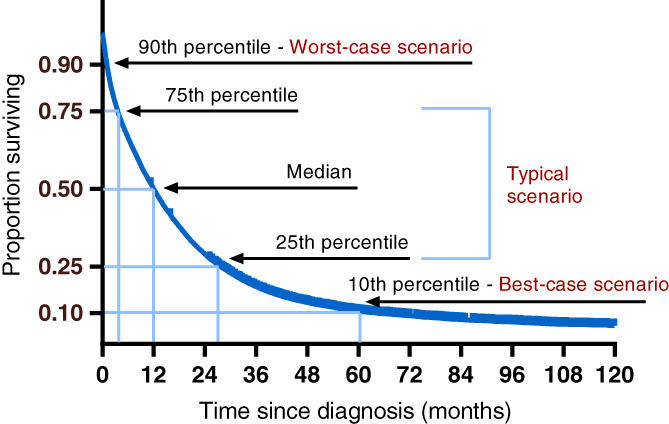
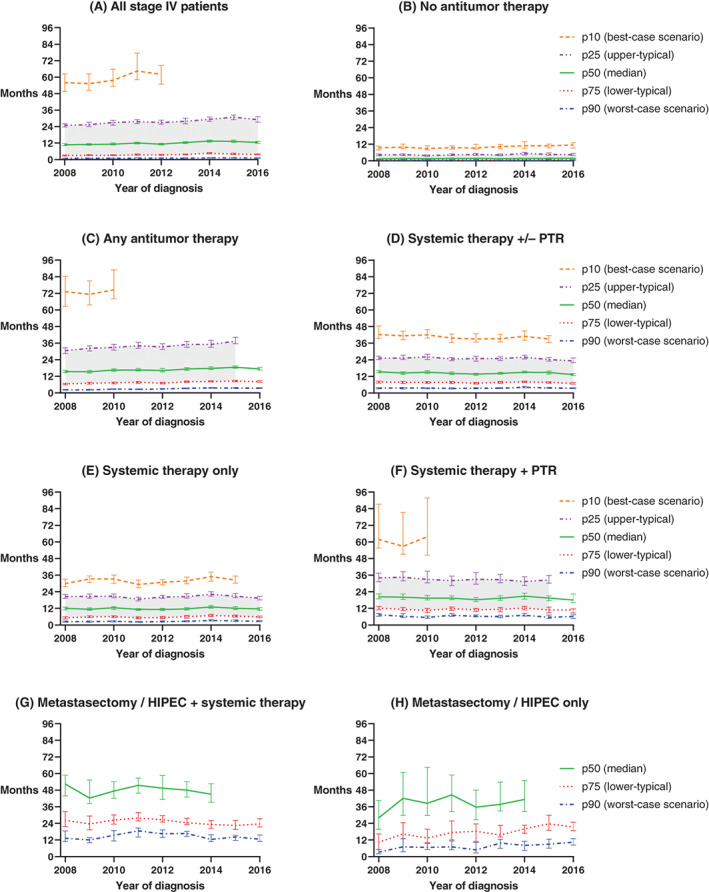
Reported median overall survival (mOS) in metastatic colorectal cancer (mCRC) patients participating in systemic therapy trials has increased to over 30 months. It is uncertain whether trial results translate to real-life populations. Moreover, patients prefer presentation of multiple survival scenarios. Population-based data of all stage IV CRC patients diagnosed between 2008 and 2016 were obtained from the Netherlands Cancer Registry, which has a case ascertainment completeness surpassing 95%. We calculated the following percentiles (scenarios) of OS per year of diagnosis for the total population, and for treatment subgroups: 10th (best-case), 25th (upper-typical), 50th (median), 75th (lower-typical) and 90th (worst-case). Twenty-five percent of patients did not receive any antitumor treatment. From 2008 to 2016, mOS of the total population (n = 27275) remained unchanged at approximately 12 months. OS improved only for the upper-typical and best-case patients; by 4.2 to 29.1 months (P < .001), and by 6 to 62 months (P < .001), respectively. No clinically relevant change was observed among patients who received systemic therapy, with mOS close to 15 months and best-case scenario approximately 40 months. A clinically relevant improvement in survival over time was observed in patients who initially received metastasectomy and/or HIPEC only. In contrast to the wide belief based on trial data that mOS of mCRC patients receiving systemic therapy has improved substantially, improvement could not be demonstrated in our real-life population. Clinicians should consider quoting multiple survival scenarios based on real-life data instead of point estimates from clinical trials, when informing patients about their life expectancy.
转移性结直肠癌(mCRC)患者参加系统治疗试验的报告中位总生存期(mOS)已延长至 30 多个月。目前尚不确定试验结果是否适用于真实人群。此外,患者更希望呈现多种生存情况。从荷兰癌症登记处获得了 2008 年至 2016 年间诊断为所有 IV 期 CRC 患者的基于人群的数据,该登记处的病例确定率超过 95%。我们计算了总人群和治疗亚组每年 OS 的以下百分位数(情况):10 分(最佳情况)、25 分(上典型)、50 分(中位数)、75 分(下典型)和 90 分(最差情况)。25%的患者未接受任何抗肿瘤治疗。2008 年至 2016 年间,总人群(n=27275)的 mOS 保持在约 12 个月不变。仅上典型和最佳情况患者的 OS 有所改善;分别提高了 4.2 至 29.1 个月(P<.001)和 6 至 62 个月(P<.001)。接受系统治疗的患者未观察到临床相关的变化,mOS 接近 15 个月,最佳情况约为 40 个月。最初仅接受转移瘤切除术和/或 HIPEC 的患者的生存时间有明显改善。与基于试验数据的广泛观点相反,即接受系统治疗的 mCRC 患者的 mOS 已大幅提高,我们在真实人群中并未证明这一点。当向患者告知其预期寿命时,临床医生应考虑根据真实数据提供多种生存情况,而不是临床试验的点估计。