Kim Sung Ryeol, Park Kyung Hee, Son Nak Hoon, Moon Jinyeong, Park Hye Jung, Kim Kyungchul, Park Jung Won, Lee Jae Hyun
Department of Internal Medicine, Yongin Severance Hospital, Yonsei University College of Medicine, Yongin, Korea.
Institute of Allergy, Yonsei University College of Medicine, Seoul, Korea.
Allergy Asthma Immunol Res. 2020 Sep;12(5):832-843. doi: 10.4168/aair.2020.12.5.832.
It is difficult to assess airway obstruction using spirometry in adult asthmatic patients with preserved lung function. Impulse oscillometry (IOS) can detect not only airway resistance but also reactance. Therefore, IOS may be useful in assessing pulmonary function in such patients. We investigated the applicability of IOS for asthma patients with preserved lung function.
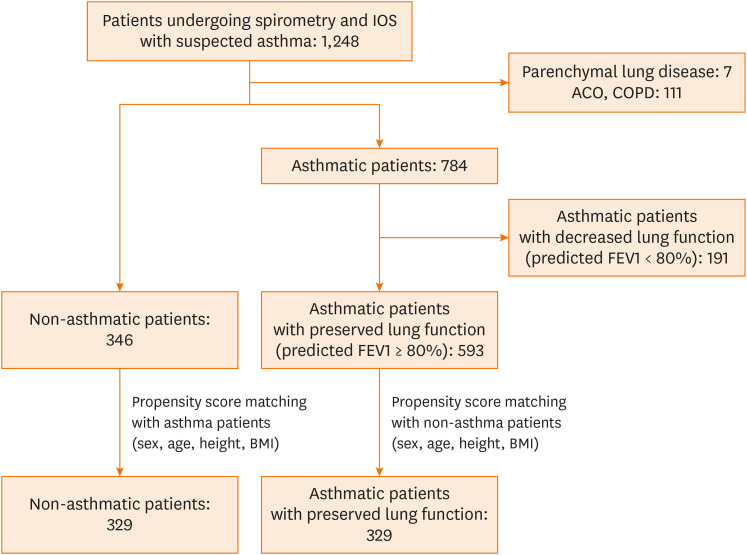
Between 2015 and 2018, 1,248 adult asthmatic patients suspected of having asthma who visited the Allergy and Asthma Center of Severance Hospital underwent both spirometry and IOS. Consequently, 784 patients had asthma, 111 had chronic obstructive lung disease (COPD) or asthma-COPD overlap, and 7 had parenchymal lung disease. The remaining 346 patients had chronic cough without underlying lung or airway disease. Among the 784 asthmatic patients, 191 with decreased lung function (predicted forced expiratory volume in 1 second [FEV1] < 80%) were excluded. Propensity score matching was performed to adjust baseline characteristics between 346 non-asthmatic and 593 asthmatic patients with preserved lung function. Subsequently, we compared the spirometry and IOS parameters between the 329 asthmatic and 329 non-asthmatic patients.
Multiple logistic regression analysis showed that the area of reactance (AX) was associated with asthma with preserved lung function. In receiver operating characteristic (ROC) curve analysis, the area under the curve (AUC) of AX (AUC = 0.6823) for asthma was not significantly different from that of FEV1 (AUC = 0.6758). However, the AUC of a combination of AX and FEV1 (AUC = 0.7437) for asthma was significantly higher than that of FEV1 alone. The cutoff value of AX was 0.51 kPa/L in univariate ROC analysis.
AX is associated with adult asthma with preserved lung function. Performing spirometry together with IOS is more beneficial than performing spirometry alone for diagnosing asthma in adult patients with preserved lung function.
对于肺功能正常的成年哮喘患者,使用肺活量测定法评估气道阻塞较为困难。脉冲振荡法(IOS)不仅可以检测气道阻力,还能检测电抗。因此,IOS可能有助于评估此类患者的肺功能。我们研究了IOS在肺功能正常的哮喘患者中的适用性。
2015年至2018年间,1248名疑似患有哮喘的成年哮喘患者前往Severance医院过敏与哮喘中心接受了肺活量测定法和IOS检查。结果,784名患者患有哮喘,111名患有慢性阻塞性肺疾病(COPD)或哮喘-COPD重叠综合征,7名患有实质性肺疾病。其余346名患者患有慢性咳嗽但无潜在的肺部或气道疾病。在784名哮喘患者中,191名肺功能下降(预测1秒用力呼气量[FEV1]<80%)的患者被排除。进行倾向得分匹配以调整346名非哮喘患者和593名肺功能正常的哮喘患者之间的基线特征。随后,我们比较了329名哮喘患者和329名非哮喘患者的肺活量测定法和IOS参数。
多因素逻辑回归分析显示,电抗面积(AX)与肺功能正常的哮喘有关。在受试者工作特征(ROC)曲线分析中,哮喘的AX曲线下面积(AUC = 0.6823)与FEV1的曲线下面积(AUC = 0.6758)无显著差异。然而,哮喘的AX与FEV1联合的AUC(AUC = 0.7437)显著高于单独的FEV1。单因素ROC分析中AX的值为0.51 kPa/L。
AX与肺功能正常的成年哮喘有关。对于诊断肺功能正常的成年患者哮喘,同时进行肺活量测定法和IOS比单独进行肺活量测定法更有益。