Kayange Neema M, Mazuguni Nicholaus, Hokororo Adolfine, Muiruri Charles, Reis Karl, Kidenya Benson R, Mazigo Humphrey D
Department of Pediatrics, Weill Bugando School of Medicine, Catholic University of Health and Allied Sciences, Mwanza, United Republic of Tanzania.
Kilimanjaro Fertility Institute (KFi), Kilimanjaro, Tanzania.
Trop Med Health. 2020 Jul 6;48:55. doi: 10.1186/s41182-020-00243-6. eCollection 2020.
In sub-Saharan Africa, renal abnormalities are a major public health concern, especially in children living in endemic areas. However, there is a dearth of data on renal abnormalities among children living in endemic areas. The objective of the study was to assess the prevalence of renal abnormalities among school children in a endemic community in Northwestern Tanzania.
A cross-sectional study was conducted between January and March 2017 among school children aged 6-13 years, attending three primary schools located along the shoreline of Lake Victoria. A single urine sample was collected from each child and screened for using circulating cathodic antigen and for eggs using a urine filtration technique. A urine dipstick was used to screen for urine protein levels, creatinine levels, microalbuminuria, and red blood cells. Venous blood was obtained for estimation of creatinine level and for malaria diagnosis. The primary outcomes were the prevalence of renal abnormalities, defined by the presence of low estimated glomerular filtration rate (eGFR), proteinuria or microalbuminuria, and hematuria in urine.
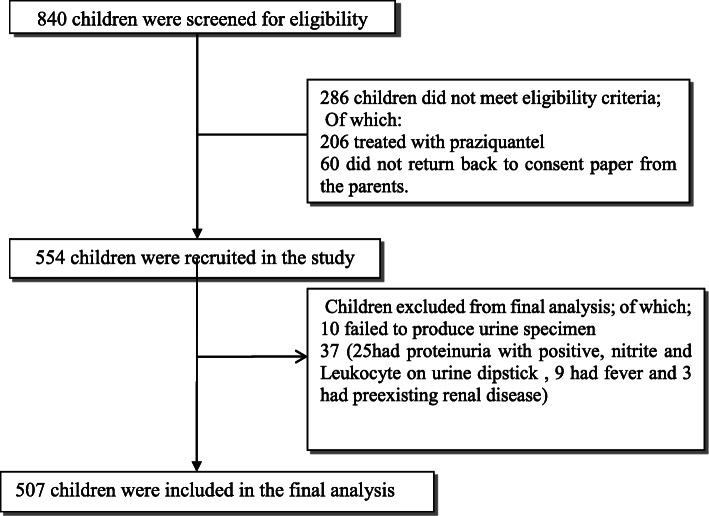
Of 507 children included in the final analysis, 49.9% (253/507) were male with a mean age of 8.51 ± 1.3 years. Overall, 64.0% (326/507) of the children were infected with , and 1.6% (8/507) of the children were infected with . A total of 71 (14%) of the children had proteinuria, 37 (7.3%) had hematuria, and 8 (1.6%) had a low estimated glomerular filtration rate (eGFR). Overall prevalence of renal abnormalities was 22.9%. Renal abnormalities (proteinuria) were associated with infection (OR = 4.9, 95% CI 2.1-11.2, < 0.001) and having red blood cells in urine (OR = 5.3, 95% CI 2.5-11.2, < 0.001).
Twenty-two percent of school children who participated in this study had renal abnormalities associated with infection. Given the high prevalence of , longitudinal epidemiological surveillance is warranted to measure the burden of renal abnormalities and assess the impact of the praziquantel treatment on these abnormalities.
在撒哈拉以南非洲地区,肾脏异常是一个主要的公共卫生问题,尤其是在生活在流行地区的儿童中。然而,关于生活在流行地区儿童肾脏异常的数据匮乏。本研究的目的是评估坦桑尼亚西北部一个流行社区学龄儿童肾脏异常的患病率。
2017年1月至3月间,对6至13岁、就读于维多利亚湖沿岸三所小学的学龄儿童进行了一项横断面研究。从每个儿童收集一份尿液样本,使用循环阴极抗原筛查血吸虫,使用尿液过滤技术筛查血吸虫卵。使用尿试纸条筛查尿蛋白水平、肌酐水平、微量白蛋白尿和红细胞。采集静脉血以估计肌酐水平并进行疟疾诊断。主要结局是肾脏异常患病率,定义为估算肾小球滤过率(eGFR)降低、蛋白尿或微量白蛋白尿以及血尿的存在。
纳入最终分析的507名儿童中,49.9%(253/507)为男性,平均年龄为8.51±1.3岁。总体而言,64.0%(326/507)的儿童感染了血吸虫,1.6%(8/507)的儿童感染了疟原虫。共有71名(14%)儿童患有蛋白尿,37名(7.3%)儿童患有血尿,8名(1.6%)儿童估算肾小球滤过率(eGFR)降低。肾脏异常总体患病率为22.9%。肾脏异常(蛋白尿)与血吸虫感染相关(比值比=4.9,9可信区间2.1-11.2,P<0.001)以及尿中出现红细胞相关(比值比=5.3,95%可信区间2.5-11.2,P<0.001)。
参与本研究的22%的学龄儿童存在与血吸虫感染相关的肾脏异常。鉴于血吸虫感染的高患病率,有必要进行纵向流行病学监测,以衡量肾脏异常的负担,并评估吡喹酮治疗对这些异常的影响。