Mazor Roei D, Weissman Ran, Luckman Judith, Domachevsky Liran, Diamond Eli L, Abdel-Wahab Omar, Shapira Shirley, Hershkovitz-Rokah Oshrat, Groshar David, Shpilberg Ofer
Clinic of Histiocytic Neoplasms, Institute of Hematology, Assuta Medical Center, Tel Aviv, Israel.
Department of Molecular Biology, Faculty of Natural Sciences, Ariel University, Ariel, Israel.
Neurooncol Adv. 2020 Mar 3;2(1):vdaa024. doi: 10.1093/noajnl/vdaa024. eCollection 2020 Jan-Dec.
Erdheim-Chester disease (ECD), a rare inflammatory myeloid neoplasm, is known to be fundamentally reliant on the constitutive activation of the MAPK signaling pathway in the majority of patients. Consequently, inhibition of the V600E-mutant BRAF kinase has proven to be a safe and efficacious long-term therapeutic strategy for -mutant ECD patients. Nevertheless, in a subset of patients with CNS disease, the efficacy of long-term treatment may diminish, facilitating suboptimal responses or disease progression.
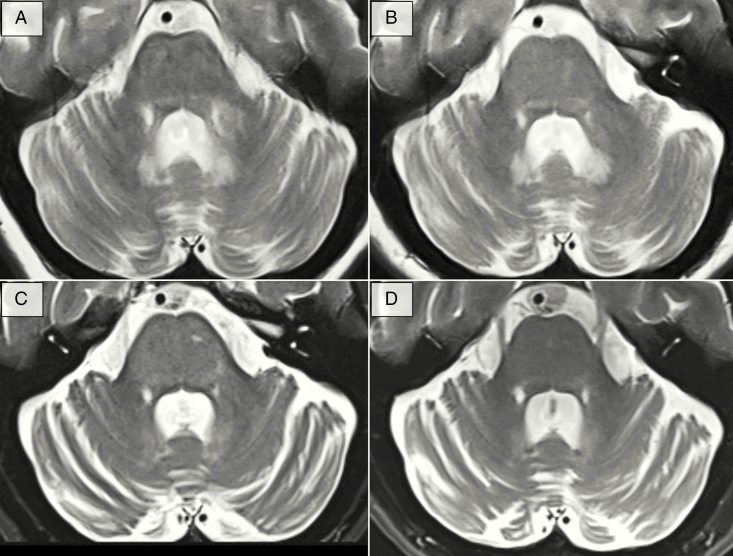
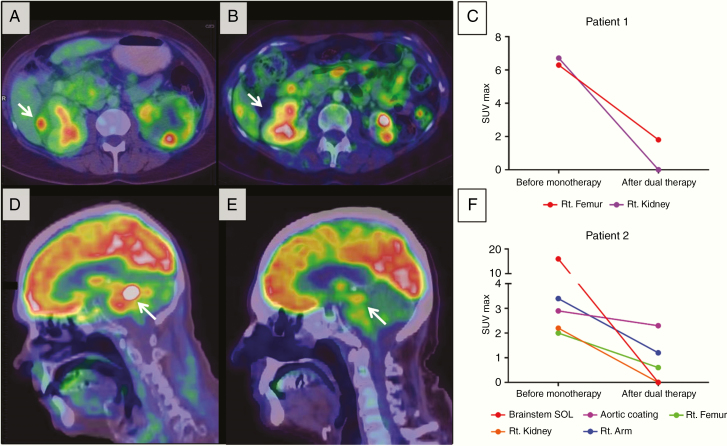
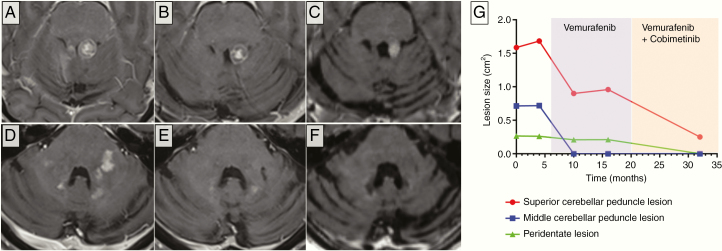
We retrospectively describe 3 -mutant ECD patients whose treatment with Vemurafenib was upgraded to Vemurafenib/Cobimetinib due to either disease progression, insufficient response, or unacceptable toxicity. CNS response to therapy was evaluated using magnetic resonance imaging (MRI) and extra-cranial disease was monitored using F-fludeoxyglucose positron emission tomography/computed tomography (PET/CT).
Three patients with a mean age of 52.6 years were treated with Vemurafenib for a mean duration of 26.6 months (range: 6-52). Monotherapies were upgraded to Vemurafenib/Cobimetinib dual therapy. The combination therapy was administered for a mean duration of 21 months (range: 19-23). All patients exhibited clinical and neurological improvement. Regression of lesions on MRI was noted in 2 patients. Both patients characterized by a PET-avid disease responded to the biological treatment regimen with complete metabolic remissions.
Dual inhibition of BRAF and downstream MEK may be a safe and effective therapeutic strategy for -mutant ECD patients for whom BRAF inhibitor therapy proved insufficient and as such appropriate for the long-term management of CNS disease in ECD.
Erdheim-Chester病(ECD)是一种罕见的炎症性髓系肿瘤,已知在大多数患者中从根本上依赖于MAPK信号通路的组成性激活。因此,抑制V600E突变的BRAF激酶已被证明是针对V600E突变ECD患者的一种安全有效的长期治疗策略。然而,在一部分患有中枢神经系统疾病的患者中,长期治疗的疗效可能会降低,导致反应欠佳或疾病进展。
我们回顾性描述了3例V600E突变的ECD患者,他们因疾病进展、反应不足或不可接受的毒性而将维莫非尼治疗升级为维莫非尼/考比替尼治疗。使用磁共振成像(MRI)评估中枢神经系统对治疗的反应,并使用氟脱氧葡萄糖正电子发射断层扫描/计算机断层扫描(PET/CT)监测颅外疾病。
3例平均年龄为52.6岁的患者接受维莫非尼治疗的平均持续时间为26.6个月(范围:6-52个月)。单一疗法升级为维莫非尼/考比替尼联合疗法。联合疗法的平均给药持续时间为21个月(范围:19-23个月)。所有患者均表现出临床和神经功能改善。2例患者的MRI病变出现消退。2例以PET-avid疾病为特征的患者对生物治疗方案有反应,实现了完全代谢缓解。
对BRAF和下游MEK的双重抑制可能是一种安全有效的治疗策略,适用于BRAF抑制剂治疗效果不佳的V600E突变ECD患者,因此适用于ECD中枢神经系统疾病的长期管理。