Centers for Disease Control and Prevention, National Center for Chronic Disease Prevention and Health Promotion, Division of Cancer Prevention and Control, 4770 Buford Highway, Atlanta, GA 30341. Email:
Centers for Disease Control and Prevention, National Center for Chronic Disease Prevention and Health Promotion, Division of Cancer Prevention and Control, Atlanta, Georgia.
Prev Chronic Dis. 2020 Jul 9;17:E54. doi: 10.5888/pcd17.190367.
Pain is one of the most common symptoms that people with cancer experience. Identification of demographic, physiologic, and behavioral correlates of pain among cancer survivors could help identify subgroups most in need of pain management.
We analyzed data from the 2012, 2014, and 2016 Behavioral Risk Factor Surveillance System Cancer Survivorship Optional Module, which was completed by 18 states and territories, to describe demographic and physiologic characteristics of cancer survivors reporting physical pain caused by cancer or cancer treatment. Adjusted and unadjusted population-based estimates and 95% confidence intervals were calculated.
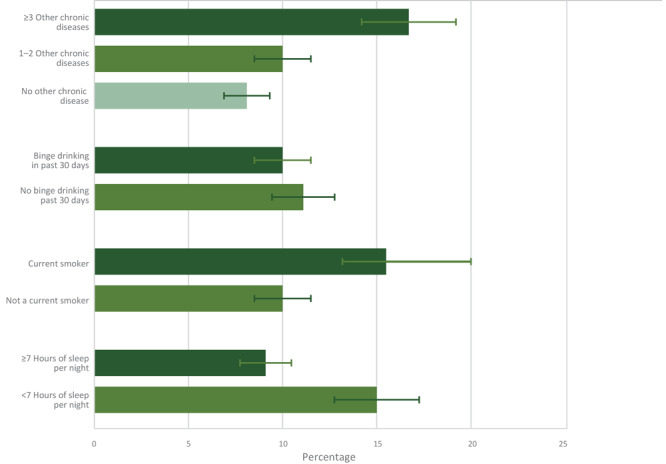
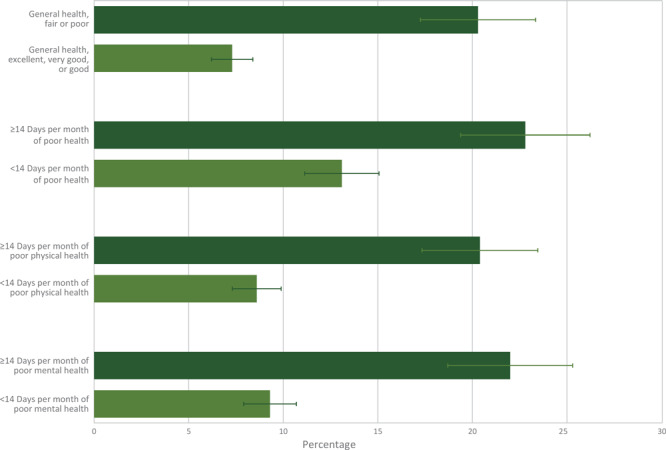
Of 12,019 cancer survivor respondents, 9.5% reported current pain related to cancer or cancer treatment. Current pain differed significantly by sex, race/ethnicity, age, and cancer type. Current pain was reported most often among survivors with more than 3 chronic diseases (16.7%) compared with survivors with none (8.1%) or 1 or 2 (10.0%). Pain was higher among survivors reporting fair or poor general health (18.0%) than among survivors reporting otherwise, and higher among survivors reporting more than 14 days of poor physical health (16.6%) or poor mental health (14.8%) compared with less than 14 days (in the past 30 days).
Our results suggest that approximately 10% of cancer survivors in the United States are experiencing pain that may have persisted for years after their initial diagnosis and may not be adequately controlled. Increasing knowledge of the most appropriate pain management planning and strategies for controlling short- and long-term chronic pain among cancer survivors could help reduce the prevalence of pain.
疼痛是癌症患者最常见的症状之一。确定癌症幸存者疼痛的人口统计学、生理学和行为相关性可以帮助确定最需要疼痛管理的亚组。
我们分析了 2012、2014 和 2016 年行为风险因素监测系统癌症幸存者可选模块的数据,该模块由 18 个州和地区完成,以描述报告由癌症或癌症治疗引起的身体疼痛的癌症幸存者的人口统计学和生理学特征。计算了调整和未调整的基于人群的估计值和 95%置信区间。
在 12019 名癌症幸存者受访者中,9.5%报告目前存在与癌症或癌症治疗相关的疼痛。目前的疼痛在性别、种族/族裔、年龄和癌症类型方面存在显著差异。与没有(8.1%)或有 1 或 2 种(10.0%)慢性疾病的幸存者相比,有 3 种以上慢性疾病的幸存者报告目前疼痛的比例更高(16.7%)。报告一般健康状况不佳或较差(18.0%)的幸存者比报告其他情况的幸存者疼痛更高,报告过去 30 天内超过 14 天身体不健康(16.6%)或心理健康不佳(14.8%)的幸存者比报告身体不健康少于 14 天(14.8%)的幸存者疼痛更高。
我们的结果表明,美国约有 10%的癌症幸存者正在经历疼痛,这种疼痛可能在他们最初诊断后多年持续存在,并且可能没有得到充分控制。增加对癌症幸存者短期和长期慢性疼痛最合适的疼痛管理规划和策略的了解,可以帮助降低疼痛的发生率。