Graduate Institute of Medical Sciences, College of Medicine, Taipei Medical University, Taipei 110, Taiwan.
Department of Obstetrics and Gynecology, Chi-Mei Medical Center, Tainan 710, Taiwan.
Int J Mol Sci. 2020 Jul 7;21(13):4810. doi: 10.3390/ijms21134810.
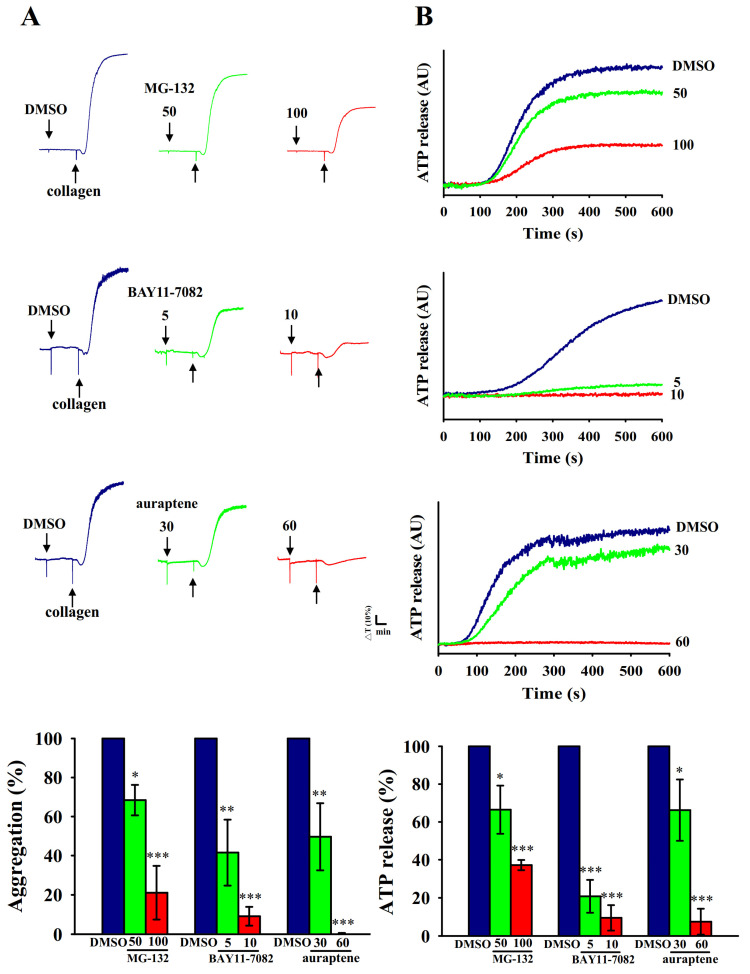
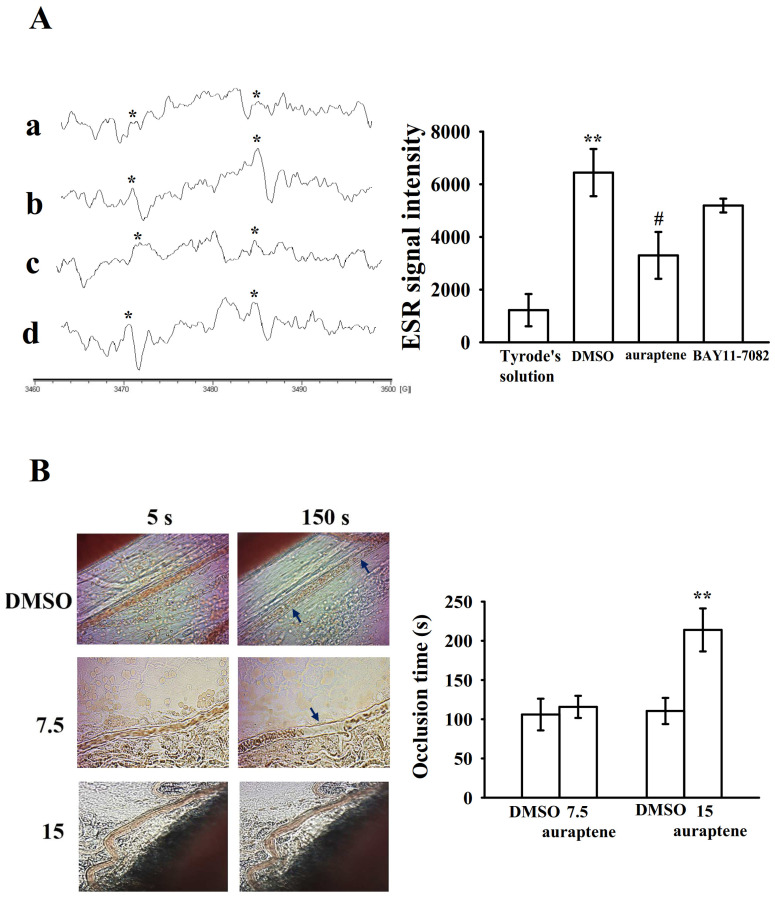
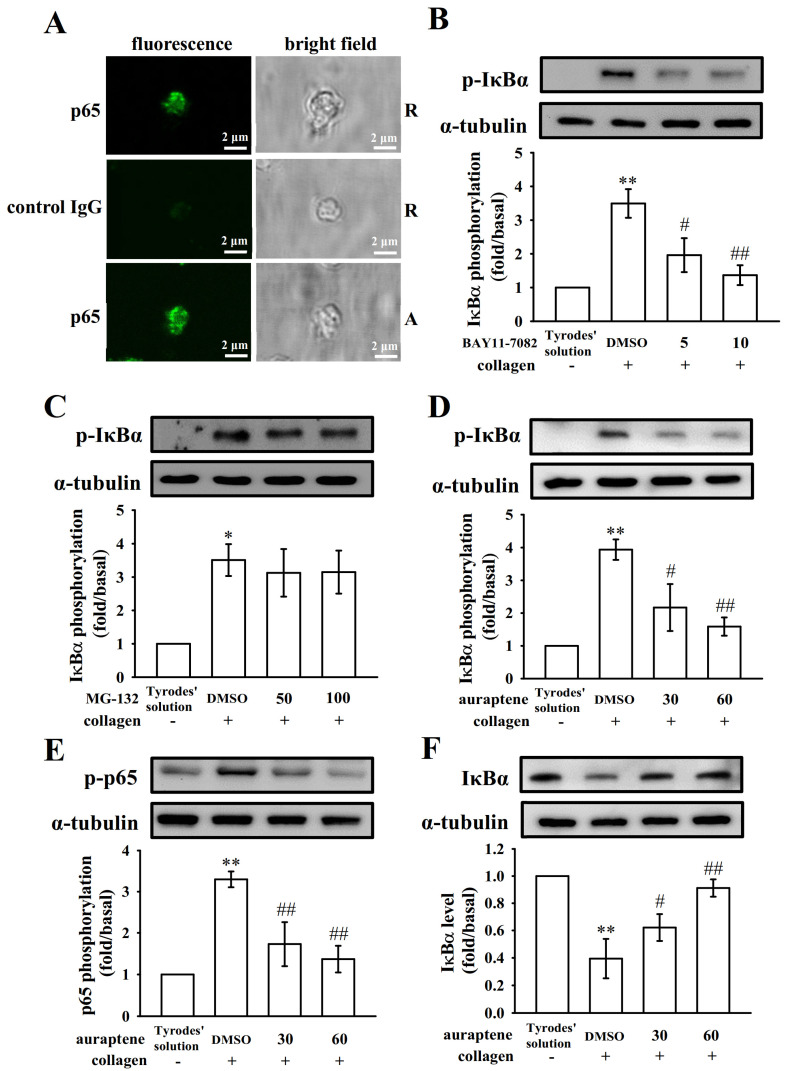
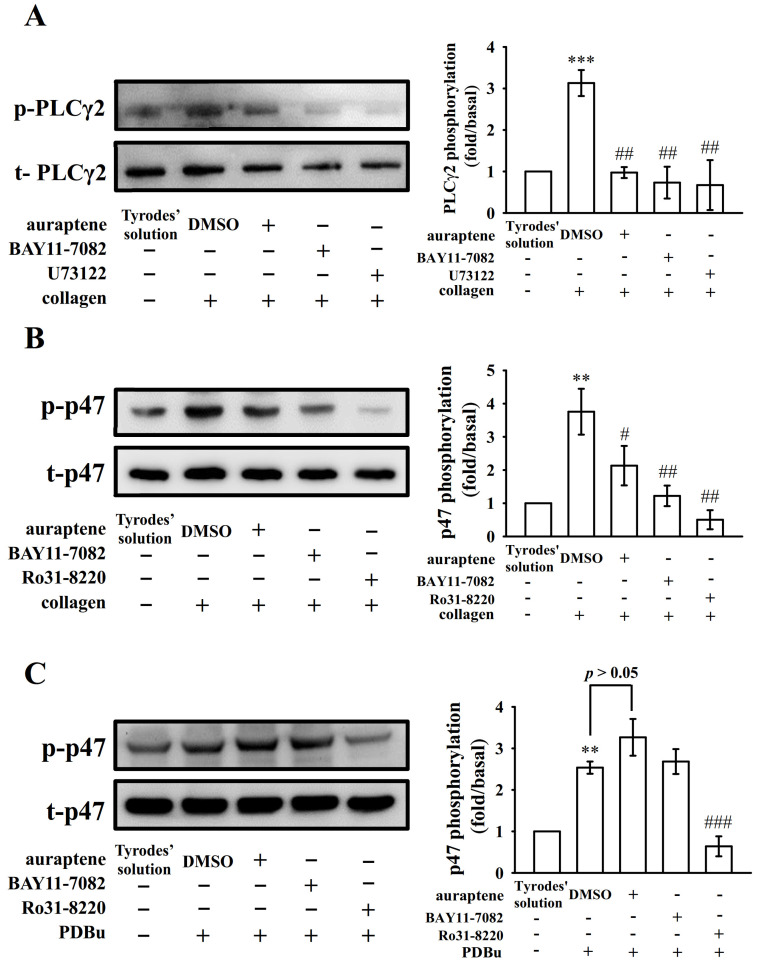
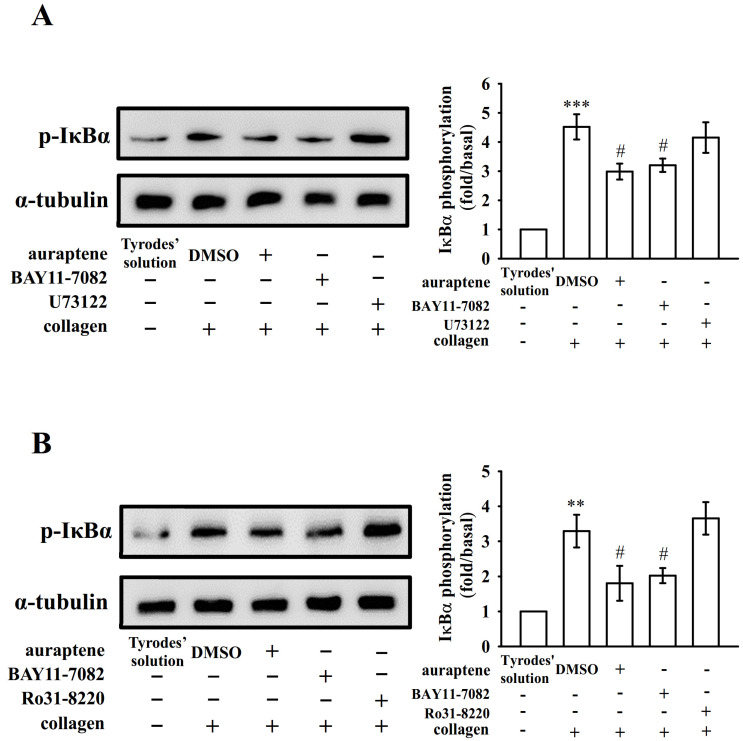
Platelets are major players in the occurrence of cardiovascular diseases. Auraptene is the most abundant coumarin derivative from plants, and it has been demonstrated to possess a potent capacity to inhibit platelet activation. Although platelets are anucleated cells, they also express the transcription factor, nuclear factor-κB (NF-κB), that may exert non-genomic functions in platelet activation. In the current study, we further investigated the inhibitory roles of auraptene in NF-κB-mediated signal events in platelets. MG-132 (an inhibitor of proteasome) and BAY11-7082 (an inhibitor of IκB kinase; IKK), obviously inhibited platelet aggregation; however, BAY11-7082 exhibited more potent activity than MG-132 in this reaction. The existence of NF-κB (p65) in platelets was observed by confocal microscopy, and auraptene attenuated NF-κB activation such as IκBα and p65 phosphorylation and reversed IκBα degradation in collagen-activated platelets. To investigate cellular signaling events between PLCγ2-PKC and NF-κB, we found that BAY11-7082 abolished PLCγ2-PKC activation; nevertheless, neither U73122 nor Ro31-8220 had effect on NF-κB activation. Furthermore, both auraptene and BAY11-7082 significantly diminished HO• formation in activated platelets. For in vivo study, auraptene prolonged the occlusion time of platelet plug in mice. In conclusion, we propose a novel inhibitory pathway of NF-κB-mediated PLCγ2-PKC activation by auraptene in human platelets, and further supported that auraptene possesses potent activity for thromboembolic diseases.
血小板是心血管疾病发生的主要参与者。花椒内酯是植物中最丰富的香豆素衍生物,已被证明具有抑制血小板活化的强大能力。尽管血小板是无核细胞,但它们也表达转录因子核因子-κB(NF-κB),这可能在血小板活化中发挥非基因组功能。在本研究中,我们进一步研究了花椒内酯在 NF-κB 介导的血小板信号事件中的抑制作用。MG-132(蛋白酶体抑制剂)和 BAY11-7082(IκB 激酶抑制剂;IKK)明显抑制血小板聚集;然而,BAY11-7082 在该反应中的活性比 MG-132 更强。通过共聚焦显微镜观察到血小板中 NF-κB(p65)的存在,花椒内酯减弱了 NF-κB 的激活,如 IκBα 和 p65 磷酸化,并逆转了胶原激活血小板中 IκBα 的降解。为了研究 PLCγ2-PKC 和 NF-κB 之间的细胞信号事件,我们发现 BAY11-7082 消除了 PLCγ2-PKC 的激活;然而,U73122 或 Ro31-8220 对 NF-κB 的激活没有影响。此外,花椒内酯和 BAY11-7082 均显著减少了活化血小板中 HO•的形成。在体内研究中,花椒内酯延长了小鼠血小板栓子的闭塞时间。总之,我们提出了花椒内酯通过 NF-κB 介导的 PLCγ2-PKC 激活在人血小板中的一种新的抑制途径,并进一步支持花椒内酯对血栓栓塞性疾病具有强大的活性。