King's College London, School of Population Health and Environmental Sciences, United Kingdom (C.F., W.M., C.D.A.W., A.B., A.D.).
National Institute for Health Research Applied Research Collaboration (ARC) South London (C.D.A.W., A.D.), Guy's and St Thomas' National Health Service Foundation Trust and King's College London, United Kingdom.
Stroke. 2020 Aug;51(8):2435-2444. doi: 10.1161/STROKEAHA.120.028992. Epub 2020 Jul 10.
With recent advances in secondary prevention management, stroke recurrence rates may have changed substantially. We aim to estimate risks and trends of stroke recurrence over the past 2 decades in a population-based cohort of patients with stroke.
Patients with a first-ever stroke between 1995 and 2018 in South London, United Kingdom (n=6052) were collected and analyzed. Rates of recurrent stroke with 95% CIs were stratified by 5-year period of index stroke and etiologic TOAST (Trial of ORG 10172 in Acute Stroke Treatment) subtype. Cumulative incidences were estimated and multivariate Cox models applied to examine associations of recurrence and recurrence-free survival.
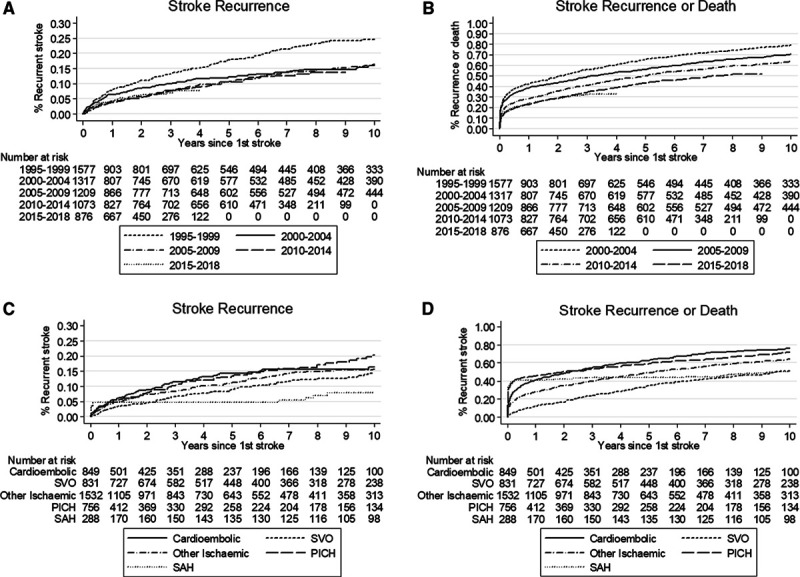
The rate of stroke recurrence at 5 years reduced from 18% (95% CI, 15%-21%) in those who had their stroke in 1995 to 1999 to 12% (10%-15%) in 2000 to 2005, and no improvement since. Recurrence-free survival has improved (35%, 1995-1999; 67%, 2010-2015). Risk of recurrence or death is lowest for small-vessel occlusion strokes and other ischemic causes (36% and 27% at 5 years, respectively). For cardioembolic and hemorrhagic index strokes around half of first recurrences are of the same type (54% and 51%, respectively). Over the whole study period a 54% increased risk of recurrence was observed among those who had atrial fibrillation before the index stroke (hazard ratio, 1.54 [1.09-2.17]).
The rate of recurrence reduced until mid-2000s but has not changed over the last decade. The majority of cardioembolic or hemorrhagic strokes that have a recurrence are stroke of the same type indicating that the implementation of effective preventive strategies is still suboptimal in these stroke subtypes.
随着二级预防管理的最新进展,中风复发率可能已经发生了实质性的变化。我们旨在评估过去 20 年中英国伦敦南部基于人群的中风患者队列中中风复发的风险和趋势。
收集并分析了 1995 年至 2018 年间在英国伦敦南部首次发生中风的 6052 名患者的数据。根据指数中风和病因 TOAST(急性中风治疗 ORG 10172 试验)亚型的 5 年期间对复发率和 95%CI 进行分层。估计累积发生率,并应用多变量 Cox 模型来检查复发和无复发生存的相关性。
5 年内中风复发率从 1995 年至 1999 年的 18%(95%CI,15%-21%)降至 2000 年至 2005 年的 12%(10%-15%),此后没有改善。无复发生存状况有所改善(35%,1995-1999 年;67%,2010-2015 年)。小血管闭塞性中风和其他缺血性病因的复发风险最低(分别为 36%和 27%,在 5 年内)。对于心源性栓塞性和出血性指数中风,首次复发中有一半左右是同一类型(分别为 54%和 51%)。在整个研究期间,与首次中风前无房颤的患者相比,有房颤的患者复发风险增加了 54%(风险比,1.54[1.09-2.17])。
复发率在 21 世纪初有所下降,但在过去十年中没有变化。大多数心源性栓塞性或出血性中风复发的类型与首次中风相同,这表明在这些中风亚型中,有效的预防策略的实施仍不理想。