Wu Vincent, Noel Christopher W, Forner David, Mok Florence, Zirkle Molly, Eskander Antoine, Lin Vincent, Lee John M
Department of Otolaryngology, Head & Neck Surgery, University of Toronto, Toronto, Canada.
Department of Otolaryngology, Head & Neck Surgery, Dalhousie University, Halifax, Canada.
J Otolaryngol Head Neck Surg. 2020 Jul 9;49(1):47. doi: 10.1186/s40463-020-00445-2.
Homeless individuals frequently experience poor access to healthcare, delayed clinical presentation, and higher disease burden. Providing subspecialty otolaryngology care to this population can be challenging. We previously reported on the prevalence of hearing impairment in Toronto's homeless community. As a secondary objective of this study, we sought to define otolaryngology specific need for this population.
One hundred adult homeless individuals were recruited across ten homeless shelters in Toronto, Canada using a stratified random sampling technique. An audiometric evaluation and head and neck physical examination were performed by an audiologist and otolaryngology resident, respectively. Basic demographic and clinical information was captured through verbal administration of a survey. Descriptive statistics were used to estimate frequency of otolaryngology specific diseases for this population.
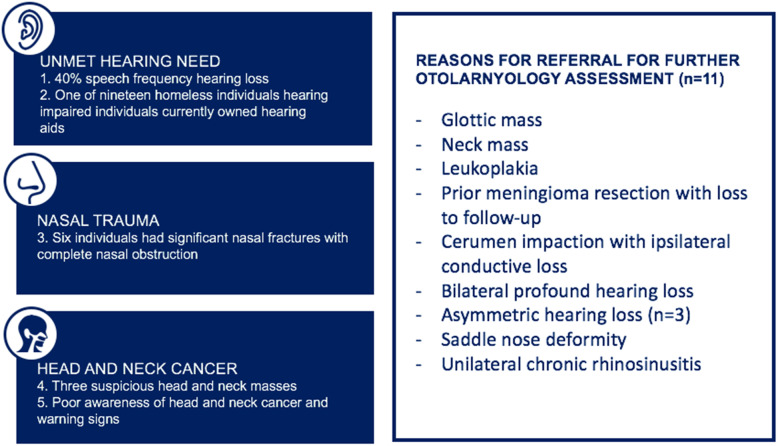
Of the 132 individuals who were initially approached to participant, 100 (76%) agreed. There were 64 males, with median age of 46 years (IQR 37-58 years). The median life duration of homelessness was 24 months (IQR 6-72 months). Participants had a wide range of medical comorbidities, with the most common being current tobacco smoking (67%), depression (36%), alcohol abuse (32%), and other substance abuse (32%). There were 22 patients with otolaryngology needs as demonstrated by one or more abnormal findings on head and neck examination. The most common finding was nasal fracture with significant nasal obstruction (6%). Eleven patients required referral to a staff otolaryngologist based on concerning or suspicious findings, including two head and neck masses, 6 were later seen in follow-up.
There were substantial otolaryngology needs amongst a homeless population within a universal healthcare system. Future research should focus on further elucidating head and neck related issues in this population and expanding the role of the otolaryngologist in providing care to homeless individuals.
无家可归者经常面临获得医疗保健困难、临床就诊延迟以及疾病负担较重的问题。为这一人群提供耳鼻喉专科护理具有挑战性。我们之前报道了多伦多无家可归社区听力障碍的患病率。作为本研究的次要目标,我们试图确定该人群对耳鼻喉科护理的特定需求。
采用分层随机抽样技术,在加拿大多伦多的十个无家可归者收容所招募了100名成年无家可归者。分别由听力学家和耳鼻喉科住院医师进行听力评估以及头颈部体格检查。通过口头询问进行调查,收集基本人口统计学和临床信息。使用描述性统计来估计该人群中耳鼻喉科特定疾病的发生率。
在最初接触的132名参与者中,100名(76%)同意参与。其中男性64名,年龄中位数为46岁(四分位间距37 - 58岁)。无家可归的中位时长为24个月(四分位间距6 - 72个月)。参与者有多种合并症,最常见的是目前吸烟(67%)、抑郁症(36%)、酒精滥用(32%)和其他药物滥用(32%)。头颈部检查有一项或多项异常结果表明有22名患者有耳鼻喉科护理需求。最常见的发现是鼻骨骨折伴严重鼻塞(6%)。11名患者因检查结果令人担忧或可疑而需要转诊至耳鼻喉科专科医生,其中包括两个头颈部肿块,6名患者后来接受了随访。
在全民医疗保健系统内的无家可归人群中,对耳鼻喉科护理有大量需求。未来的研究应专注于进一步阐明该人群中与头颈部相关的问题,并扩大耳鼻喉科医生在为无家可归者提供护理方面的作用。