Department of Anesthesiology, Kaohsiung Chang Gung Memorial Hospital, Chang Gung University College of Medicine, No. 123, Ta-Pei Rd., Niao-Song Dist., Kaohsiung City, 833, Taiwan.
Department of Anesthesiology, Chi Mei Medical Center, No.901, Zhonghua Rd. Yongkang Dist., Tainan City, 710, Taiwan.
Sci Rep. 2020 Jul 9;10(1):11245. doi: 10.1038/s41598-020-68193-x.
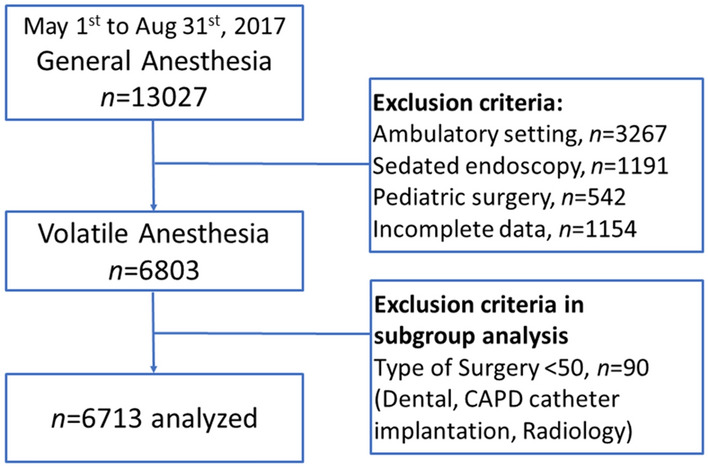
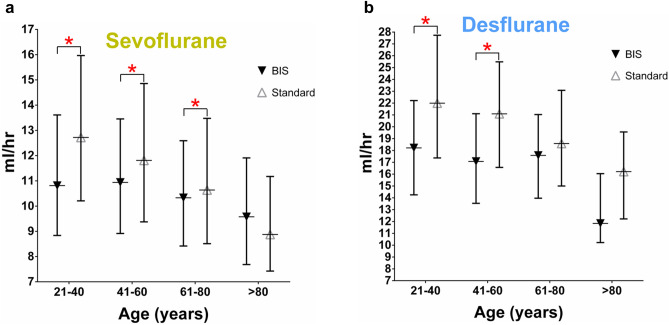
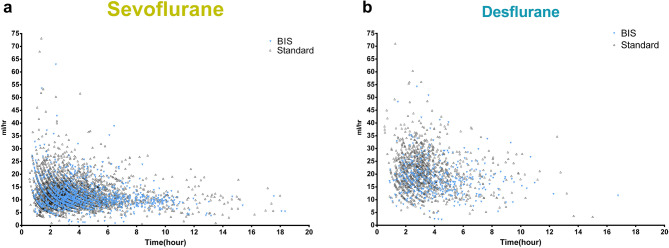
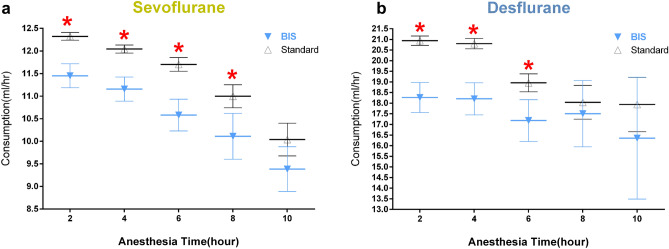
Many well-controlled clinical studies have shown that BIS-guided anesthesia could prevent intraoperative awareness and improve postoperative morbidity and mortality, by optimizing the amount of volatile anesthetics administered to patients. However, we questioned if the previously reported advantages of BIS-guided anesthesia in controlled studies would still apply in real-world settings. This retrospective study based on real-world settings clarified the role of BIS-guided anesthesia in reducing anesthetic consumption. We obtained anesthesia records from an electronic database of a medical center in southern Taiwan. A total of 6,713 cases were enrolled, where 1,324 cases receiving sevoflurane underwent BIS-guided anesthesia and 378 received desflurane; further, 3,819 receiving sevoflurane underwent standard anesthesia practice and 1,192 cases received desflurane. The median (25-75% interquartile values) of the average hourly consumption of sevoflurane or desflurane decreased significantly under BIS-guided anesthesia [10.5 (8.7-13.0) mL/h and 17.4 (13.7-21.1) mL/h, respectively] compared to that under standard anesthesia practice [11.4 (9.0-14.5) mL/h, and 20.2 (15.8-25.0), mL/h, respectively]. Furthermore, the average hourly consumption of these two volatile anesthetics varied inversely with age and anesthesia time in both groups. A significant reduction was found in the hourly consumption of volatile anesthetics in patients under BIS-guided anesthesia compared to standard anesthesia practice in different age groups or different anesthesia time. We concluded that BIS-guided anesthesia could reduce consumption of volatile anesthetics in real-world settings as well.
许多精心控制的临床研究表明,通过优化给予患者的挥发性麻醉剂的量,BIS 引导的麻醉可以预防术中意识并改善术后发病率和死亡率。然而,我们质疑先前报道的 BIS 引导麻醉在对照研究中的优势是否仍然适用于真实环境。这项基于真实环境的回顾性研究阐明了 BIS 引导麻醉在减少麻醉剂消耗方面的作用。我们从台湾南部一家医疗中心的电子数据库中获取了麻醉记录。共纳入 6713 例病例,其中 1324 例接受七氟醚的患者接受 BIS 引导麻醉,378 例接受地氟醚;进一步,3819 例接受七氟醚的患者接受标准麻醉实践,1192 例接受地氟醚。BIS 引导麻醉下七氟醚或地氟醚的平均每小时消耗量中位数(25%-75%四分位间距)明显降低[分别为 10.5(8.7-13.0)mL/h 和 17.4(13.7-21.1)mL/h],与标准麻醉实践相比[分别为 11.4(9.0-14.5)mL/h 和 20.2(15.8-25.0)mL/h]。此外,两组中两种挥发性麻醉剂的平均每小时消耗量均随年龄和麻醉时间的变化而变化。与标准麻醉实践相比,BIS 引导麻醉下患者的挥发性麻醉剂每小时消耗量在不同年龄组或不同麻醉时间均显著降低。我们的结论是,BIS 引导麻醉在真实环境中也可以减少挥发性麻醉剂的消耗。