Shiferaw Wondimeneh Shibabaw, Aynalem Yared Asmare, Akalu Tadesse Yirga, Demelew Tefera Mulugeta
College of Health Science, Debre Berhan University, Debre Birhan, Ethiopia.
College of Health Science, Debre Markos University, Debre Markos, Ethiopia.
J Cancer Prev. 2020 Jun 30;25(2):111-118. doi: 10.15430/JCP.2020.25.2.111.
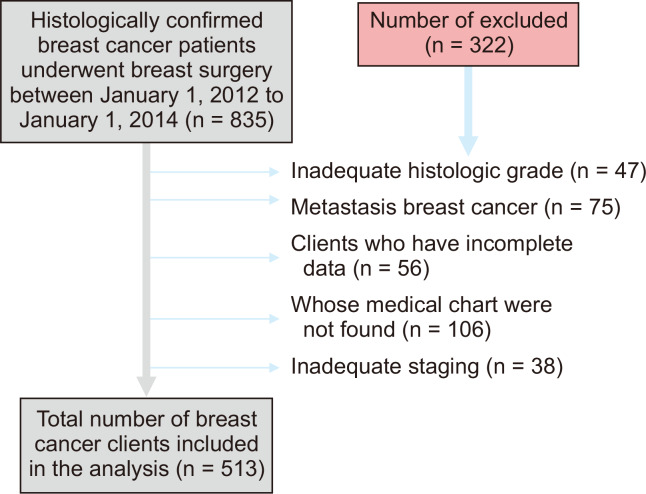
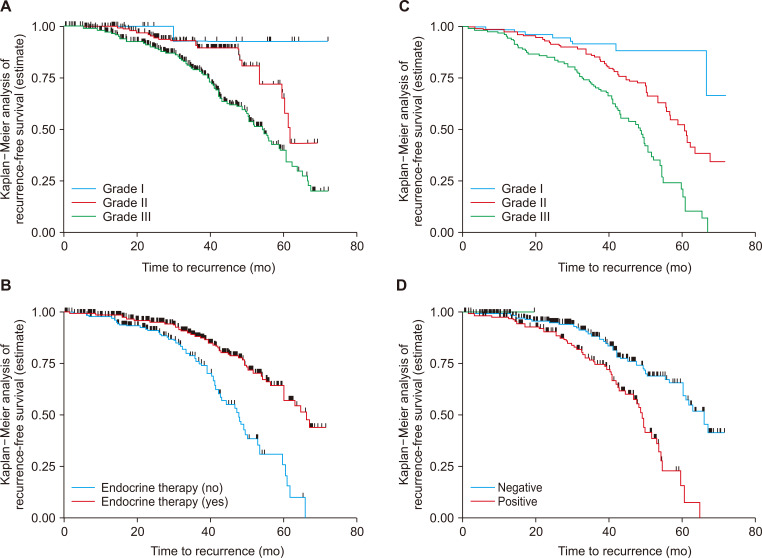
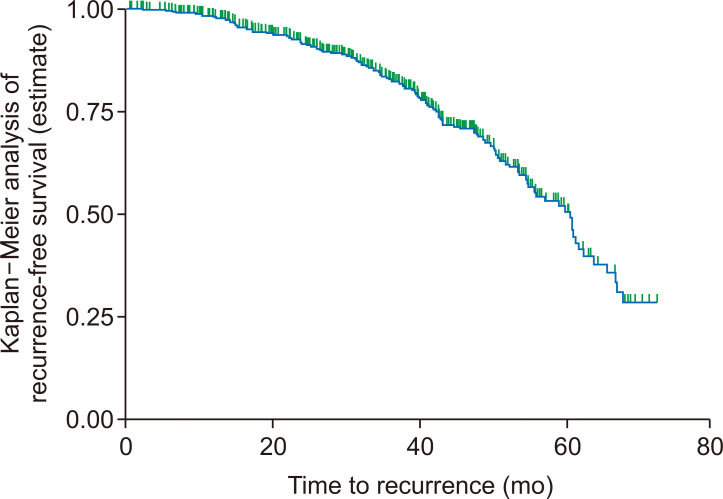
Currently, breast cancer is becoming a major public health problem for developing countries. In Ethiopia, breast cancer is the most prevalent cancer among women, and constitutes a major public health concern. Hence, this study was aimed to determine the incidence and predictor of recurrence among breast cancer clients at Black Lion Specialized Hospital, Ethiopia, in 2018. We analyzed 513 patients out of 835 women breast cancer patients treated at Black Lion Specialized Hospital. Recurrent-free survival was determined using the Kaplan-Meier method, with comparisons between groups through the log-rank test. The Cox proportional hazards model was used to identify predictors of recurrence among breast cancer clients. The incidence rate of recurrence among breast cancer was 6.5% per (95% CI = 6.49-12.47) follow-up. The median recurrent-free survival time was 60.33 months (95% CI = 54.46-62.30). Predictors of recurrence were negative estrogen receptor (hazard ratio [HR] = 1.8, 95% CI = 1.53-7.62), high histologic grade (HR = 2.8, 95% CI = 1.14-10.31), positive lymph node status (HR = 2.6, 95% CI = 1.14-10.31), clinical staging III (HR = 2.5, 95% CI = 1.26-9.42), and involved deep surgical margin (HR = 3.6, 95% CI = 2.14-8.61). This research showed that incidence of recurrence was high. Advanced clinical stage, positive nodal status, high histologic grade, negative estrogen receptor, and involved deep surgical margin were associated with higher recurrence rates. In contrast, hormonal therapy has a great role in decreasing the development of recurrence.
目前,乳腺癌正成为发展中国家的一个主要公共卫生问题。在埃塞俄比亚,乳腺癌是女性中最常见的癌症,也是一个重大的公共卫生问题。因此,本研究旨在确定2018年埃塞俄比亚黑狮专科医院乳腺癌患者的复发率及复发预测因素。我们分析了在黑狮专科医院接受治疗的835名女性乳腺癌患者中的513例。采用Kaplan-Meier法确定无复发生存率,并通过对数秩检验进行组间比较。采用Cox比例风险模型确定乳腺癌患者复发的预测因素。乳腺癌复发率为每(95%可信区间=6.49-12.47)随访年6.5%。无复发生存时间的中位数为60.33个月(95%可信区间=54.46-62.30)。复发的预测因素为雌激素受体阴性(风险比[HR]=1.8,95%可信区间=1.53-7.62)、高组织学分级(HR=2.8,95%可信区间=1.14-10.31)、阳性淋巴结状态(HR=2.6,95%可信区间=1.14-10.31)、临床分期III期(HR=2.5,95%可信区间=1.26-9.42)和手术切缘深部受累(HR=3.6,95%可信区间=2.14-8.61)。本研究表明复发率较高。临床分期晚、淋巴结阳性状态、高组织学分级、雌激素受体阴性和手术切缘深部受累与较高的复发率相关。相比之下,激素治疗在降低复发风险方面具有重要作用。