
脑肿瘤 BRAF V600E 突变状态的临床意义,重点是一种新的管理算法。
Clinical Relevance of BRAF V600E Mutation Status in Brain Tumors with a Focus on a Novel Management Algorithm.
机构信息
Department of Clinical Pathomorphology, Collegium Medicum in Bydgoszcz, Nicolaus Copernicus University, Torun, Poland.
Department of Tumor Pathology and Pathomorphology, Oncology Centre, Prof. Franciszek Łukaszczyk Memorial Hospital, Bydgoszcz, Poland.
出版信息
Target Oncol. 2020 Aug;15(4):531-540. doi: 10.1007/s11523-020-00735-9.
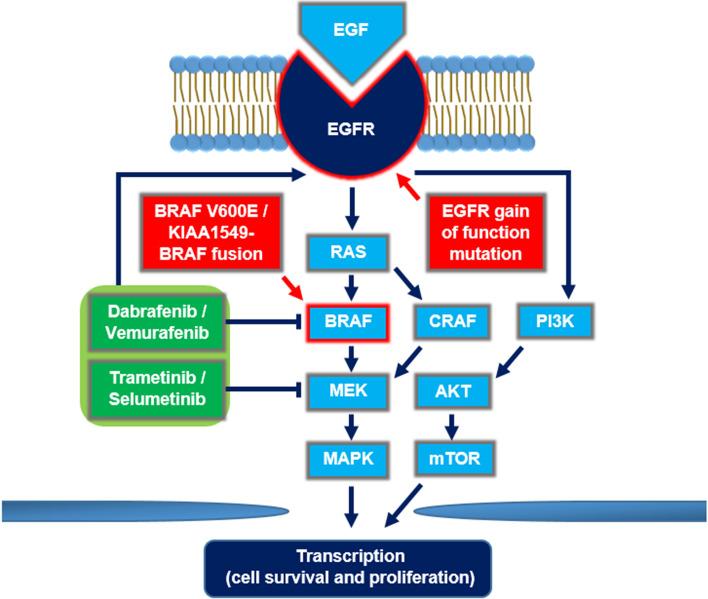
The possible application of BRAF-targeted therapy in brain tumors is growing continuously. We have analyzed clinical strategies that address BRAF activation in primary brain tumors and verified current recommendations regarding screening for BRAF mutations. There is preliminary evidence for a range of positive responses in certain brain tumor types harboring the BRAF V600E mutation. National Comprehensive Cancer Network Guidelines for central nervous system cancers recommend screening for the BRAF V600E mutation in pilocytic astrocytoma, pleomorphic xanthoastrocytoma, and ganglioglioma. We suggest additional testing in glioblastomas WHO grade IV below the age of 30 years, especially those with epithelioid features, papillary craniopharyngiomas, and pediatric low-grade astrocytomas. BRAF-targeted therapy should be limited to the setting of a clinical trial. If the patient harboring a V600E mutation does not qualify for a trial, multimodality treatment is recommended. Dual inhibition of both RAF and MEK is expected to provide more potent and durable effects than anti-BRAF monotherapy. First-generation RAF inhibitors should be avoided. Gain-of-function mutations of EGFR and KIAA fusions may compromise BRAF-targeted therapy. BRAF alterations that result in MAPK pathway activation are common events in several types of brain tumors. BRAF V600E mutation emerges as a promising molecular target. The proposed algorithm was designed to help oncologists to provide the best therapeutic options for brain tumor patients.
BRAF 靶向治疗在脑肿瘤中的应用不断增加。我们分析了针对原发性脑肿瘤中 BRAF 激活的临床策略,并验证了目前关于 BRAF 突变筛查的建议。在某些携带 BRAF V600E 突变的脑肿瘤类型中,有初步证据表明存在一系列阳性反应。国家综合癌症网络中枢神经系统癌症指南建议在毛细胞星形细胞瘤、多形性黄色星形细胞瘤和神经节胶质瘤中筛查 BRAF V600E 突变。我们建议在 30 岁以下的胶质母细胞瘤 WHO 分级 IV 中进行额外的检测,特别是具有上皮样特征、乳头状颅咽管瘤和儿科低级别星形细胞瘤。BRAF 靶向治疗应限于临床试验的环境。如果携带 V600E 突变的患者不符合试验条件,则推荐采用多模态治疗。RAF 和 MEK 的双重抑制预计比抗 BRAF 单药治疗具有更强和更持久的效果。第一代 RAF 抑制剂应避免使用。EGFR 的功能获得性突变和 KIAA 融合可能会影响 BRAF 靶向治疗。导致 MAPK 通路激活的 BRAF 改变是几种脑肿瘤中的常见事件。BRAF V600E 突变是一个很有前途的分子靶点。提出的算法旨在帮助肿瘤学家为脑肿瘤患者提供最佳治疗选择。

 Zotero 插件