School of Education, University of Durham, Durham, UK.
Dipartimento di Scienze della Formazione (DISFOR), University of Genoa, Genoa, Italy.
Psychol Res. 2021 Jul;85(5):1986-1996. doi: 10.1007/s00426-020-01382-5. Epub 2020 Jul 10.
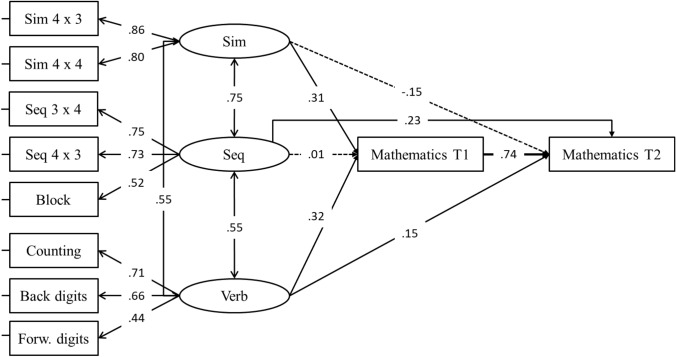
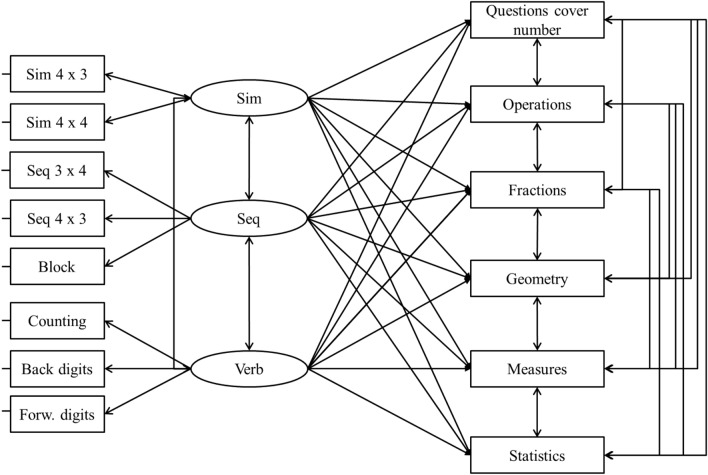
A number of previous studies have used working memory components to predict mathematical performance in a variety of ways; however, there is no consideration of the contributions of the subcomponents of visuospatial working memory to this prediction. In this paper we conducted a 2-year follow-up to the data presented in Allen et al. (Q J Exp Psychol 73(2):239-248, 2020b) to ascertain how these subcomponents of visuospatial working memory related to later mathematical performance. 159 children (M age = 115.48 months) completed the maths test for this second wave of the study. Results show a shift from spatial-simultaneous influence to spatial-sequential influence, whilst verbal involvement remained relatively stable. Results are discussed in terms of their potential for education and future research.
先前的许多研究都以各种方式使用工作记忆成分来预测数学表现;然而,对于视觉空间工作记忆的子成分对这种预测的贡献,并没有考虑在内。在本文中,我们对 Allen 等人(Q J Exp Psychol 73(2):239-248, 2020b)提出的数据进行了为期两年的随访,以确定这些视觉空间工作记忆的子成分与后期数学表现的关系。159 名儿童(M 年龄=115.48 个月)完成了这项研究的第二次浪潮中的数学测试。结果表明,空间同时影响向空间顺序影响的转变,而言语参与相对稳定。结果从教育和未来研究的角度进行了讨论。