Merck & Co., Inc., MMD, West Point, PA, USA.
Merck & Co., Inc., MRL, West Point, PA, USA.
Protein J. 2020 Aug;39(4):318-327. doi: 10.1007/s10930-020-09907-y.
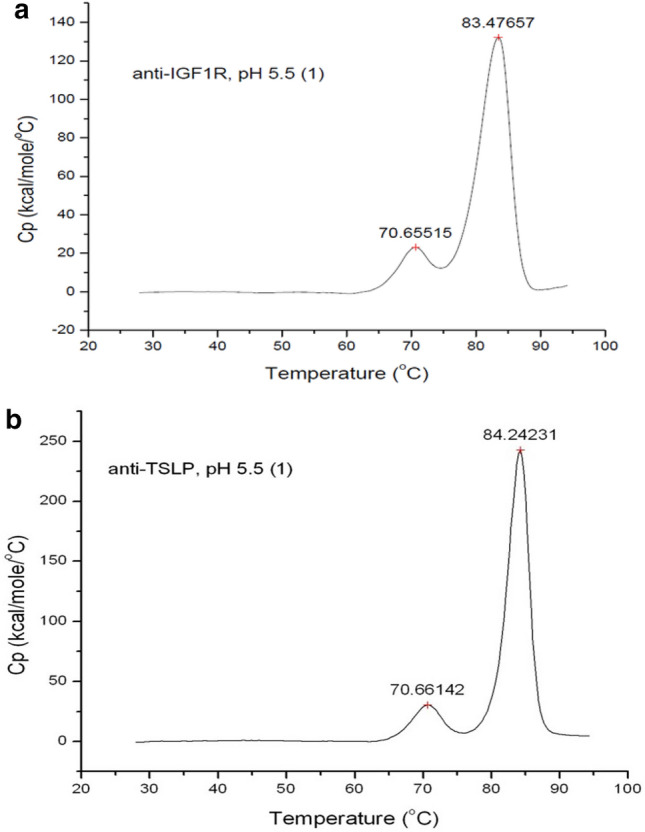
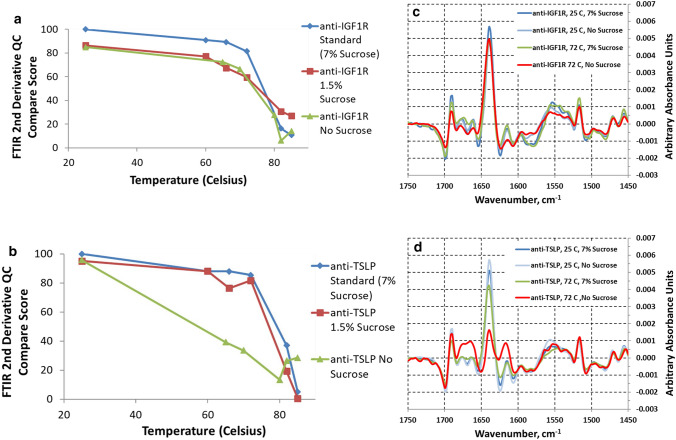
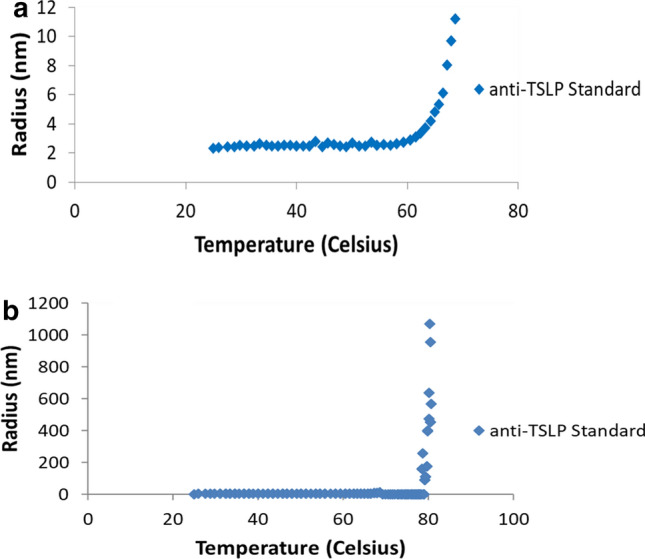
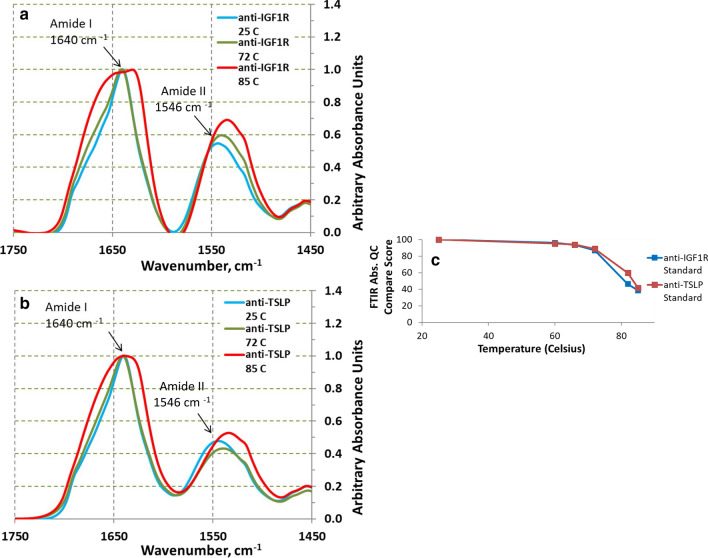
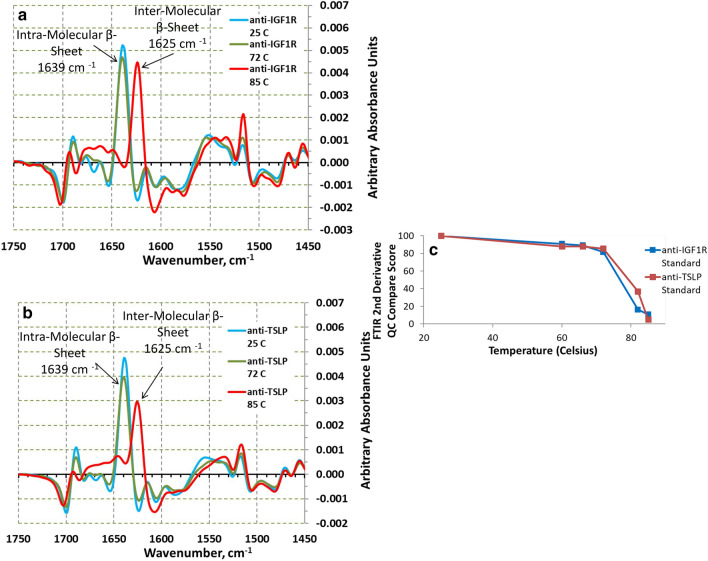
The temperature-dependent secondary structure of two monoclonal IgG antibodies, anti-IGF1R and anti-TSLP, were examined by transmission mode Fourier Transform Infrared (FTIR) spectroscopy. Anti-IGF1R and anti-TSLP are IgG monoclonal antibodies (mAbs) directed against human Insulin-like Growth Factor 1 Receptor for anti-tumor activity and Thymic Stromal Lymphopoietin cytokine for anti-asthma activity, respectively. Differential scanning calorimetry (DSC) clearly indicates both antibodies in their base formulations have a lower temperature protein conformational change near 70 °C (T) and a higher temperature protein conformational change near 85 °C (T). Thermal scanning dynamic light scatting (TS-DLS) indicates a significant particle size increase for both antibodies near T suggesting a high level of protein aggregation. The nature of these protein conformational changes associated with increasing the formulation temperature and decreasing sucrose concentration were identified by transmission mode FTIR and second derivative FTIR spectroscopy of temperature controlled aqueous solutions of both monoclonal antibodies. The transition from intra-molecular β sheets to inter-molecular β sheets was clearly captured for both monoclonal antibodies using FTIR spectroscopy. Finally, FTIR Spectroscopy was able to show the impact of a common excipient such as sucrose on the stability of each monoclonal antibody, further demonstrating the usefulness of FTIR spectroscopy for studying protein aggregation and formulation effects.
通过传输模式傅里叶变换红外(FTIR)光谱法研究了两种单克隆 IgG 抗体,抗 IGF1R 和抗 TSLP 的温度依赖性二级结构。抗 IGF1R 和抗 TSLP 分别是针对人类胰岛素样生长因子 1 受体的 IgG 单克隆抗体(mAb),用于抗肿瘤活性,和针对胸腺基质淋巴细胞生成素细胞因子的用于抗哮喘活性。差示扫描量热法(DSC)清楚地表明,两种抗体在其基础配方中都具有较低温度的蛋白质构象变化,约为 70°C(T),以及较高温度的蛋白质构象变化,约为 85°C(T)。热扫描动态光散射(TS-DLS)表明,两种抗体在 T 附近的粒径显著增加,表明蛋白质聚集程度很高。通过传输模式 FTIR 和两种单克隆抗体温度控制水溶液的二阶导数 FTIR 光谱,确定了与增加配方温度和降低蔗糖浓度相关的这些蛋白质构象变化的性质。FTIR 光谱清楚地捕捉到了两种单克隆抗体中从分子内β片层到分子间β片层的转变。最后,FTIR 光谱能够显示出常见赋形剂(如蔗糖)对每种单克隆抗体稳定性的影响,进一步证明了 FTIR 光谱在研究蛋白质聚集和配方效应方面的有用性。