Department of Radiotherapy, Qilu Hospital, Cheeloo College of Medicine, Shandong University, Jinan, China.
Department of Ultrasound, Shandong Province Coal Taishan Sanatorium, Taian, China.
Thorac Cancer. 2020 Aug;11(8):2316-2324. doi: 10.1111/1759-7714.13570. Epub 2020 Jul 12.
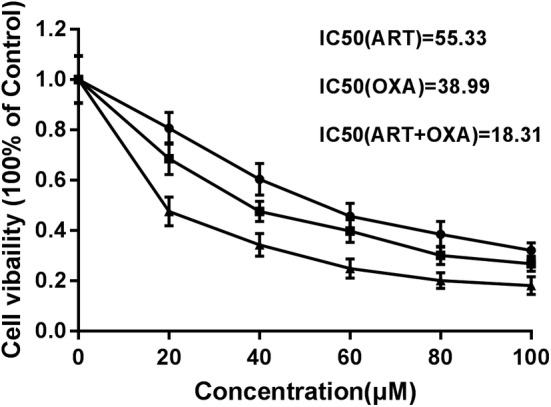
Esophageal cancer (EC) is a prevalent malignant cancer worldwide. Interestingly, the antimalaria compound artemisinin (ART) is also reported to have anticancer potential, although its underlying mechanism in EC is unclear. In this study, we explored the anticancer role of ART in EC109 and further explored the combination of ART and oxaliplatin (OXA) for their synergetic anticancer functions.
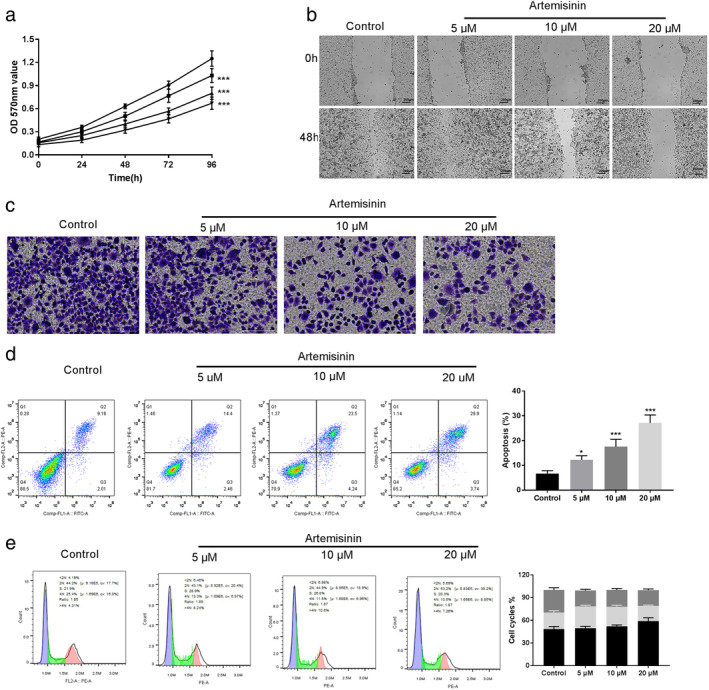
Human EC cell line EC109 was used. After ART or oxaliplatin (OXA) treatment, cell proliferation, migration, and invasion were measured by MTT, transwell, and scratch wound assays, respectively. Flow cytometry was performed to examine the cell cycle and apoptosis. The mRNA and protein levels were determined using qRT-PCR and western blotting.
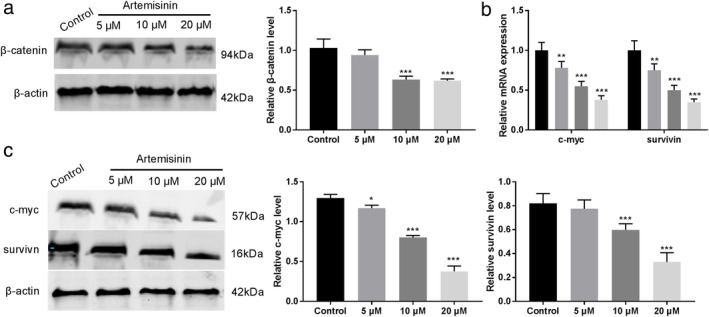
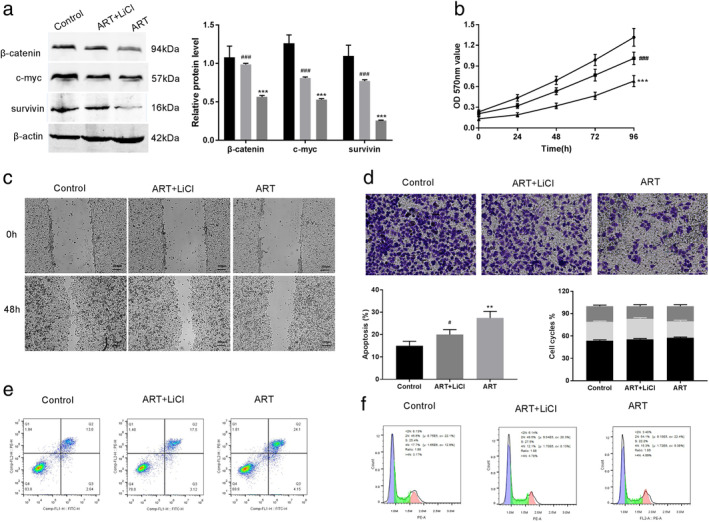
The migration and invasion abilities of EC109 were suppressed by ART. This was due to the inhibitory effect of ART on the Wnt/β-catenin signaling pathway. The levels of β-catenin, c-myc, and survivin were also downregulated by ART. ART inhibits the proliferation of EC109 cells by arresting the cells in the G1-phase of cell cycle. By using LiCl, an activator of the Wnt/β-catenin pathway, we further verified that the inhibition of the Wnt/β-catenin pathway was indeed due to ART. Remarkably, ART enhanced the anticancer effects of OXA in EC109 cells. OXA combined with ART was found to be more efficient in decreasing tumor growth compared to the individual drugs.
ART could suppress tumor progression by inhibiting Wnt/β-catenin signaling pathway, and it may also enhance the antitumor effect of OXA in EC. Thus, ART could be a novel anticancer drug for EC treatment.
SIGNIFICANT FINDINGS OF THE STUDY: ART could be a novel anticancer drug for esophageal cancer (EC) treatment.
Combination treatment with artemisinin and oxaliplatin inhibits tumorigenesis in esophageal cancer EC109 cells through the Wnt/β-catenin signaling pathway.
食管癌(EC)是全球普遍存在的恶性肿瘤。有趣的是,抗疟疾化合物青蒿素(ART)也被报道具有抗癌潜力,尽管其在 EC 中的作用机制尚不清楚。在这项研究中,我们探讨了 ART 在 EC109 中的抗癌作用,并进一步探讨了 ART 和奥沙利铂(OXA)联合应用的协同抗癌作用。
使用人食管癌细胞系 EC109。用 ART 或奥沙利铂(OXA)处理后,通过 MTT、Transwell 和划痕实验分别测量细胞增殖、迁移和侵袭。用流式细胞术检测细胞周期和凋亡。用 qRT-PCR 和 Western blot 测定 mRNA 和蛋白水平。
ART 抑制了 EC109 的迁移和侵袭能力。这是由于 ART 对 Wnt/β-catenin 信号通路的抑制作用。ART 还下调了β-catenin、c-myc 和 survivin 的水平。ART 通过将细胞周期阻滞在 G1 期来抑制 EC109 细胞的增殖。通过使用 LiCl(Wnt/β-catenin 通路的激活剂),我们进一步验证了 Wnt/β-catenin 通路的抑制确实是由于 ART。值得注意的是,ART 增强了 OXA 在 EC109 细胞中的抗癌作用。与单独使用药物相比,OXA 联合 ART 更有效地降低肿瘤生长。
ART 通过抑制 Wnt/β-catenin 信号通路抑制肿瘤进展,并且可能增强 OXA 在 EC 中的抗肿瘤作用。因此,ART 可能成为治疗食管癌的新型抗癌药物。