Women and Health Initiative, Department of Global Health and Population, Harvard TH Chan School of Public Health, Boston, MA, USA.
Maternal and Child Health Nursing Department, School of Nursing, The University of Jordan, Amman, Jordan.
BMC Int Health Hum Rights. 2020 Jul 13;20(1):16. doi: 10.1186/s12914-020-00234-y.
The determinants of sexual- and gender-based violence (SGBV) and early marriage are embedded across different levels of the social ecological system, including at the individual, family, community, and policy levels. In Jordan and the Middle East, SGBV, honor killing, and early marriage are priority public health and human rights issues that often overlap, and affect a significant percentage of youth. Jordan is home to a large number of refugees from across the Middle East, who may be even more vulnerable to these forms of violence than the local youth. The purpose of this analysis is to 1) synthesize the existing literature and 2) present the perspectives of key stakeholders to identify research gaps, programmatic lessons learned, and opportunities for policy change from an ecological perspective at the individual, community, health-system, and policy/legal levels.
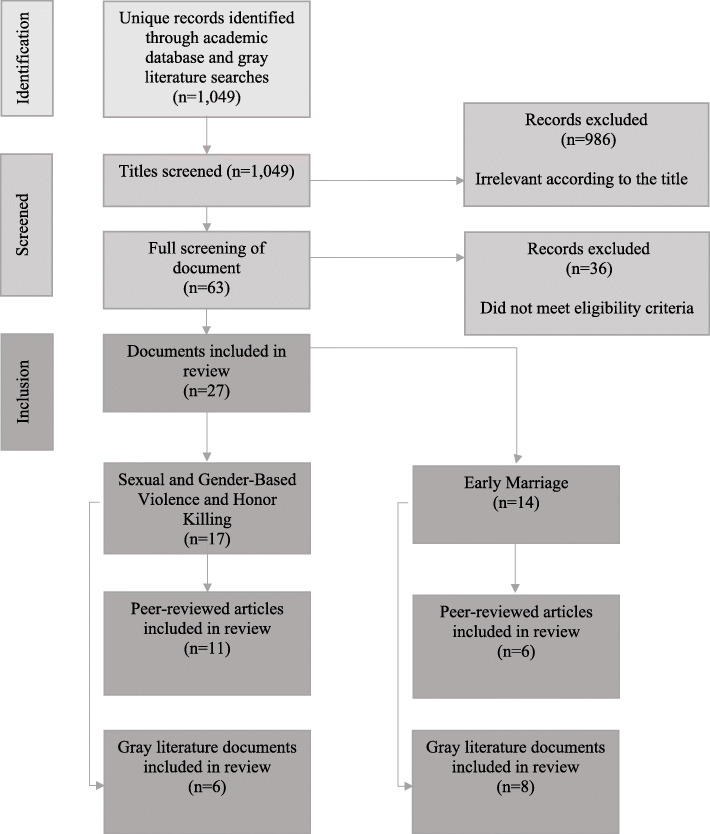
This study includes 1) a systematic literature review of both published and unpublished literature since 2008 and 2) focus group discussions (FGDs) with key stakeholders representing 18 international and local governmental and non-governmental organizations.
The literature review included 27 documents. Stakeholder discussions highlighted important research and policy gaps. Prevalence estimates of SGBV, honor killing, and early marriage vary across sources; however, all of them indicate that they remain important issues for youth in Jordan. Several sources indicate that early marriage has been increasing in Jordan since the beginning of the war in Syria, especially among Syrian refugees. Refugee youth are particularly vulnerable to SGBV and early marriage given the worsening economic situation in Jordan. The norms, attitudes, and practices that support SGBV in Jordan appear to be reinforced within families and communities. Despite ongoing programs, SGBV services are limited, especially for youth, and there is little awareness of service availability amongst target populations. Laws and policies continue to offer legal justification for SGBV, honor killing, and early marriage.
As countries across the Middle East face instability and continue to struggle with the urgent health needs of large refugee and youth populations, this review provides valuable insight relevant to research, programs, and policy in Jordan and across the region.
性暴力和基于性别的暴力(SGBV)以及早婚的决定因素存在于社会生态系统的不同层面,包括个人、家庭、社区和政策层面。在约旦和中东地区,SGBV、荣誉谋杀和早婚是优先的公共卫生和人权问题,这些问题经常重叠,影响了很大一部分年轻人。约旦是来自中东各地的大量难民的家园,他们可能比当地年轻人更容易受到这些形式的暴力侵害。本分析的目的是 1)综合现有文献,2)从个人、社区、卫生系统和政策/法律层面,从生态角度介绍主要利益攸关方的观点,以确定研究差距、方案经验教训和政策变革机会。
本研究包括 1)对 2008 年以来发表和未发表的文献进行系统文献回顾,2)与代表 18 个国际和当地政府及非政府组织的主要利益攸关方进行焦点小组讨论(FGD)。
文献回顾包括 27 份文件。利益攸关方的讨论强调了重要的研究和政策差距。SGBV、荣誉谋杀和早婚的流行率估计因来源而异;然而,所有这些都表明它们仍然是约旦青年的重要问题。一些消息来源表明,自叙利亚战争开始以来,约旦的早婚率一直在上升,尤其是在叙利亚难民中。由于约旦经济状况恶化,难民青年特别容易受到 SGBV 和早婚的影响。在约旦,支持 SGBV 的规范、态度和做法似乎在家庭和社区中得到加强。尽管正在开展各项方案,但 SGBV 服务有限,尤其是针对青年的服务,目标人群对服务的可获得性几乎没有认识。法律和政策继续为 SGBV、荣誉谋杀和早婚提供法律依据。
随着中东各国面临不稳定,并继续努力应对大量难民和青年人口的紧急健康需求,本审查为约旦和该地区的研究、方案和政策提供了有价值的见解。