School of Design Art, Xiamen University of Technology, Xiamen 361024, China.
Thermal Environment and Ergonomics Research Group (TEERG), Institute of Textiles and Clothing, The Hong Kong Polytechnic University, Hung Hom 999007, Hong Kong.
Int J Environ Res Public Health. 2020 Jul 11;17(14):4995. doi: 10.3390/ijerph17144995.
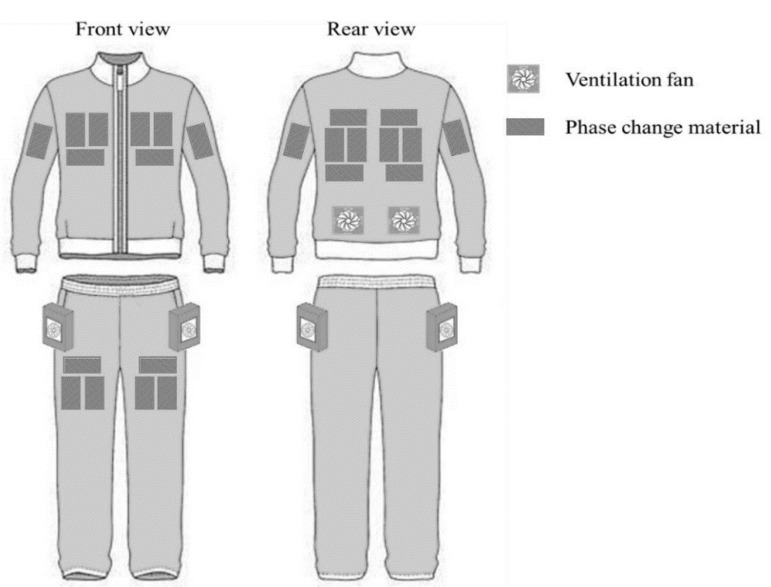
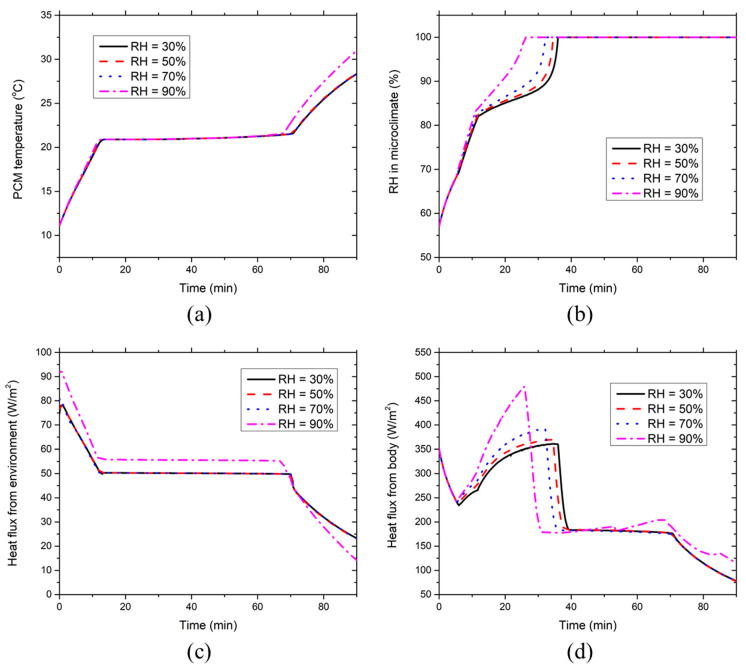
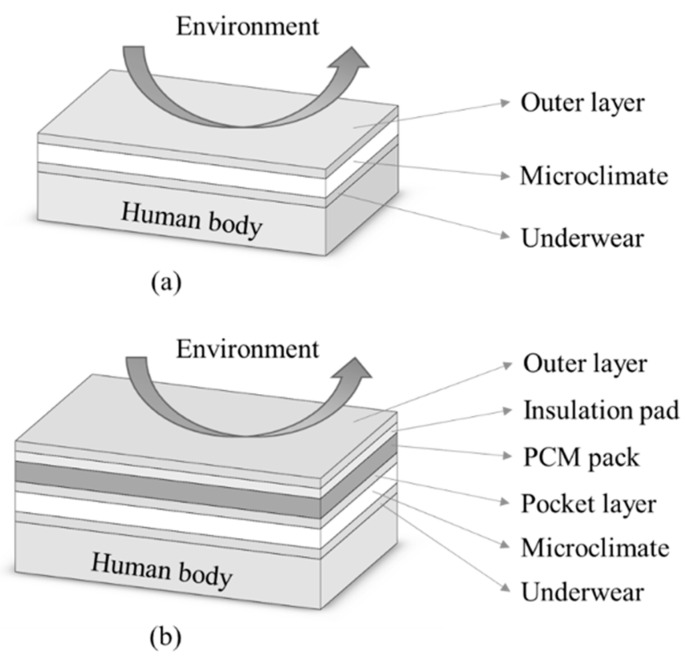
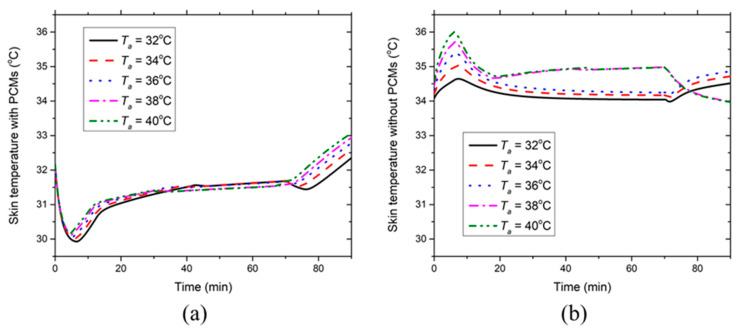
Hybrid personal cooling systems (HPCS) incorporated with ventilation fans and phase change materials (PCMs) have shown its superior capability for mitigating workers' heat strain while performing heavy labor work in hot environments. In a previous study, the effects of thermal resistance of insulation pads, and latent heat and melting temperature of PCMs on the HPCS's thermal performance have been investigated. In addition to the aforementioned factors, environmental conditions, i.e., ambient temperature and relative humidity, also significantly affect the thermal performance of the HPCS. In this paper, a numerical parametric study was performed to investigate the effects of the environmental temperature and relative humidity (RH) on the thermal management of the HPCS. Five levels of air temperature under RH = 50% (i.e., 32, 34, 36, 38 and 40 °C) and four levels of environmental RH at two ambient temperatures of 36 and 40 °C were selected (i.e., RH = 30, 50, 70 and 90%) for the numerical analysis. Results show that high environmental temperatures could accelerate the PCM melting process and thereby weaken the cooling performance of HPCS. In the moderately hot environment (36 °C), HPCS presented good cooling performance with the maximum core temperature at around 37.5 °C during excise when the ambient RH ≤ 70%, whereas good cooling performance could be only seen under RH ≤ 50% in the extremely hot environment (40 °C). Thus, it may be concluded that the maximum environmental RH under which the HPCS exhibiting good cooling performance decreases with an increase in the environmental temperature.
混合个人冷却系统 (HPCS) 结合通风扇和相变材料 (PCM),已被证明在高温环境下进行重体力劳动时,具有缓解工人热应激的优越能力。在之前的研究中,已经研究了隔热垫的热阻、PCM 的潜热和熔化温度对 HPCS 热性能的影响。除了上述因素外,环境条件,即环境温度和相对湿度,也会显著影响 HPCS 的热性能。在本文中,进行了数值参数研究,以调查环境温度和相对湿度 (RH) 对 HPCS 热管理的影响。在 RH = 50%的条件下(即 32、34、36、38 和 40°C)选择了五个空气温度水平,在两个环境温度 36 和 40°C 下选择了四个环境 RH 水平(即 RH = 30、50、70 和 90%)进行数值分析。结果表明,高环境温度会加速 PCM 的熔化过程,从而削弱 HPCS 的冷却性能。在较热的环境(36°C)中,当环境 RH≤70%时,HPCS 在运动时的核心温度最高约为 37.5°C,表现出良好的冷却性能,而在极热的环境(40°C)中,只有在 RH≤50%时才能看到良好的冷却性能。因此,可以得出结论,HPCS 表现出良好冷却性能的最大环境 RH 随着环境温度的升高而降低。