Department of Pathology, Brigham and Women's Hospital and Harvard Medical School, 75 Francis Street, Boston, MA, 02115, USA.
Department of Pathology, Boston Children's Hospital and Harvard Medical School, 300 Longwood Ave, Bader Building, Boston, MA, 02115, USA.
Acta Neuropathol Commun. 2020 Jul 14;8(1):107. doi: 10.1186/s40478-020-00980-z.
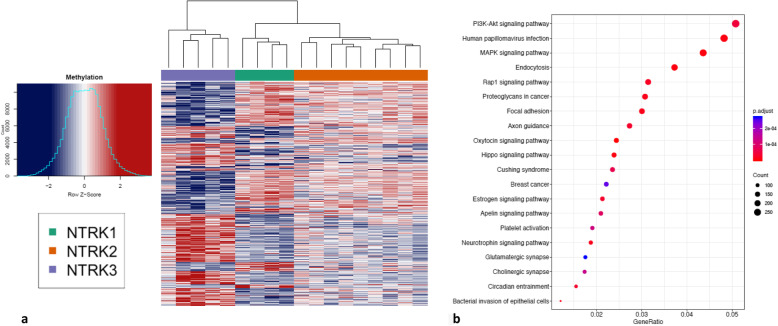
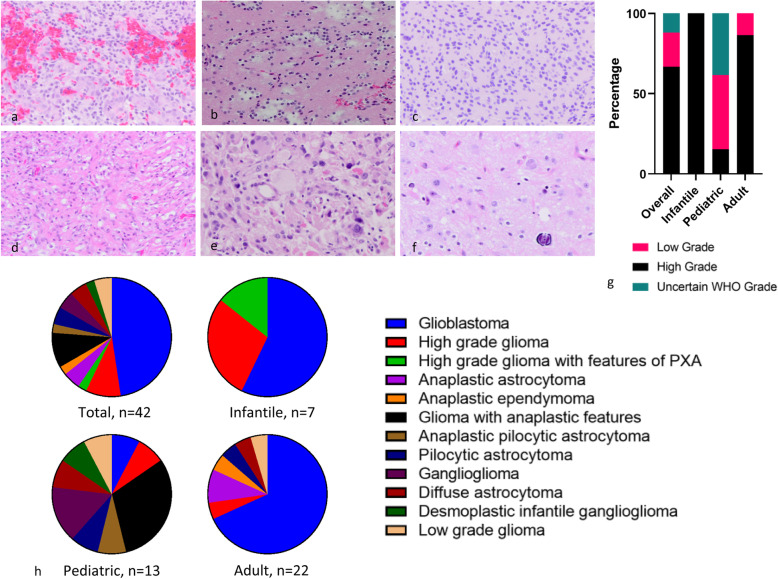
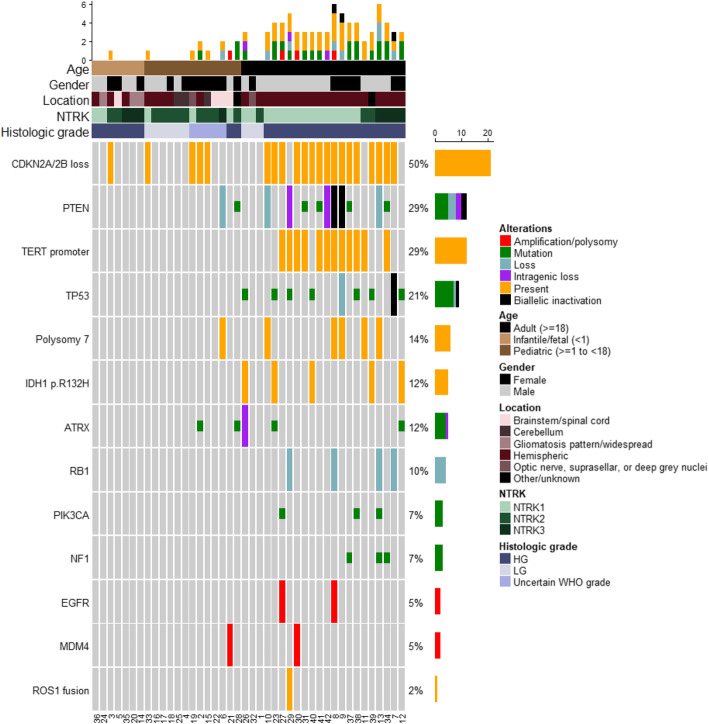
Fusions involving neurotrophic tyrosine receptor kinase (NTRK) genes are detected in ≤2% of gliomas and can promote gliomagenesis. The remarkable therapeutic efficacy of TRK inhibitors, which are among the first Food and Drug Administration-approved targeted therapies for NTRK-fused gliomas, has generated significant clinical interest in characterizing these tumors. In this multi-institutional retrospective study of 42 gliomas with NTRK fusions, next generation DNA sequencing (n = 41), next generation RNA sequencing (n = 1), RNA-sequencing fusion panel (n = 16), methylation profile analysis (n = 18), and histologic evaluation (n = 42) were performed. All infantile NTRK-fused gliomas (n = 7) had high-grade histology and, with one exception, no other significant genetic alterations. Pediatric NTRK-fused gliomas (n = 13) typically involved NTRK2, ranged from low- to high-histologic grade, and demonstrated histologic overlap with desmoplastic infantile ganglioglioma, pilocytic astrocytoma, ganglioglioma, and glioblastoma, among other entities, but they rarely matched with high confidence to known methylation class families or with each other; alterations involving ATRX, PTEN, and CDKN2A/2B were present in a subset of cases. Adult NTRK-fused gliomas (n = 22) typically involved NTRK1 and had predominantly high-grade histology; genetic alterations involving IDH1, ATRX, TP53, PTEN, TERT promoter, RB1, CDKN2A/2B, NF1, and polysomy 7 were common. Unsupervised principal component analysis of methylation profiles demonstrated no obvious grouping by histologic grade, NTRK gene involved, or age group. KEGG pathway analysis detected methylation differences in genes involved in PI3K/AKT, MAPK, and other pathways. In summary, the study highlights the clinical, histologic, and molecular heterogeneity of NTRK-fused gliomas, particularly when stratified by age group.
涉及神经营养酪氨酸受体激酶(NTRK)基因的融合在 ≤2%的神经胶质瘤中被检测到,并且可以促进神经胶质瘤的发生。TRK 抑制剂的显著治疗效果,作为首批获得美国食品和药物管理局批准的针对 NTRK 融合神经胶质瘤的靶向治疗药物之一,引起了人们对这些肿瘤特征的极大临床兴趣。在这项涉及 42 例 NTRK 融合神经胶质瘤的多机构回顾性研究中,进行了下一代 DNA 测序(n=41)、下一代 RNA 测序(n=1)、RNA 测序融合面板(n=16)、甲基化谱分析(n=18)和组织学评估(n=42)。所有婴儿型 NTRK 融合神经胶质瘤(n=7)均具有高级别组织学特征,除 1 例外,无其他明显的遗传改变。儿科 NTRK 融合神经胶质瘤(n=13)通常涉及 NTRK2,组织学分级从低到高不等,与促纤维增生性婴儿性节细胞神经胶质瘤、毛细胞型星形细胞瘤、节细胞瘤和胶质母细胞瘤等实体之间存在组织学重叠,但很少与高置信度匹配已知的甲基化类家族或彼此匹配;涉及 ATRX、PTEN 和 CDKN2A/2B 的改变存在于部分病例中。成人 NTRK 融合神经胶质瘤(n=22)通常涉及 NTRK1,且主要具有高级别组织学特征;涉及 IDH1、ATRX、TP53、PTEN、TERT 启动子、RB1、CDKN2A/2B、NF1 和 7 号染色体三体的遗传改变很常见。基于未监督主成分分析的甲基化谱分析未显示出明显的按组织学分级、涉及的 NTRK 基因或年龄组分组的情况。KEGG 通路分析检测到参与 PI3K/AKT、MAPK 和其他通路的基因的甲基化差异。总之,该研究强调了 NTRK 融合神经胶质瘤的临床、组织学和分子异质性,特别是按年龄组分层时。