Nuffield Department of Clinical Neurosciences, University of Oxford, Oxford, UK.
Department of Neurology, University of Miami, Miami, Florida.
Ann Clin Transl Neurol. 2020 Aug;7(8):1296-1306. doi: 10.1002/acn3.51114. Epub 2020 Jul 14.
To evaluate the CSF levels of chitinase proteins during the presymptomatic and early symptomatic phases of amyotrophic lateral sclerosis (ALS).
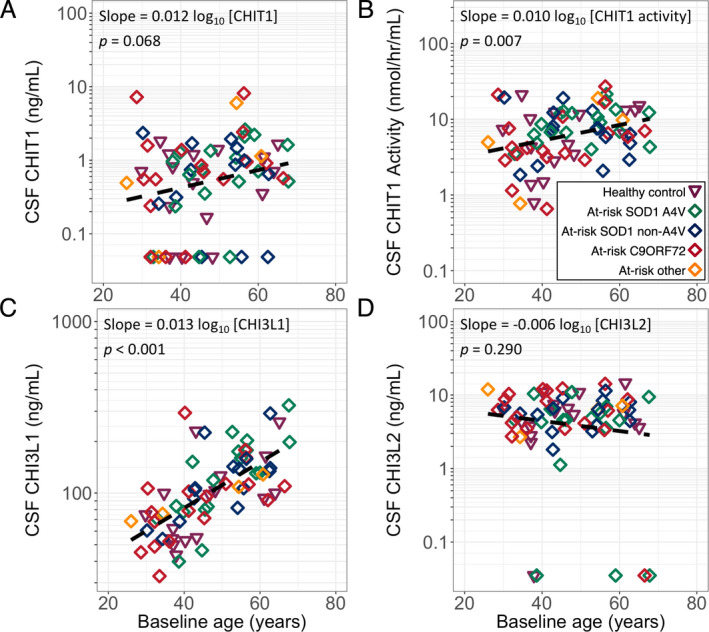
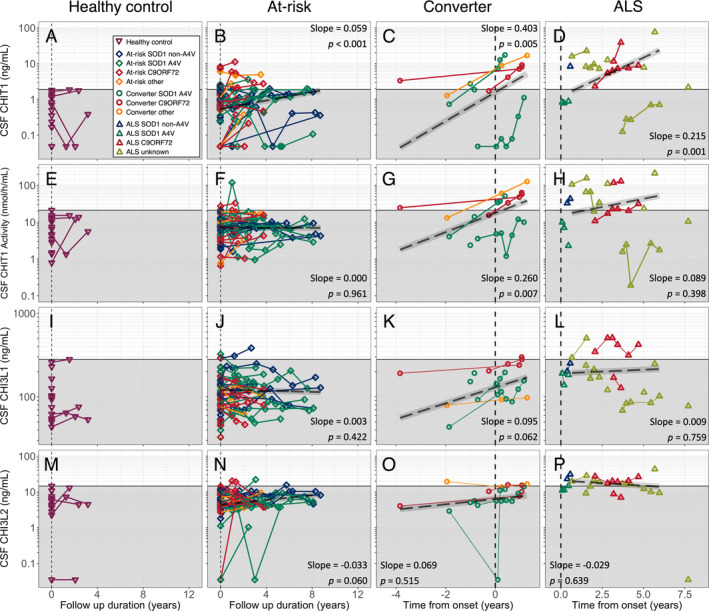
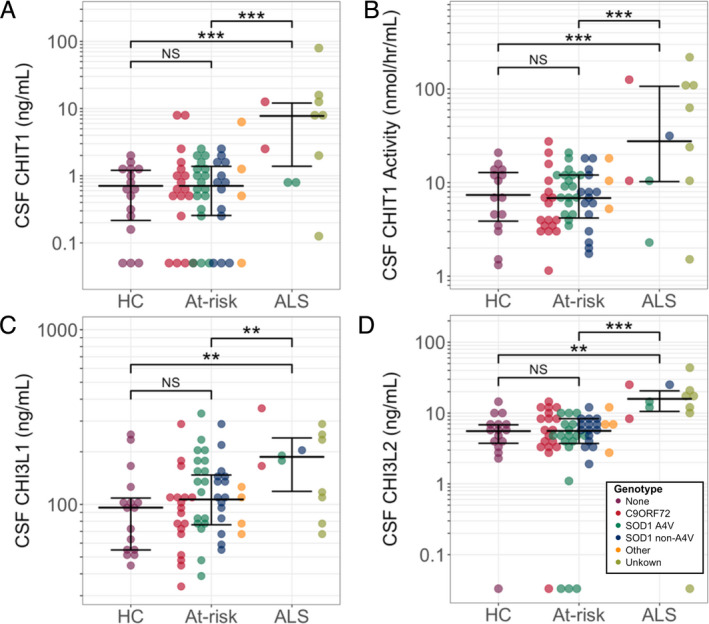
CSF samples were obtained from 16 controls, 55 individuals at-risk for ALS (including 18 carrying a mutation in C9ORF72, 33 in SOD1), 12 ALS patients, and 7 phenoconverters (individuals diagnosed with ALS during follow-up). At-risk individuals and phenoconverters were enrolled through the Pre-fALS study, which includes individuals carrying an ALS-associated gene mutation without disease manifestations at initial assessment. Longitudinal CSF collections, where possible, took place every 3-12 months for ALS patients and every 1-2 years for others. CSF levels of chitotriosidase 1 (CHIT1), chitinase-3-like protein 1 (CHI3L1, YKL-40) and chitinase-3-like protein 2 (CHI3L2, YKL-39) were measured by ELISA, along with CHIT1 activity. Longitudinal changes in at-risk individuals and phenoconverters were fitted to linear mixed effects models.
Slowly rising levels of CHIT1 were observed over time in the at-risk individuals (slope 0.059 log [CHIT1] per year, P < 0.001). Among phenoconverters, CHIT1 levels and activity rose more sharply (0.403 log [CHIT1] per year, P = 0.005; 0.260 log [CHIT1 activity] per year, P = 0.007). Individual levels of both CHI3L1 and CHI3L2 remained relatively stable over time in all participant groups.
The CHIT1 neuroinflammatory response is a feature of the late presymptomatic to early symptomatic phases of ALS. This study does not suggest a long prodrome of upregulated glial activity in ALS pathogenesis, but strengthens the place of CHIT1 as part of a panel of biomarkers to objectively assess the impact of immune-modulatory therapeutic interventions in ALS.
评估在肌萎缩侧索硬化症(ALS)的无症状前和早期症状阶段,甲壳质酶蛋白在脑脊液中的水平。
从 16 名对照者、55 名 ALS 风险个体(包括 18 名携带 C9ORF72 突变、33 名携带 SOD1 突变的个体)、12 名 ALS 患者和 7 名表型转化者(在随访中被诊断为 ALS 的个体)中获取脑脊液样本。风险个体和表型转化者是通过 Pre-fALS 研究招募的,这些个体在初次评估时携带 ALS 相关基因突变但没有疾病表现。如果可能,对 ALS 患者每 3-12 个月进行一次纵向脑脊液采集,对其他个体每 1-2 年进行一次。通过 ELISA 测量了壳三糖酶 1(CHIT1)、几丁质酶-3 样蛋白 1(CHI3L1,YKL-40)和几丁质酶-3 样蛋白 2(CHI3L2,YKL-39)的水平以及 CHIT1 活性。将风险个体和表型转化者的纵向变化拟合到线性混合效应模型中。
在风险个体中,随着时间的推移,CHIT1 水平呈缓慢上升趋势(每年增加 0.059 log [CHIT1],P<0.001)。在表型转化者中,CHIT1 水平和活性上升更为明显(每年增加 0.403 log [CHIT1],P=0.005;每年增加 0.260 log [CHIT1 活性],P=0.007)。在所有参与者组中,CHI3L1 和 CHI3L2 的个体水平随时间相对稳定。
CHIT1 神经炎症反应是 ALS 无症状前晚期到早期症状阶段的特征。本研究并未表明 ALS 发病机制中有较长的神经胶质细胞活性上调的前驱期,但它强化了 CHIT1 作为生物标志物组的一部分,用于客观评估免疫调节治疗干预对 ALS 的影响。