Curry Caitlin J, Davis Brian W, Bertola Laura D, White Paula A, Murphy William J, Derr James N
Interdisciplinary Program in Genetics, Texas A&M University, College Station, TX.
Department of Veterinary Pathobiology, College of Veterinary Medicine and Biomedical Sciences, Texas A&M University, College Station, TX.
Mol Biol Evol. 2021 Jan 4;38(1):48-57. doi: 10.1093/molbev/msaa174.
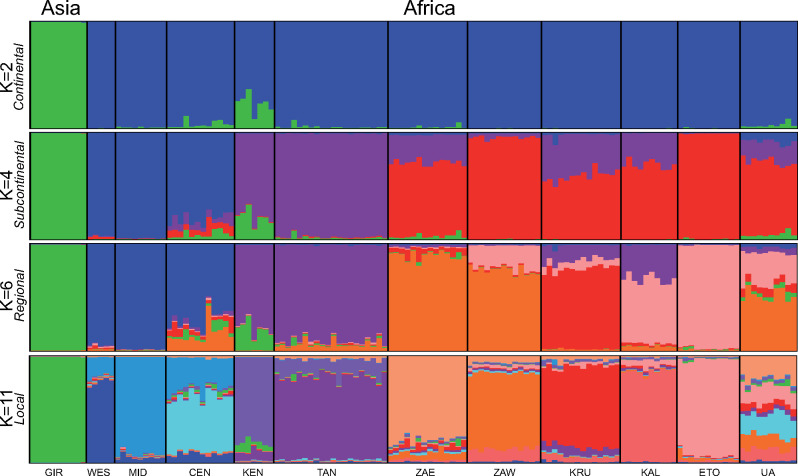
Direct comparisons between historical and contemporary populations allow for detecting changes in genetic diversity through time and assessment of the impact of habitat fragmentation. Here, we determined the genetic architecture of both historical and modern lions to document changes in genetic diversity over the last century. We surveyed microsatellite and mitochondrial genome variation from 143 high-quality museum specimens of known provenance, allowing us to directly compare this information with data from several recently published nuclear and mitochondrial studies. Our results provide evidence for male-mediated gene flow and recent isolation of local subpopulations, likely due to habitat fragmentation. Nuclear markers showed a significant decrease in genetic diversity from the historical (HE = 0.833) to the modern (HE = 0.796) populations, whereas mitochondrial genetic diversity was maintained (Hd = 0.98 for both). Although the historical population appears to have been panmictic based on nDNA data, hierarchical structure analysis identified four tiers of genetic structure in modern populations and was able to detect most sampling locations. Mitogenome analyses identified four clusters: Southern, Mixed, Eastern, and Western and were consistent between modern and historically sampled haplotypes. Within the last century, habitat fragmentation caused lion subpopulations to become more geographically isolated as human expansion changed the African landscape. This resulted in an increase in fine-scale nuclear genetic structure and loss of genetic diversity as lion subpopulations became more differentiated, whereas mitochondrial structure and diversity were maintained over time.
对历史种群和当代种群进行直接比较,有助于检测遗传多样性随时间的变化,并评估栖息地破碎化的影响。在此,我们确定了历史时期和现代狮子的遗传结构,以记录过去一个世纪遗传多样性的变化。我们调查了143个已知来源的高质量博物馆标本的微卫星和线粒体基因组变异,使我们能够将这些信息与最近发表的几项核基因和线粒体研究的数据直接进行比较。我们的结果为雄性介导的基因流动以及近期局部亚种群的隔离提供了证据,这可能是由于栖息地破碎化所致。核标记显示,从历史种群(HE = 0.833)到现代种群(HE = 0.796),遗传多样性显著下降,而线粒体遗传多样性得以维持(两者的Hd均为0.98)。尽管根据核DNA数据,历史种群似乎是随机交配的,但层次结构分析确定了现代种群中的四层遗传结构,并且能够检测到大多数采样地点。线粒体基因组分析确定了四个聚类:南部、混合、东部和西部,并且在现代和历史采样的单倍型之间是一致的。在过去的一个世纪里,随着人类扩张改变了非洲的地貌,栖息地破碎化导致狮子亚种群在地理上更加隔离。这导致了精细尺度核遗传结构的增加和遗传多样性的丧失,因为狮子亚种群变得更加分化,而线粒体结构和多样性随时间得以维持。