Pimentel Emely, Sivalingam Kalaiselvi, Doke Mayur, Samikkannu Thangavel
School of Medicine, St. George's University, Great River, NY, United States.
Department of Pharmaceutical Sciences, Irma Lerma Rangel College of Pharmacy, Texas A&M University, Kingsville, TX, United States.
Front Neurosci. 2020 May 21;14:513. doi: 10.3389/fnins.2020.00513. eCollection 2020.
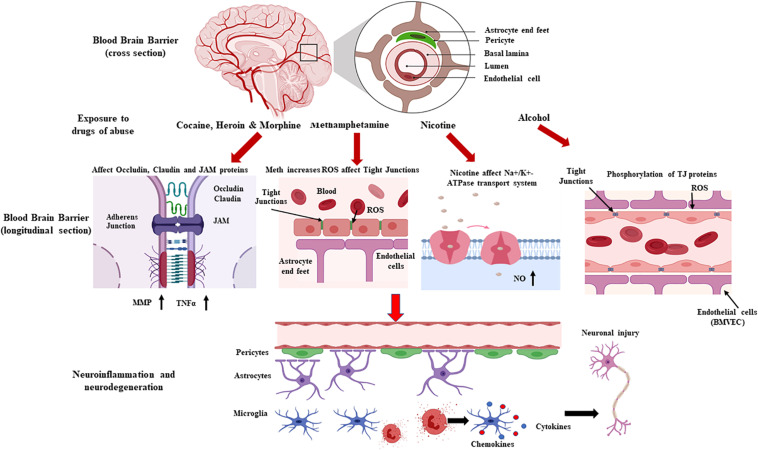
The use of psychostimulants and alcohol disrupts blood-brain barrier (BBB) integrity, resulting in alterations to cellular function, and contributes to neurotoxicity. The BBB is the critical boundary of the central nervous system (CNS) where it maintains intracellular homeostasis and facilitates communication with the peripheral circulation. The BBB is regulated by tight junction (TJ) proteins that closely interact with endothelial cells (EC). The complex TJ protein network consists of transmembrane proteins, including claudins, occludins, and junction adhesion molecules (JAM), as well as cytoskeleton connected scaffolding proteins, zonula occludentes (ZO-1, 2, and 3). The use of psychostimulants and alcohol is known to affect the CNS and is implicated in various neurological disorders through neurotoxicity that partly results from increased BBB permeability. The present mini review primarily focuses on BBB structure and permeability. Moreover, we assess TJ protein and cytoskeletal changes induced by cocaine, methamphetamine, morphine, heroin, nicotine, and alcohol. These changes promote glial activation, enzyme potentiation, and BBB remodeling, which affect neuroinflammatory pathways. Although the effect of drugs of abuse on BBB integrity and the underlying mechanisms are well studied, the present review enhances the understanding of the underlying mechanisms through which substance abuse disorders cause BBB dysfunction.
精神兴奋剂和酒精的使用会破坏血脑屏障(BBB)的完整性,导致细胞功能改变,并促成神经毒性。血脑屏障是中枢神经系统(CNS)的关键边界,它维持细胞内稳态并促进与外周循环的交流。血脑屏障由紧密连接(TJ)蛋白调节,这些蛋白与内皮细胞(EC)密切相互作用。复杂的TJ蛋白网络由跨膜蛋白组成,包括闭合蛋白、闭锁蛋白和连接粘附分子(JAM),以及与细胞骨架相连的支架蛋白,即闭合小带(ZO-1、ZO-2和ZO-3)。已知精神兴奋剂和酒精的使用会影响中枢神经系统,并通过血脑屏障通透性增加导致的神经毒性,与各种神经系统疾病有关。本小型综述主要关注血脑屏障的结构和通透性。此外,我们评估了可卡因、甲基苯丙胺、吗啡、海洛因、尼古丁和酒精引起的TJ蛋白和细胞骨架变化。这些变化会促进神经胶质激活、酶增强和血脑屏障重塑,从而影响神经炎症途径。尽管滥用药物对血脑屏障完整性的影响及其潜在机制已得到充分研究,但本综述加深了对物质使用障碍导致血脑屏障功能障碍的潜在机制的理解。