Eix Emily F, Nett Jeniel E
Departments of Medicine and Medical Microbiology and Immunology, University of Wisconsin-Madison, Madison, WI, United States.
Front Microbiol. 2020 Jun 25;11:1437. doi: 10.3389/fmicb.2020.01437. eCollection 2020.
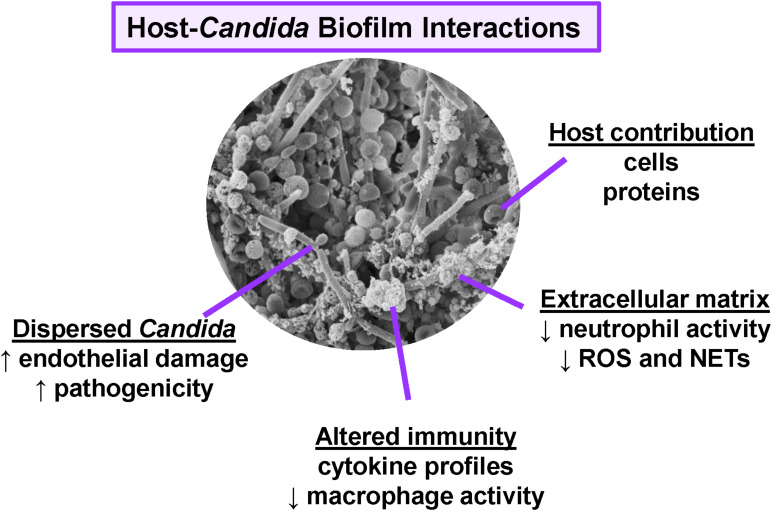
spp. proliferate as surface-associated biofilms in a variety of clinical niches. These biofilms can be extremely difficult to eradicate in healthcare settings. Cells within biofilm communities grow as aggregates and produce a protective extracellular matrix, properties that impact the ability of the host to respond to infection. Cells that disperse from biofilms display a phenotype of enhanced pathogenicity. In this review, we highlight host-biofilm interactions for , focusing on how biofilm formation influences innate immune responses.
某些物种在各种临床环境中以表面相关生物膜的形式增殖。在医疗环境中,这些生物膜极难根除。生物膜群落中的细胞以聚集体形式生长,并产生保护性细胞外基质,这些特性会影响宿主对感染作出反应的能力。从生物膜中分散出来的细胞表现出致病性增强的表型。在本综述中,我们重点介绍了[具体物种]的宿主-生物膜相互作用,着重探讨生物膜形成如何影响先天免疫反应。