Bertani Lorenzo, Blandizzi Corrado, Mumolo Maria Gloria, Ceccarelli Linda, Albano Eleonora, Tapete Gherardo, Baiano Svizzero Giovanni, Zanzi Federico, Coppini Francesca, de Bortoli Nicola, Bellini Massimo, Morganti Riccardo, Marchi Santino, Costa Francesco
Department of Translational Research and New Tecnologies in Medicine and Surgery, University of Pisa, Pisa, Italy.
Department of Clinical and Experimental Medicine, University of Pisa, Pisa, Italy.
Clin Transl Gastroenterol. 2020 May;11(5):e00174. doi: 10.14309/ctg.0000000000000174.
Biological therapies are widely used for the treatment of ulcerative colitis. However, only a low proportion of patients achieve clinical remission and even less mucosal healing. There is currently scarce knowledge about the early markers of therapeutic response, with particular regard to mucosal healing. The aim of this prospective study was to evaluate the role of fecal calprotectin (FC) as early predictor of mucosal healing.
A prospective observational study was conducted on patients with ulcerative colitis, who started biological therapy with infliximab, adalimumab, golimumab, or vedolizumab at our center. All patients underwent colonoscopy, performed by 2 blinded operators, at baseline and week 54 or in case of therapy discontinuation because of loss of response. FC was assessed at baseline and week 8 and evaluated as putative predictor of mucosal healing at week 54.
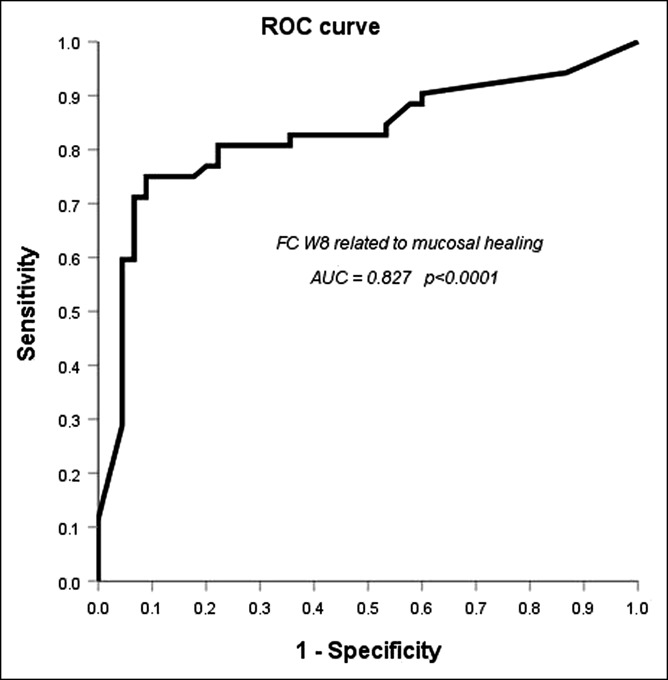
We enrolled 109 patients, and 97 were included in the analysis. Twenty-six patients (27%) experienced loss of response. Over 71 patients (73%) with clinical response at week 54, clinical remission was obtained in 60 patients (61.9%) and mucosal healing in 45 patients (46.4%). After 8 weeks of treatment, FC predicted mucosal healing at week 54 (P < 0.0001). Sensitivity, specificity, positive predictive value, and negative predictive value were estimated to be 75%, 88.9%, 86.6%, and 75.5%, respectively, based on a cutoff of 157.5 mg/kg.
The present study suggests that FC assessment after 8 weeks of treatment with all the biological drugs could represent a promising early marker of response to therapy in terms of mucosal healing.
生物疗法广泛用于治疗溃疡性结肠炎。然而,只有一小部分患者实现临床缓解,实现黏膜愈合的患者更少。目前对于治疗反应的早期标志物,尤其是关于黏膜愈合方面的了解很少。这项前瞻性研究的目的是评估粪便钙卫蛋白(FC)作为黏膜愈合早期预测指标的作用。
对在我们中心开始使用英夫利昔单抗、阿达木单抗、戈利木单抗或维多珠单抗进行生物治疗的溃疡性结肠炎患者进行了一项前瞻性观察研究。所有患者在基线时以及第54周或因治疗反应丧失而停药时,由2名盲法操作人员进行结肠镜检查。在基线和第8周评估FC,并将其作为第54周黏膜愈合的假定预测指标进行评估。
我们纳入了109例患者,97例纳入分析。26例患者(27%)出现治疗反应丧失。在第54周有临床反应的71例患者(73%)中,60例患者(61.9%)实现临床缓解,45例患者(46.4%)实现黏膜愈合。治疗8周后,FC可预测第54周的黏膜愈合情况(P < 0.0001)。基于157.5 mg/kg的临界值,敏感性、特异性、阳性预测值和阴性预测值分别估计为75%、88.9%、86.6%和75.5%。
本研究表明,在使用所有生物药物治疗8周后评估FC,可能是治疗反应在黏膜愈合方面有前景的早期标志物。