Massadeh Salam, Omer Mustafa E, Alterawi Asmaa, Ali Rizwan, Alanazi Fayez H, Almutairi Fares, Almotairi Wejdan, Alobaidi Faris F, Alhelal Khulud, Almutairi Mansour S, Almalik Abdulaziz, Obaidat Aiman A, Alaamery Manal, Yassin Alaa Eldeen
Developmental Medicine Department, King Abdullah International Medical Research Center, King Saud Bin Abdulaziz University for Health Sciences, King Abdulaziz Medical City, Ministry of National Guard-Health Affairs (MNG-HA), Riyadh 11481, Saudi Arabia.
KACST-BWH Centre of Excellence for Biomedicine, Joint Centers of Excellence Program, King Abdulaziz City for Science and Technology (KACST), Riyadh 11442, Saudi Arabia.
Pharmaceutics. 2020 Jul 15;12(7):666. doi: 10.3390/pharmaceutics12070666.
The aim of this work is to optimize a polyethylene glycolated (PEGylated) polymer-lipid hybrid nanoparticulate system for the delivery of anastrozole (ANS) to enhance its biopharmaceutical attributes and overall efficacy.
ANS loaded PEGylated polymer-lipid hybrid nanoparticles (PLNPs) were prepared by a direct emulsification solvent evaporation method. The physical incorporation of PEG was optimized using variable ratios. The produced particles were evaluated to discern their particle size and shape, zeta-potential, entrapment efficiency, and physical stability. The drug-release profiles were studied, and the kinetic model was analyzed. The anticancer activity of the ANS PLNPs on estrogen-positive breast cancer cell lines was determined using flow cytometry.
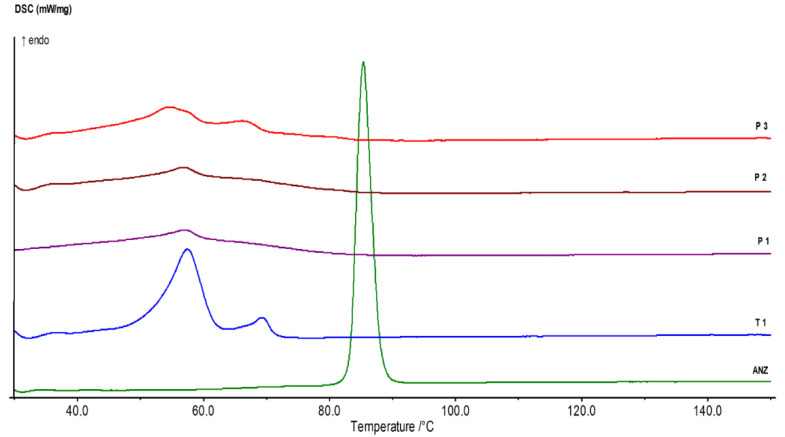
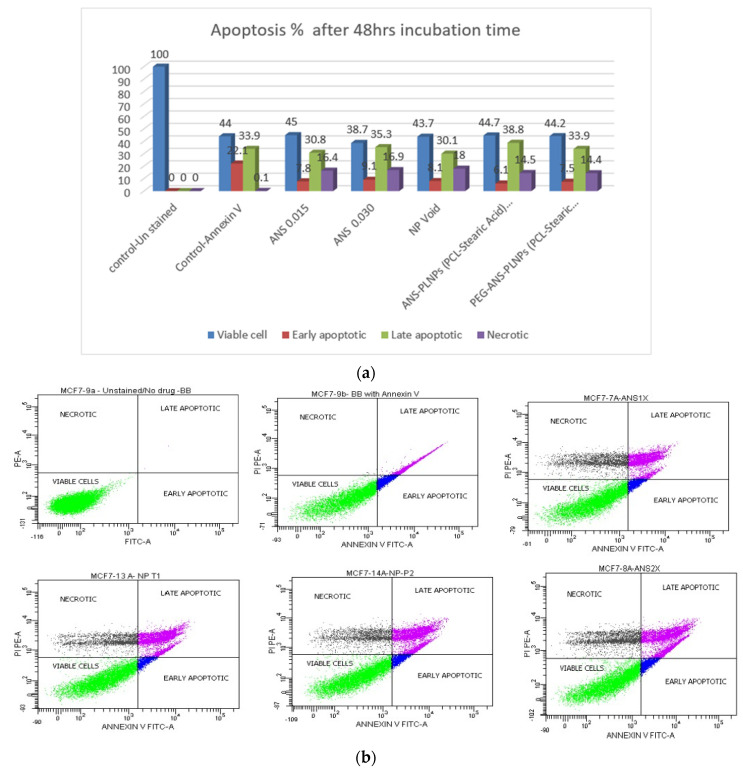
The prepared ANS-PLNPs showed particle sizes in the range of 193.6 ± 2.9 to 218.2 ± 1.9 nm, with good particle size uniformity (i.e., poly-dispersity index of around 0.1). Furthermore, they exhibited relatively low zeta-potential values ranging from -0.50 ± 0.52 to 6.01 ± 4.74. The transmission electron microscopy images showed spherical shape of ANS-PLNPs and the compliance with the sizes were revealed by light scattering. The differential scanning calorimetry DSC patterns of the ANS PLNPs revealed a disappearance of the characteristic sharp melting peak of pure ANS, supporting the incorporation of the drug into the polymeric matrices of the nanoparticles. Flow cytometry showed the apoptosis of MCF-7 cell lines in the presence of ANS-PLNPs.
PEGylated polymeric nanoparticles presented a stable encapsulated system with which to incorporate an anticancer drug (ANS) with a high percentage of entrapment efficiency (around 80%), good size uniformity, and induction of apoptosis in MCF-7 cells.
本研究旨在优化一种聚乙二醇化(PEG化)的聚合物-脂质杂化纳米颗粒系统,用于阿那曲唑(ANS)的递送,以增强其生物药剂学特性和整体疗效。
采用直接乳化溶剂蒸发法制备负载ANS的PEG化聚合物-脂质杂化纳米颗粒(PLNPs)。使用不同比例优化PEG的物理掺入。对制备的颗粒进行评估,以确定其粒径和形状、zeta电位、包封率和物理稳定性。研究药物释放曲线,并分析动力学模型。使用流式细胞术测定ANS PLNPs对雌激素阳性乳腺癌细胞系的抗癌活性。
制备的ANS-PLNPs粒径范围为193.6±2.9至218.2±1.9nm,粒径均匀性良好(即多分散指数约为0.1)。此外,它们的zeta电位值相对较低,范围为-0.50±0.52至6.01±4.74。透射电子显微镜图像显示ANS-PLNPs呈球形,光散射显示其尺寸符合要求。ANS PLNPs的差示扫描量热法(DSC)图谱显示纯ANS特征性的尖锐熔融峰消失,支持药物掺入纳米颗粒的聚合物基质中。流式细胞术显示在ANS-PLNPs存在下MCF-7细胞系发生凋亡。
PEG化聚合物纳米颗粒呈现出一种稳定的包封系统,可用于掺入抗癌药物(ANS),包封率高(约80%),粒径均匀性好,并能诱导MCF-7细胞凋亡。