Department of Computational Biology, University of Lausanne, Quartier Sorge, 1015 Lausanne, Switzerland.
University of California Los Angeles (UCLA). College Life Sciences - Ecology and Evolutionary Biology. Los Angeles, CA, USA.
Syst Biol. 2021 Feb 10;70(2):376-388. doi: 10.1093/sysbio/syaa055.
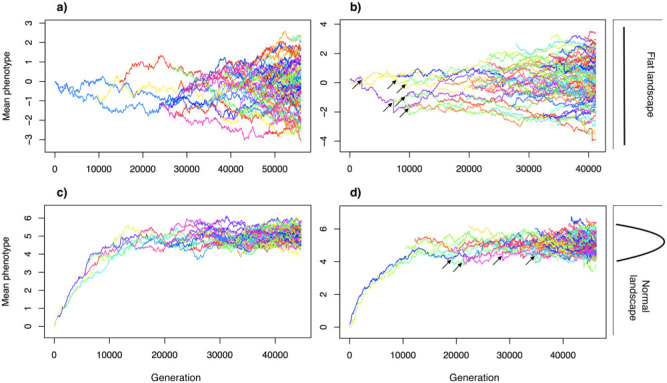
Current phylogenetic comparative methods modeling quantitative trait evolution generally assume that, during speciation, phenotypes are inherited identically between the two daughter species. This, however, neglects the fact that species consist of a set of individuals, each bearing its own trait value. Indeed, because descendent populations after speciation are samples of a parent population, we can expect their mean phenotypes to randomly differ from one another potentially generating a "jump" of mean phenotypes due to asymmetrical trait inheritance at cladogenesis. Here, we aim to clarify the effect of asymmetrical trait inheritance at speciation on macroevolutionary analyses, focusing on model testing and parameter estimation using some of the most common models of quantitative trait evolution. We developed an individual-based simulation framework in which the evolution of phenotypes is determined by trait changes at the individual level accumulating across generations, and cladogenesis occurs then by separation of subsets of the individuals into new lineages. Through simulations, we assess the magnitude of phenotypic jumps at cladogenesis under different modes of trait inheritance at speciation. We show that even small jumps can strongly alter both the results of model selection and parameter estimations, potentially affecting the biological interpretation of the estimated mode of evolution of a trait. Our results call for caution when interpreting analyses of trait evolution, while highlighting the importance of testing a wide range of alternative models. In the light of our findings, we propose that future methodological advances in comparative methods should more explicitly model the intraspecific variability around species mean phenotypes and how it is inherited at speciation.
目前,用于模拟数量性状进化的系统发育比较方法通常假设,在物种形成过程中,表型在两个子物种之间以相同的方式遗传。然而,这忽略了一个事实,即物种由一组个体组成,每个个体都具有自己的特征值。事实上,由于物种形成后衍生的种群是母种群的样本,我们可以预期它们的平均表型会随机彼此不同,这可能会由于性状在分支处的不对称遗传而产生“跳跃”。在这里,我们旨在阐明物种形成时性状不对称遗传对宏观进化分析的影响,重点是使用一些最常见的数量性状进化模型进行模型检验和参数估计。我们开发了一种基于个体的模拟框架,其中表型的进化是由个体水平上的性状变化决定的,这些变化在几代之间积累,然后通过将个体的子集分离到新的谱系中来发生分支。通过模拟,我们评估了在不同的性状遗传模式下分支处的表型跳跃的幅度。我们表明,即使是小的跳跃也可以强烈改变模型选择和参数估计的结果,这可能会影响对特征进化估计模式的生物学解释。我们的研究结果呼吁在解释特征进化分析时要谨慎,同时强调测试广泛的替代模型的重要性。根据我们的发现,我们建议未来比较方法的方法学进展应更明确地模拟物种平均表型周围的种内变异性以及它在物种形成时是如何遗传的。