Med Oral Patol Oral Cir Bucal. 2020 Sep 1;25(5):e691-e699. doi: 10.4317/medoral.23700.
To assess the effect of implantoplasty and implant-abutment design on the fracture resistance and macroscopic morphology of narrow-diameter (3.5 mm) dental implants.
Screw-shaped titanium dental implants (n = 48) were studied in vitro. Three groups (n = 16) were established, based on implant-abutment connection type: external hexagon, internal hexagon and conical. Eight implants from each group were subjected to an implantoplasty procedure; the remaining 8 implants served as controls. Implant wall thickness was recorded. All samples were subjected to a static strength test.
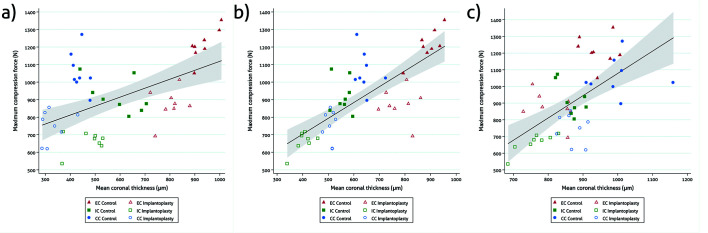
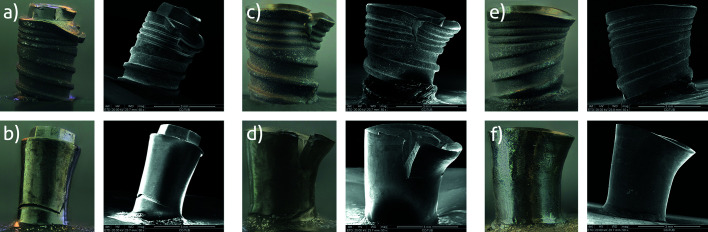
The mean wall thickness reductions varied between 106.46 and 153.75 µm. The mean fracture strengths for the control and test groups were, respectively, 1211.90±89.95 N and 873.11±92.37 N in the external hexagon implants; 918.41±97.19 N and 661.29±58.03 N in the internal hexagon implants; and 1058.67±114.05 N and 747.32±90.05 N in the conical connection implants. Implant wall thickness and fracture resistance (P < 0.001) showed a positive correlation. Fracture strength was influenced by both implantoplasty (P < 0.001) and connection type (P < 0.001).
Implantoplasty in diameter-reduced implants decreases implant wall thickness and fracture resistance, and varies depending on the implant-abutment connection. Internal hexagon and conical connection implants seem to be more prone to fracture after implantoplasty.
评估种植体预备和种植体-基台连接设计对小直径(3.5 毫米)牙科种植体抗折强度和宏观形态的影响。
体外研究了螺旋形钛牙科种植体(n = 48)。基于种植体-基台连接类型,建立了 3 个组(n = 16):外六方、内六方和锥形。每组 8 个种植体进行种植体预备程序;其余 8 个种植体作为对照。记录种植体壁厚度。所有样本均进行静态强度测试。
壁厚度减少的平均值在 106.46 和 153.75 µm 之间。外六方种植体中,对照组和试验组的平均断裂强度分别为 1211.90±89.95 N 和 873.11±92.37 N;内六方种植体分别为 918.41±97.19 N 和 661.29±58.03 N;锥形连接种植体分别为 1058.67±114.05 N 和 747.32±90.05 N。种植体壁厚度和抗折强度(P < 0.001)呈正相关。种植体预备(P < 0.001)和连接类型(P < 0.001)均影响断裂强度。
在直径减小的种植体中进行种植体预备会降低种植体壁厚度和抗折强度,并且取决于种植体-基台连接。内六方和锥形连接种植体在进行种植体预备后似乎更容易发生骨折。