Schulich Faculty of Chemistry and Russell Berrie Nanotechnology Institute, Technion-Israel Institute of Technology, Technion City, Haifa 32000, Israel.
Department of Chemistry & Chemical Biology, Baker Laboratory, Cornell University, Ithaca, New York 14853, United States.
J Am Chem Soc. 2020 Aug 12;142(32):13743-13755. doi: 10.1021/jacs.0c03590. Epub 2020 Aug 3.
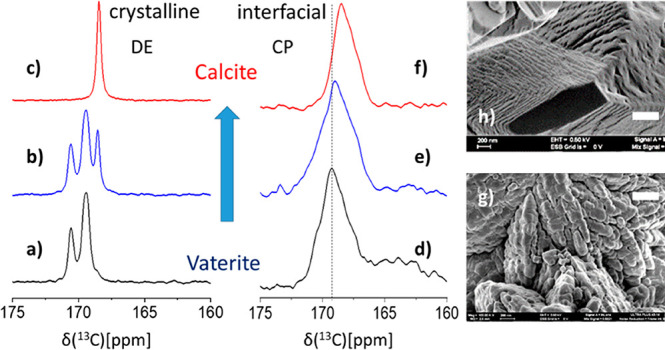
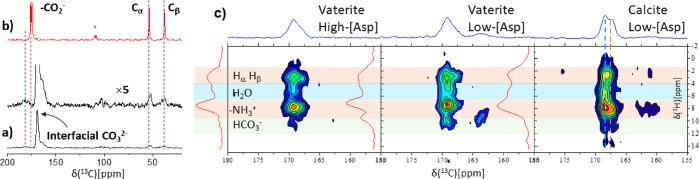
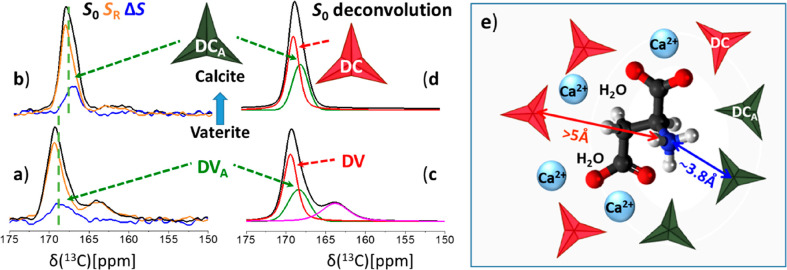
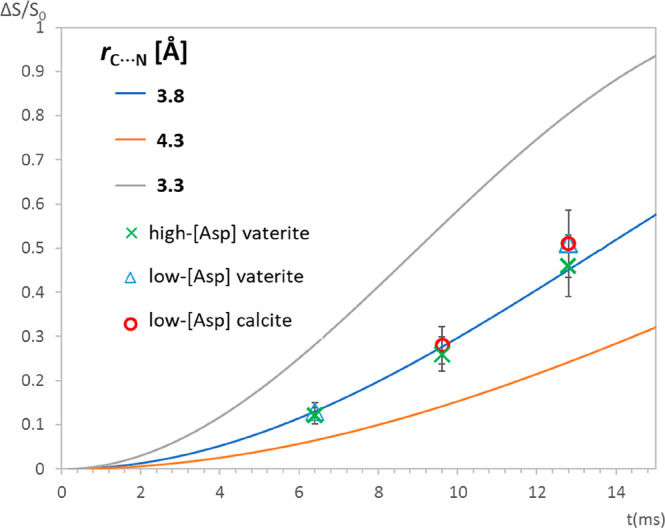
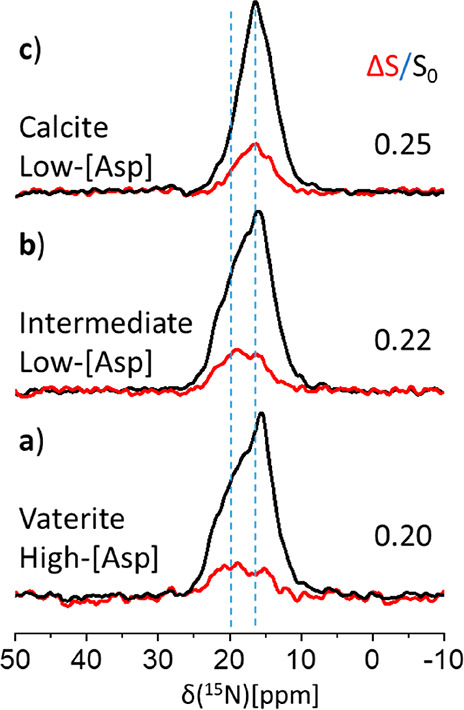
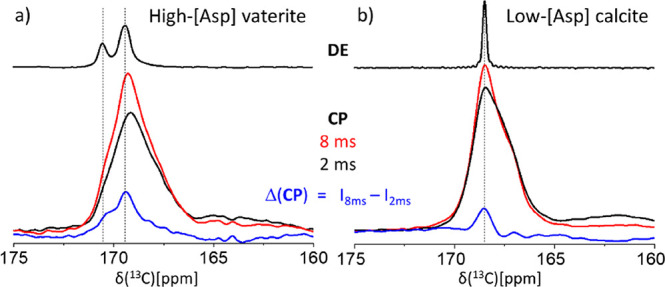
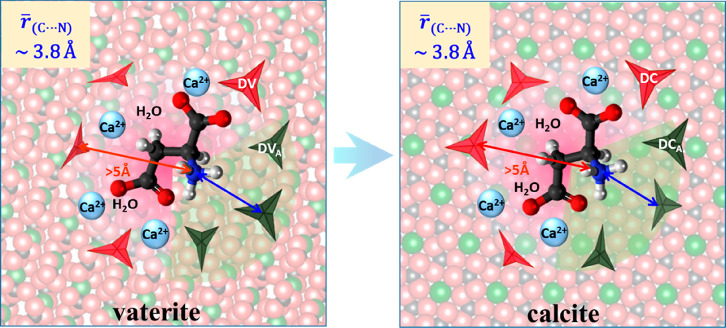
In many marine organisms, biomineralization-the crystallization of calcium-based ionic lattices-demonstrates how regulated processes optimize for diverse functions, often via incorporation of agents from the precipitation medium. We study a model system consisting of l-aspartic acid (Asp) which when added to the precipitation solution of calcium carbonate crystallizes the thermodynamically disfavored polymorph vaterite. Though vaterite is at best only kinetically stable, that stability is tunable, as vaterite grown with Asp at high concentration is both thermally and temporally stable, while vaterite grown at 10-fold lower Asp concentration, yet 2-fold less in the crystal, spontaneously transforms to calcite. Solid-state NMR shows that Asp is sparsely occluded within vaterite and calcite. CP-REDOR NMR reveals that each Asp is embedded in a perturbed occlusion shell of ∼8 disordered carbonates which bridge to the bulk. In both the as-deposited vaterites and the evolved calcite, the perturbed shell contains two sets of carbonate species distinguished by their proximity to the amine and identifiable based on C chemical shifts. The embedding shell and the occluded Asp act as an integral until which minimally rearranges even as the bulk undergoes extensive reorganization. The resilience of these occlusion units suggests that large Asp-free domains drive the vaterite to calcite transformation-which are retarded by the occlusion units, resulting in concentration-dependent lattice stability. Understanding the structure and properties of the occlusion unit, uniquely amenable to ssNMR, thus appears to be a key to explaining other macroscopic properties, such as hardness.
在许多海洋生物中,生物矿化——钙基离子晶格的结晶——展示了如何通过调节过程来优化多样化的功能,通常是通过引入沉淀介质中的试剂。我们研究了一个由 L-天冬氨酸(Asp)组成的模型体系,当添加到碳酸钙的沉淀溶液中时,它会结晶出热力学上不利的多晶型文石。尽管文石充其量只是动力学稳定的,但它的稳定性是可调的,因为在高浓度的 Asp 存在下生长的文石在热和时间上都是稳定的,而在 10 倍低浓度的 Asp 存在下生长的文石,晶体中的 Asp 含量却少了 2 倍,却会自发地转化为方解石。固态 NMR 表明 Asp 稀疏地被包裹在文石和方解石中。CP-REDOR NMR 揭示了每个 Asp 都嵌入在一个由大约 8 个无序碳酸盐桥接到本体的扰动包裹壳中。在沉积的文石和演化的方解石中,扰动壳都包含两组碳酸盐物种,它们的区别在于与胺的接近程度,并可以根据 C 化学位移来识别。嵌入的壳和被包裹的 Asp 作为一个整体,即使本体经历了广泛的重组,也很少发生重排。这些包裹单元的弹性表明,较大的无 Asp 区域会驱动文石向方解石的转化,而包裹单元会阻碍这一转化,从而导致晶格稳定性与浓度相关。了解包裹单元的结构和性质,对于解释其他宏观性质,如硬度,似乎是关键。