Department of Orthodontics and Dentofacial Orthopaedics, Faculty of Dental Medicine, Damascus University, Damascus, Syria.
Department of Prosthodontics, Institute of Dentistry and Oral Sciences, Palacký University in Olomouc, Olomouc, Czech Republic.
BMC Oral Health. 2020 Jul 20;20(1):209. doi: 10.1186/s12903-020-01191-7.
The objective of this randomized clinical trial was to evaluate Low-Level Laser Therapy (LLLT) effectiveness in spontaneous and chewing pain reduction following initial orthodontic archwire placement.
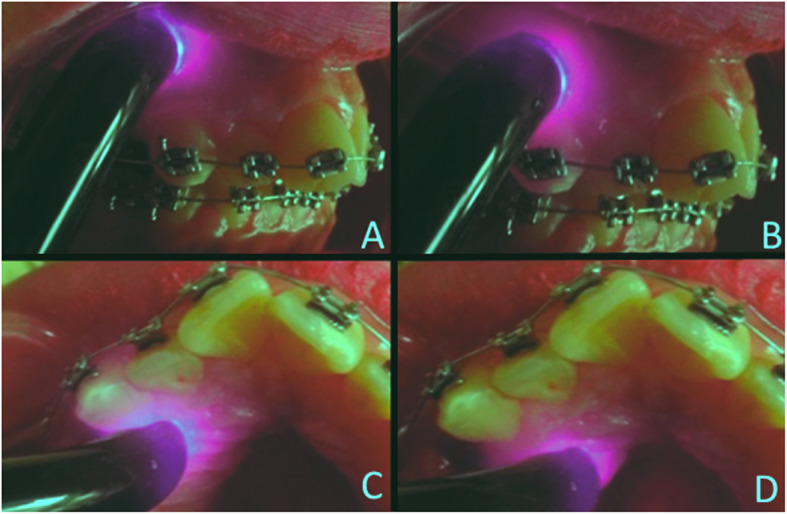
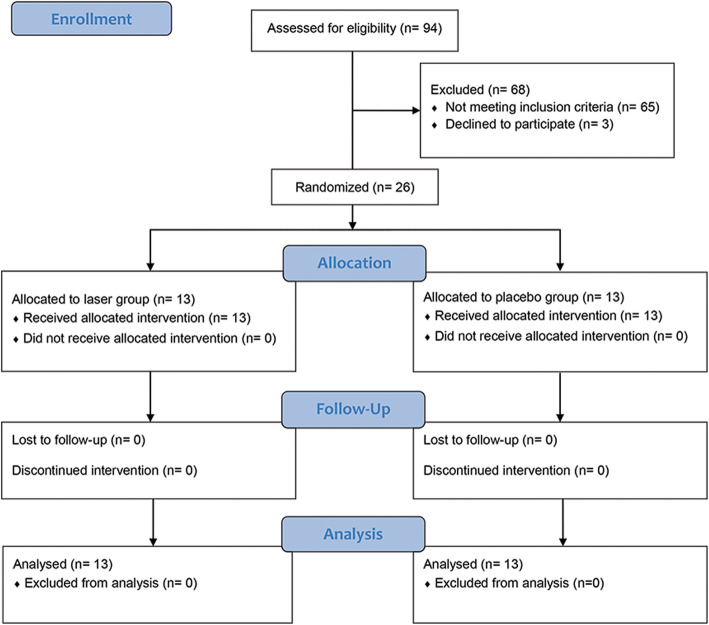
26 patients (mean age 20.07 ± 3.13 years) with maxillary Little's Irregularity Index (LII) of 7 mm or more that indicates first maxillary premolars extraction and no medications intake were eligible for this trial. Patients were randomly assigned with 1:1 ratio using simple randomization technique to receive either LLL or placebo treatment. Blinding was applicable for patients only. In the laser group, patients received a single LLL dose (wavelength 830 nm, energy 2 J/point) in four points (2 buccal, 2 palatal) for each maxillary anterior tooth root. Patients in the placebo group had the same laser application procedure without emitting the laser beam. Patients were asked to score spontaneous and chewing pain intensity by filling out a questionnaire with a 100-mm Visual Analogue Scale (VAS) after 1, 6, 24, 48, and 72 h of treatment application. Independent t-test was used to compare the mean pain scores between the laser and placebo groups for both spontaneous and chewing pain at each studied time point.
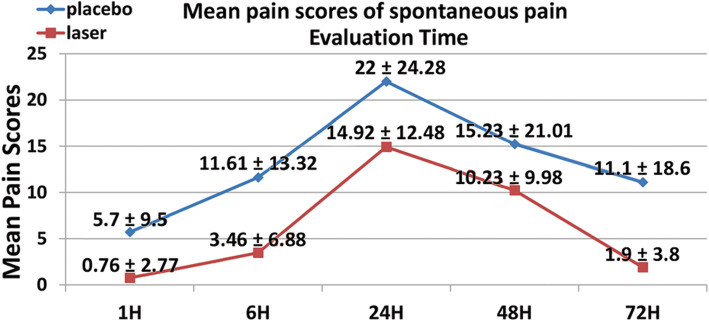
No dropout occurred so the results of the 26 patients were statistically analyzed. Despite some clinical differences observed between the two groups, no statistical significance was found for each studied time point (p > 0.05) for both spontaneous and chewing pain except after 72 h for chewing pain with a VAS score of (18.84 ± 13.44) mm for the laser group compared to (38.15 ± 27.06) mm for the placebo group.
LLLT, with the suggested parameters, is not effective in pain reduction following initial orthodontic archwire placement.
Name of the registry: Clinicaltrials.gov Trial registration number: NCT02568436. Date of registration: 26 September 2015 'Retrospectively registered'.
本随机临床试验的目的是评估低水平激光疗法(LLLT)在初始正畸弓丝放置后减轻自发性和咀嚼疼痛的效果。
符合试验条件的患者为上颌 Little 不调指数(LII)大于或等于 7mm,需拔除第一上颌前磨牙且未服用任何药物的 26 例患者(平均年龄 20.07 ± 3.13 岁)。采用简单随机化技术,以 1:1 的比例将患者随机分为 LLL 或安慰剂治疗组。仅对患者进行盲法。激光组的患者在每颗上颌前牙的四个部位(2 个颊侧,2 个腭侧)接受单次 LLL 剂量(波长 830nm,能量 2J/点)。安慰剂组的患者进行相同的激光应用程序,但不发射激光束。治疗应用后 1、6、24、48 和 72 小时,患者通过填写 100mm 视觉模拟量表(VAS)问卷,评估自发性和咀嚼疼痛强度。采用独立 t 检验比较激光组和安慰剂组在每个研究时间点的自发性和咀嚼疼痛的平均疼痛评分。
无脱落病例,因此对 26 例患者的结果进行了统计学分析。尽管两组之间观察到一些临床差异,但在每个研究时间点(p>0.05),无论是自发性疼痛还是咀嚼疼痛,均未发现统计学意义,除了咀嚼疼痛在 72 小时时,激光组的 VAS 评分为(18.84 ± 13.44)mm,而安慰剂组为(38.15 ± 27.06)mm。
在所建议的参数下,LLLT 不能有效减轻初始正畸弓丝放置后的疼痛。
注册机构名称:Clinicaltrials.gov 试验注册编号:NCT02568436. 注册日期:2015 年 9 月 26 日“回顾性注册”。