Honan Mallory C, Fahey Megan J, Fischer-Tlustos Amanda J, Steele Michael A, Greenwood Sabrina L
Department of Animal and Veterinary Sciences, The University of Vermont, Burlington, VT 05405 USA.
Department of Animal Biosciences, University of Guelph, Guelph, ON N1G 2W1 Canada.
J Anim Sci Biotechnol. 2020 Jul 17;11:81. doi: 10.1186/s40104-020-00478-7. eCollection 2020.
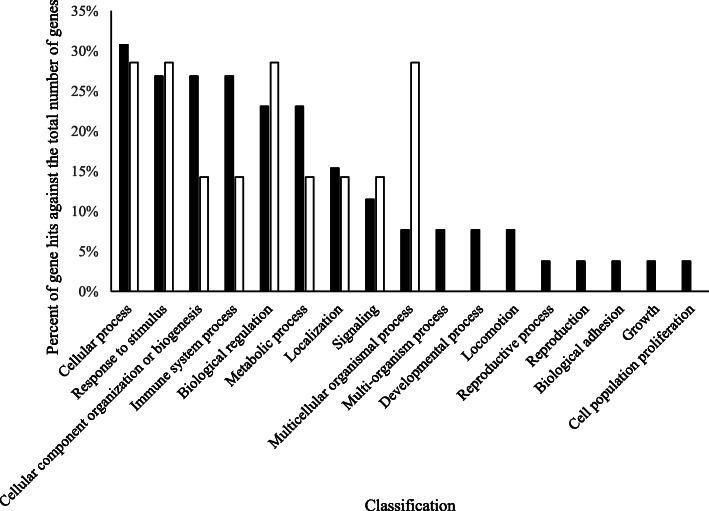
The milk fat globule membrane (MFGM) proteomes of colostrum and transition milk are rich sources of proteins that are likely important for neonatal calf health. In addition, characterization of these proteomes could also yield valuable information regarding mammary gland physiology of the early postpartum lactating cow. The objectives of this research were to characterize the MFGM proteomes of colostrum and transition milk through sample collections at four timepoints postpartum, including the first milking (M1, colostrum), second milking (M2, transition milk), fourth milking (M4, transition milk), and fourteenth milking (M14, mature milk), and compare these proteomes between multiparous (MP; = 10) and primiparous (PP; = 10) Holstein dairy cows. Isolated MFGM proteins were labeled using Tandem Mass tagging and analyzed using liquid chromatography-tandem mass spectrometry (LC-MS/MS). Protein identification was completed using MASCOT and Sequest in Proteome Discoverer 2.2. The scaled abundance values were analyzed using PROC MIXED in SAS to determine the effects of milking (MIL), parity (PAR), and MIL × PAR. The adaptive false-discovery rate (FDR)-adjusted values were determined using PROC MULTTEST. Protein characterization and bioinformatic analysis were completed using a combination of PANTHER, Blast, and Uniprot.
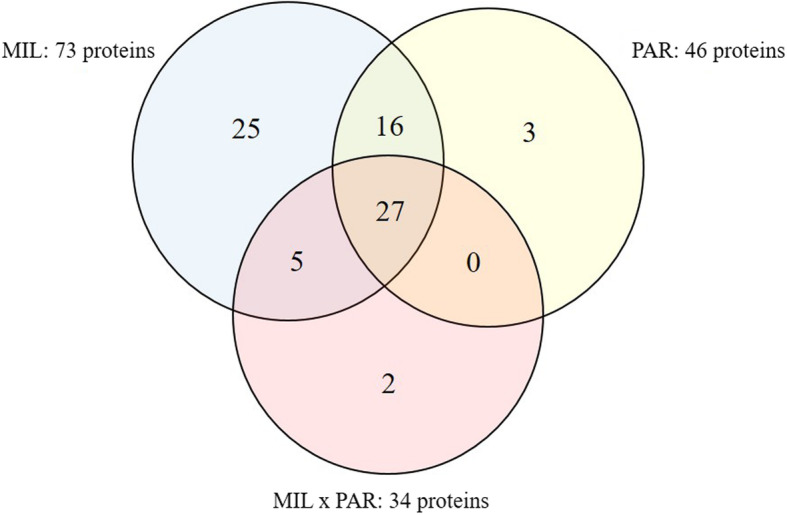
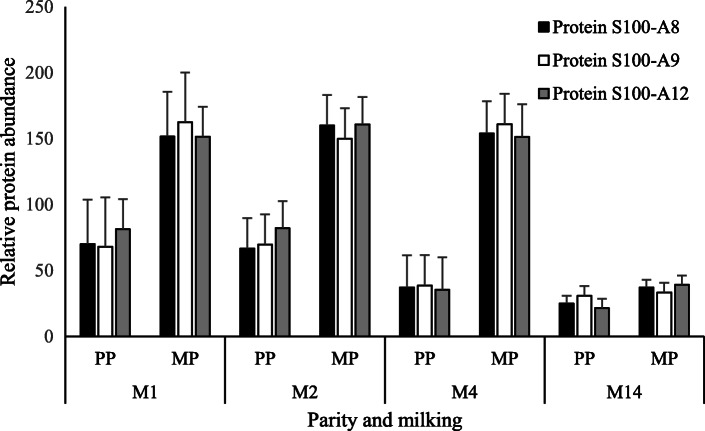
A total of 104 common proteins were identified in each of the MFGM samples. Statistical analysis revealed that 70.2% of identified proteins were affected by MIL. Of these, 78.1% were lower in M14 compared with M1, including immune-related proteins lactotransferrin, lactadherin and hemopexin. Parity affected 44.2% of proteins. Of the proteins affected by PAR, 84.8% were higher in MP cows compared with PP cows, including apolipoprotein E and histones 2A, 2B, 3, and 4 b. Butyrophilin subfamily 1 member 1A and annexin 5 were higher in samples from PP cows. Milking × parity affected 32.7% of identified proteins, including lactotransferrin, gelsolin, vitamin D binding protein, and S100 proteins.
This research supports previous findings that the Holstein MFGM proteome changes rapidly during the first week of lactation. In addition, this research identifies the impact of parity on the colostrum and transition milk MFGM proteomes, which may be important for milk-fed calf health or for the identification of protein biomarkers for mammary functionality.
初乳和过渡乳的乳脂肪球膜(MFGM)蛋白质组富含对新生犊牛健康可能很重要的蛋白质。此外,这些蛋白质组的特征分析也可能产生有关产后早期泌乳奶牛乳腺生理学的有价值信息。本研究的目的是通过在产后四个时间点采集样本,包括第一次挤奶(M1,初乳)、第二次挤奶(M2,过渡乳)、第四次挤奶(M4,过渡乳)和第十四次挤奶(M14,成熟乳),来表征初乳和过渡乳的MFGM蛋白质组,并比较经产(MP;n = 10)和初产(PP;n = 10)荷斯坦奶牛之间的这些蛋白质组。使用串联质量标签对分离的MFGM蛋白质进行标记,并使用液相色谱 - 串联质谱(LC-MS/MS)进行分析。使用Proteome Discoverer 2.2中的MASCOT和Sequest完成蛋白质鉴定。使用SAS中的PROC MIXED分析标准化丰度值,以确定挤奶(MIL)、胎次(PAR)和MIL×PAR的影响。使用PROC MULTTEST确定自适应错误发现率(FDR)调整后的P值。使用PANTHER、Blast和Uniprot的组合完成蛋白质表征和生物信息学分析。
在每个MFGM样本中总共鉴定出104种常见蛋白质。统计分析表明,70.2%的鉴定蛋白质受挤奶影响。其中,与M1相比,M14中78.1%的蛋白质含量较低,包括免疫相关蛋白质乳铁蛋白、乳黏附素和血红素结合蛋白。胎次影响44.2%的蛋白质。在受PAR影响的蛋白质中,与PP奶牛相比,MP奶牛中84.8%的蛋白质含量较高,包括载脂蛋白E和组蛋白2A、2B、3和4b。嗜乳脂蛋白亚家族1成员1A和膜联蛋白5在PP奶牛的样本中含量较高。挤奶×胎次影响32.7%的鉴定蛋白质,包括乳铁蛋白、凝溶胶蛋白、维生素D结合蛋白和S100蛋白。
本研究支持先前的发现,即荷斯坦MFGM蛋白质组在泌乳第一周内变化迅速。此外,本研究确定了胎次对初乳和过渡乳MFGM蛋白质组的影响,这可能对以牛奶喂养的犊牛健康或乳腺功能的蛋白质生物标志物的鉴定很重要。