Tao Zhonghua, Li Ting, Feng Zhe, Liu Chang, Shao Yilin, Zhu Mingyu, Gong Chengcheng, Wang Biyun, Cao Jun, Wang Leipin, Du Yiqun, Lizaso Analyn, Li Bing, Zhang Jian, Hu Xichun
Department of Medical Oncology, Fudan University Shanghai Cancer Center, Shanghai, China.
Department of Oncology, Shanghai Medical College, Fudan University, Shanghai, China.
Front Oncol. 2020 Jun 30;10:1023. doi: 10.3389/fonc.2020.01023. eCollection 2020.
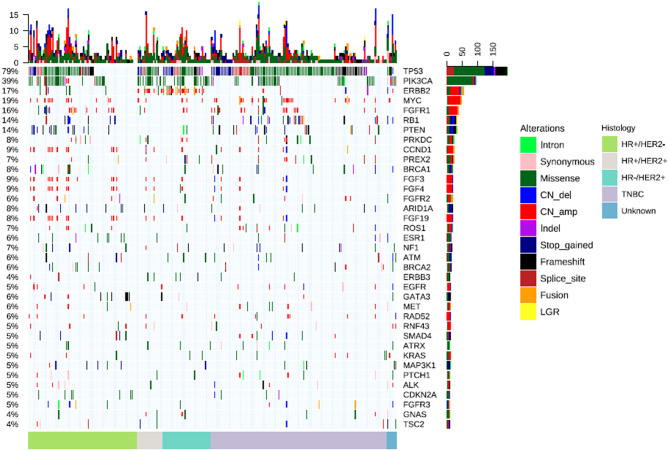
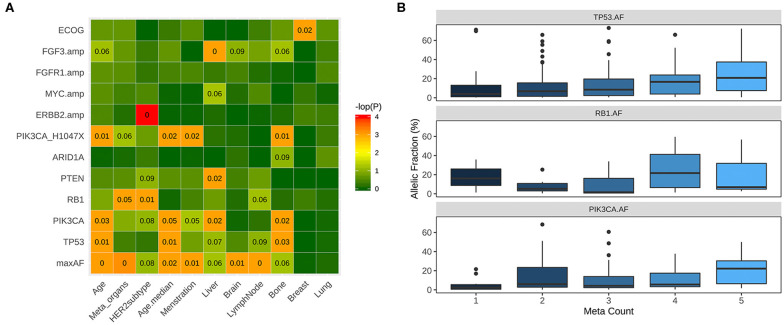
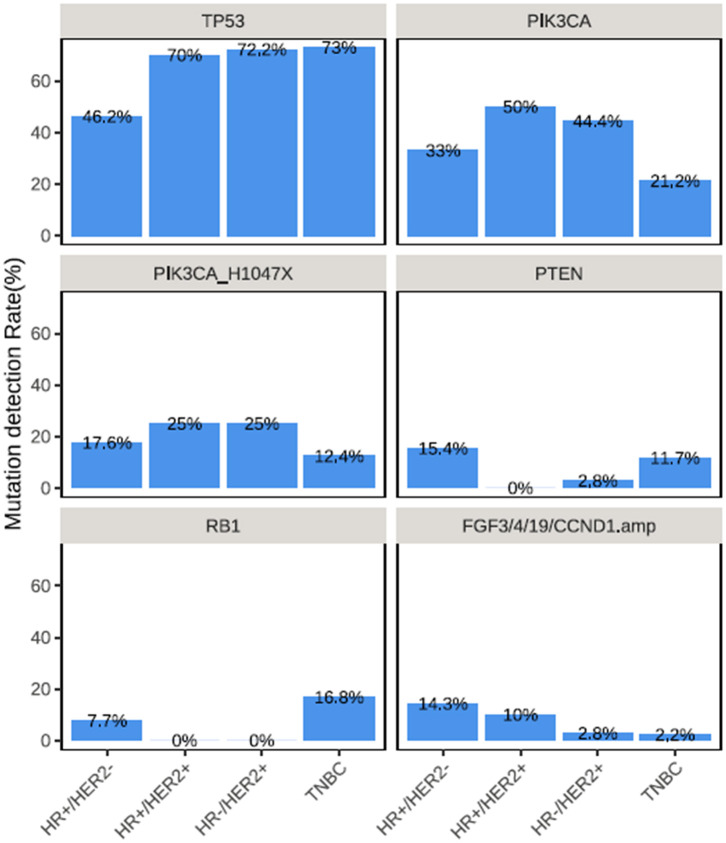
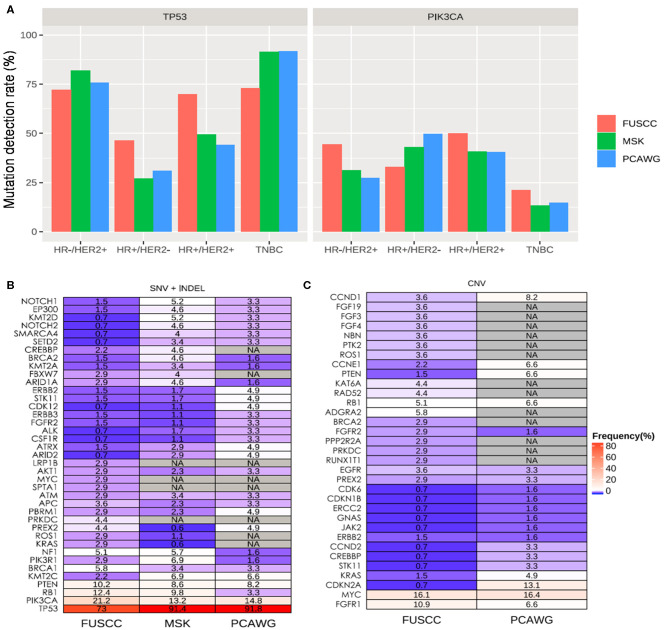
Breast cancer (BC) is a type of disease with high heterogeneity. Molecular profiling, by revealing the intrinsic nature of its various subtypes, has extensively improved the therapeutic management of BC patients. However, the genomic mutation landscape of Chinese metastatic BC has not been fully explored. Matched plasma and mononuclear cells from 290 Chinese women with metastatic BC were sequenced using either of the two commercially-available panels consisting of 520 cancer-related and 108 BC-related genes. Both panels cover the same critical regions of 91 genes. The circulating tumor DNA mutation profile from our cohort was then compared with publicly-available metastatic BC datasets from Memorial Sloan Kettering Cancer Center (MSKCC) and Pan-cancer analysis of whole genomes (PCAWG). A total of 1,201 mutations spanning 91 genes were detected from 234 patients, resulting in a mutation detection rate of 80.7%. TP53 (64.1%) was the gene with highest mutation frequency, followed by PIK3CA (31%), PTEN (11%), and RB1 (10%). Copy number amplifications (CNAs) in MYC (14.1%), FGFR1 (13.3%), CCND1 (6.6%), FGF3 (6.6%), FGF4 (6.2%) and FGF19 (6.2%) were also detected from our cohort. TP53 mutations were significantly more frequent among triple negative BC (TNBC), HR-/HER2+, and HR+/HER2+ BC, while less common in HR+/HER2- ( < 0.01). Meanwhile, PIK3CA mutations were significantly more frequent among HR+/HER2+, HR+/HER2-, and HR-/HER2+ BC, while less common in TNBC ( < 0.01). Pathogenic or likely pathogenic BRCA1/2 germline mutations were detected in 5.9% of the cohort and 4.4% in TNBC subgroup. Maximum allelic fraction (maxAF) of TP53, RB1, and PIK3CA mutations were associated with multiple organ metastasis. Patients with PIK3CA, PTEN, and RB1 mutation were more likely to have liver metastasis ( < 0.02). Compared with MSKCC and PCAWG dataset, Chinese patients had observably difference in genetic variation rates in different molecular subtypes (TNBC: TP53 73.0 vs. 91.5%, < 0.001; PIK3CA 21.2 vs. 13.2%, = 0.061; HR+/HER2-: FGFR1 3.3 vs. 0.7%, = 0.035; TP 53 46.2 vs. 27.7%, < 0.001; RB1 6.6 vs. 2.7%, = 0.046; CDKN2A 7.7 vs. 1.0%, < 0.001; PIK3CA 30.8 vs. 44.2%, = 0.012; CDH1 1.1 vs. 18.2%, < 0.001; GATA3 7.7 vs. 17.2%, = 0.02). A distinct gene mutation profile was elucidated in Chinese women with metastatic BC, justifying further research. Liquid biopsy provides a quick, real-time, and minimally invasive tool for future clinical trial and routine practice.
乳腺癌(BC)是一种具有高度异质性的疾病。分子谱分析通过揭示其各种亚型的内在本质,极大地改善了BC患者的治疗管理。然而,中国转移性BC的基因组突变格局尚未得到充分探索。对290名中国转移性BC女性患者的配对血浆和单核细胞,使用由520个癌症相关基因和108个BC相关基因组成的两种商用检测板之一进行测序。两种检测板都覆盖了91个基因的相同关键区域。然后将我们队列中的循环肿瘤DNA突变谱与纪念斯隆凯特琳癌症中心(MSKCC)和全基因组泛癌分析(PCAWG)公开的转移性BC数据集进行比较。从234名患者中检测到91个基因的总共1201个突变,突变检测率为80.7%。TP53(64.1%)是突变频率最高的基因,其次是PIK3CA(31%)、PTEN(11%)和RB1(10%)。在我们的队列中还检测到MYC(14.1%)、FGFR1(13.3%)、CCND1(6.6%)、FGF3(6.6%)、FGF4(6.2%)和FGF19(6.2%)的拷贝数扩增(CNA)。TP53突变在三阴性乳腺癌(TNBC)、HR-/HER2+和HR+/HER2+ BC中明显更常见,而在HR+/HER2-中较少见(<0.01)。同时,PIK3CA突变在HR+/HER2+、HR+/HER2-和HR-/HER2+ BC中明显更常见,而在TNBC中较少见(<0.01)。在5.9%的队列和TNBC亚组的4.4%中检测到致病性或可能致病性的BRCA1/2种系突变。TP53、RB1和PIK3CA突变的最大等位基因分数(maxAF)与多器官转移相关。PIK3CA、PTEN和RB1突变的患者更有可能发生肝转移(<0.02)。与MSKCC和PCAWG数据集相比,中国患者在不同分子亚型中的基因变异率存在明显差异(TNBC:TP53 73.0%对91.5%,<0.001;PIK3CA 21.2%对13.2%,=0.061;HR+/HER2-:FGFR1 3.3%对0.7%,=0.035;TP 53 46.2%对27.7%,<0.001;RB1 6.6%对2.7%,=0.046;CDKN2A 7.7%对1.0%,<0.001;PIK3CA 30.8%对44.2%,=0.012;CDH1 1.1%对18.2%,<0.001;GATA3 7.7%对17.2%,=0.02)。在中国转移性BC女性中阐明了独特的基因突变谱,值得进一步研究。液体活检为未来的临床试验和常规实践提供了一种快速、实时且微创的工具。