Khattak Muhammad A, Abed Afaf, Reid Anna L, McEvoy Ashleigh C, Millward Michael, Ziman Melanie, Gray Elin S
Department of Medical Oncology, Fiona Stanley Hospital, Murdoch, WA, Australia.
School of Medical and Health Sciences, Edith Cowan University, Perth, WA, Australia.
Front Oncol. 2020 Jun 30;10:1041. doi: 10.3389/fonc.2020.01041. eCollection 2020.
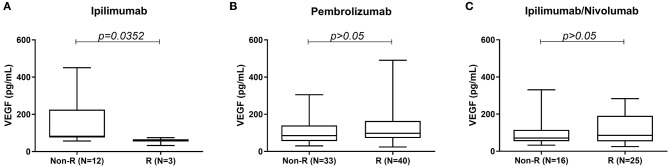
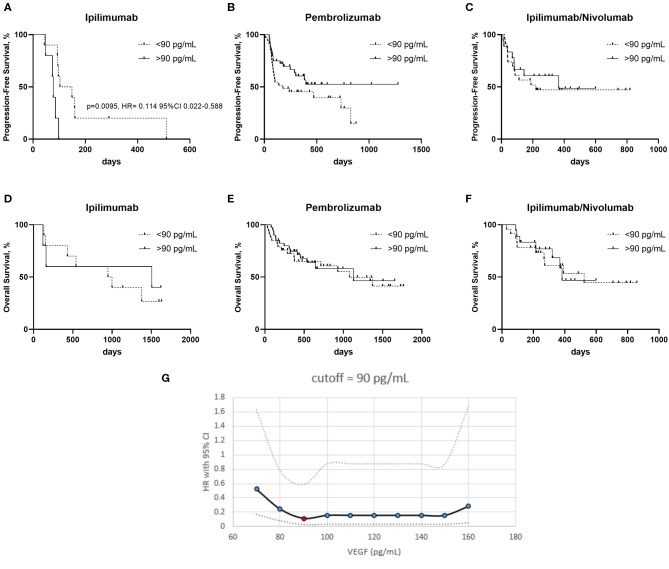
The development of biomarkers predictive of response to immune checkpoint inhibitor (ICI) therapies in advanced melanoma is an area of great interest in oncology. Our study evaluated the potential role of serum vascular endothelial growth factor (VEGF) as a predictive biomarker of clinical benefit and response to treatment with ICIs. Pre-treatment peripheral blood samples were obtained from advanced melanoma patients undergoing ICI therapy as monotherapy or in combination at two tertiary care hospitals in Western Australia. Serum VEGF levels were correlated with response to therapy and survival outcomes. Serum VEGF samples were collected from a total of 130 patients treated with ICI therapy (pembrolizumab 73, ipilimumab 15, and ipilimumab/nivolumab combination 42). Median serum VEGF level was significantly higher in the non-responders (82.15 pg/mL) vs. responders (60.40 pg/mL) in the ipilimumab monotherapy cohort ( < 0.0352). However, no difference was seen in VEGF levels between non-responders and responders in pembrolizumab and ipilimumab/nivolumab treated patients. The results of our study confirm previous observations that that high pre-treatment serum VEGF levels in advanced melanoma patients may predict poor response to ipilimumab. However, serum VEGF is not predictive of outcome in patients treated with anti-PD-1 agents alone or in combination with ipilimumab.
在晚期黑色素瘤中,开发可预测免疫检查点抑制剂(ICI)疗法疗效的生物标志物是肿瘤学领域备受关注的一个方面。我们的研究评估了血清血管内皮生长因子(VEGF)作为临床获益和ICI治疗反应预测生物标志物的潜在作用。从西澳大利亚州两家三级护理医院接受ICI单药治疗或联合治疗的晚期黑色素瘤患者中获取治疗前外周血样本。血清VEGF水平与治疗反应和生存结果相关。共收集了130例接受ICI治疗患者的血清VEGF样本(帕博利珠单抗73例、伊匹木单抗15例、伊匹木单抗/纳武利尤单抗联合治疗42例)。在伊匹木单抗单药治疗队列中,无反应者的血清VEGF水平中位数(82.15 pg/mL)显著高于反应者(60.40 pg/mL)(P<0.0352)。然而,在接受帕博利珠单抗和伊匹木单抗/纳武利尤单抗治疗的患者中,无反应者和反应者之间的VEGF水平未见差异。我们的研究结果证实了先前的观察结果,即晚期黑色素瘤患者治疗前血清VEGF水平高可能预示对伊匹木单抗反应不佳。然而,血清VEGF不能预测单独使用抗PD-1药物或与伊匹木单抗联合使用患者的治疗结果。