Division of Primary Care, School of Medicine, University of Nottingham, Nottingham, United Kingdom.
Division of Psychiatry and Applied Psychology, School of Medicine, University of Nottingham, Nottingham, United Kingdom.
PLoS Med. 2020 Jul 22;17(7):e1003215. doi: 10.1371/journal.pmed.1003215. eCollection 2020 Jul.
The use of antidepressants in children and adolescents remains controversial. We examined trends over time and variation in antidepressant prescribing in children and young people in England and whether the drugs prescribed reflected UK licensing and guidelines.
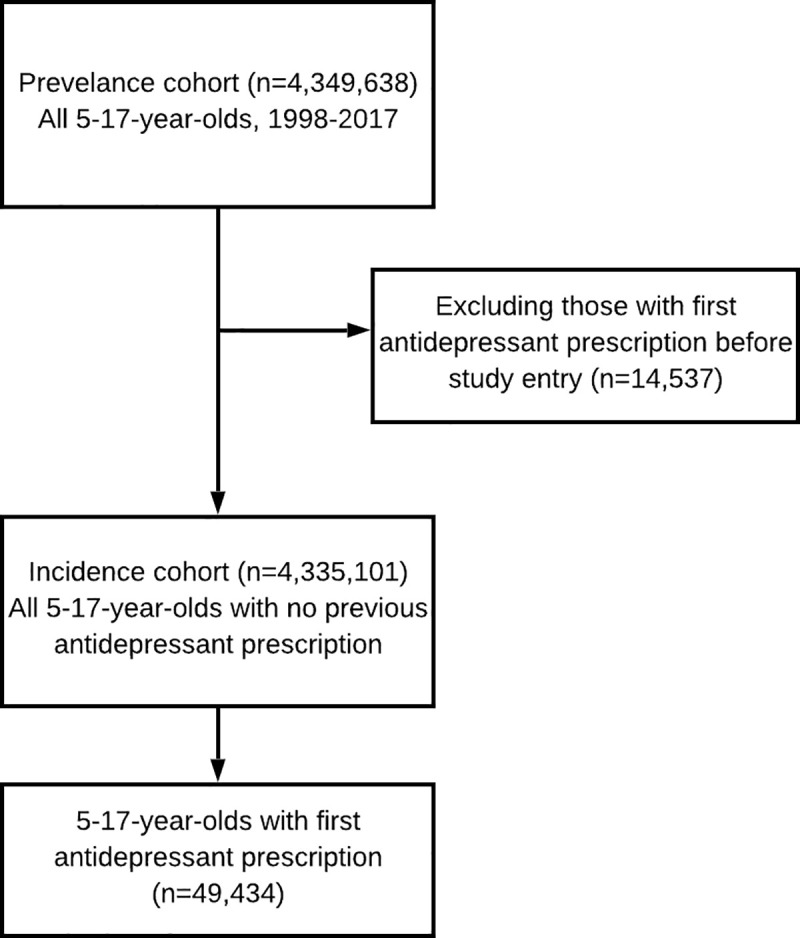
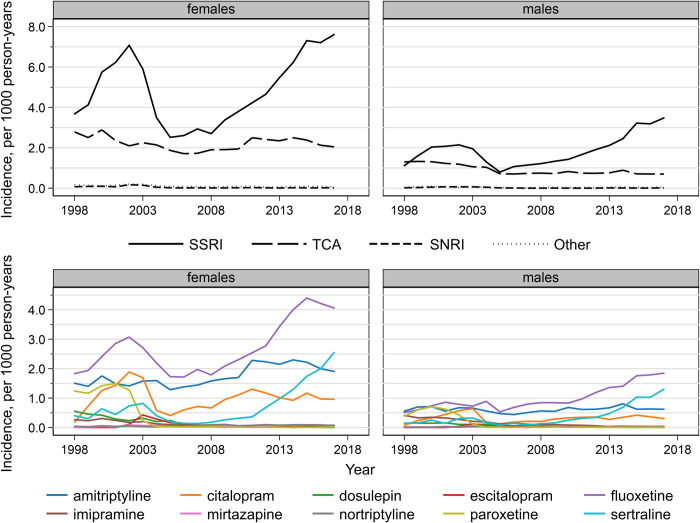
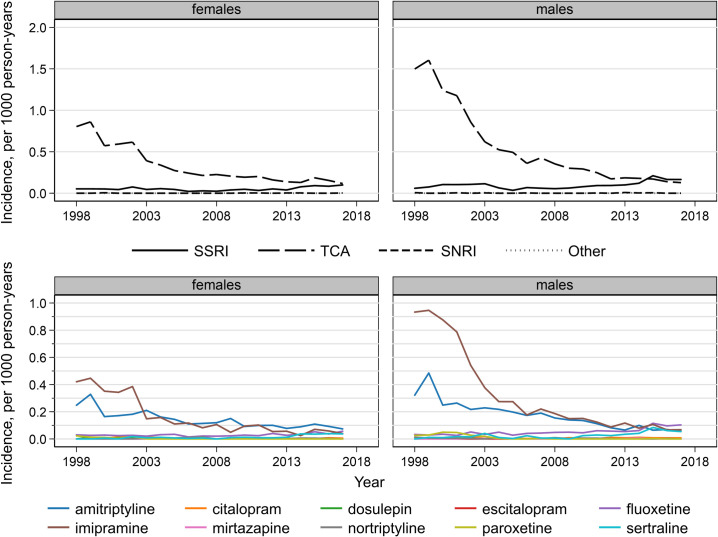
QResearch is a primary care database containing anonymised healthcare records of over 32 million patients from more than 1,500 general practices across the UK. All eligible children and young people aged 5-17 years in 1998-2017 from QResearch were included. Incidence and prevalence rates of antidepressant prescriptions in each year were calculated overall, for 4 antidepressant classes (selective serotonin reuptake inhibitors [SSRIs], tricyclic and related antidepressants [TCAs], serotonin and norepinephrine reuptake inhibitors [SNRIs], and other antidepressants), and for individual drugs. Adjusted trends over time and differences by social deprivation, region, and ethnicity were examined using Poisson regression, taking clustering within general practitioner (GP) practices into account using multilevel modelling. Of the 4.3 million children and young people in the cohort, 49,434 (1.1%) were prescribed antidepressants for the first time during 20 million years of follow-up. Males made up 52.0% of the cohorts, but only 34.1% of those who were first prescribed an antidepressant in the study period. The largest proportion of the cohort was from London (24.4%), and whilst ethnicity information was missing for 39.5% of the cohort, of those with known ethnicity, 75.3% were White. Overall, SSRIs (62.6%) were the most commonly prescribed first antidepressant, followed by TCAs (35.7%). Incident antidepressant prescribing decreased in 5- to 11-year-olds from a peak of 0.9 in females and 1.6 in males in 1999 to less than 0.2 per 1,000 for both sexes in 2017, but incidence rates more than doubled in 12- to 17-year-olds between 2005 and 2017 to 9.7 (females) and 4.2 (males) per 1,000 person-years. The lowest prescription incidence rates were in London, and the highest were in the South East of England (excluding London) for all sex and age groups. Those living in more deprived areas were more likely to be prescribed antidepressants after adjusting for region. The strongest trend was seen in 12- to 17-year-old females (adjusted incidence rate ratio [aIRR] 1.12, 95% confidence interval [95% CI] 1.11-1.13, p < 0.001, per deprivation quintile increase). Prescribing rates were highest in White and lowest in Black adolescents (aIRR 0.32, 95% CI 0.29-0.36, p < 0.001 [females]; aIRR 0.32, 95% CI 0.27-0.38, p < 0.001 [males]). The 5 most commonly prescribed antidepressants were either licensed in the UK for use in children and young people (CYP) or included in national guidelines. Limitations of the study are that, because we did not have access to secondary care prescribing information, we may be underestimating the prevalence and misidentifying the first antidepressant prescription. We could not assess whether antidepressants were dispensed or taken.
Our analysis provides evidence of a continuing rise of antidepressant prescribing in adolescents aged 12-17 years since 2005, driven by SSRI prescriptions, but a decrease in children aged 5-11 years. The variation in prescribing by deprivation, region, and ethnicity could represent inequities. Future research should examine whether prescribing trends and variation are due to true differences in need and risk factors, access to diagnosis or treatment, prescribing behaviour, or young people's help-seeking behaviour.
儿童和青少年使用抗抑郁药仍然存在争议。我们研究了英国儿童和青少年抗抑郁药处方的时间趋势和变化,以及所开药物是否反映了英国的许可和指南。
QResearch 是一个初级保健数据库,包含来自英国 1500 多家普通诊所的超过 3200 万患者的匿名医疗记录。在 1998 年至 2017 年期间,QResearch 中的所有符合条件的 5-17 岁儿童和青少年都包括在内。在每个年份计算了抗抑郁药处方的发生率和患病率,并按 4 种抗抑郁药类别(选择性 5-羟色胺再摄取抑制剂 [SSRIs]、三环和相关抗抑郁药 [TCAs]、5-羟色胺和去甲肾上腺素再摄取抑制剂 [SNRIs] 和其他抗抑郁药)以及个别药物进行了计算。使用泊松回归检查了随时间的调整趋势和社会剥夺、地区和种族的差异,考虑了普通医生(GP)实践中的聚类,使用多水平模型进行了分析。在队列中的 430 万儿童和青少年中,有 49434 人(1.1%)在 2000 万年的随访期间首次开了抗抑郁药。男性占队列的 52.0%,但在研究期间首次开抗抑郁药的比例仅为 34.1%。队列中最大的一部分来自伦敦(24.4%),虽然 39.5%的队列的种族信息缺失,但已知种族的人中,有 75.3%是白人。总的来说,SSRIs(62.6%)是最常开的第一种抗抑郁药,其次是 TCAs(35.7%)。5-11 岁儿童的抗抑郁药处方发生率从 1999 年女性的峰值 0.9 和男性的 1.6 降至 2017 年的男女均低于 0.2/1000,但 2005 年至 2017 年期间,12-17 岁儿童的发病率增加了一倍以上,达到 9.7(女性)和 4.2(男性)/1000 人年。处方发生率最低的是伦敦,在英格兰东南部(不包括伦敦),所有性别和年龄组的发生率最高。在调整了地区因素后,生活在贫困地区的人更有可能开抗抑郁药。最强的趋势出现在 12-17 岁的女性中(调整后的发病率比 [aIRR] 1.12,95%置信区间 [95%CI] 1.11-1.13,p < 0.001,每增加一个贫困五分位数)。在白人和黑人青少年中,开处方的比例最高和最低(aIRR 0.32,95%CI 0.29-0.36,p < 0.001 [女性];aIRR 0.32,95%CI 0.27-0.38,p < 0.001 [男性])。最常开的 5 种抗抑郁药在英国均有儿童和青少年(CYP)使用许可,或列入国家指南。研究的局限性在于,由于我们无法获得二级保健处方信息,因此我们可能低估了患病率并错误地确定了首次抗抑郁药处方。我们无法评估抗抑郁药是否被配药或服用。
我们的分析提供了证据,表明自 2005 年以来,12-17 岁青少年的抗抑郁药处方持续上升,主要是 SSRIs 处方,但 5-11 岁儿童的处方数量下降。按贫困程度、地区和种族划分的处方差异可能代表不平等。未来的研究应该研究处方趋势和差异是否是由于真正的需求和风险因素、获得诊断或治疗的机会、处方行为或年轻人寻求帮助的行为的差异造成的。