Department of Fibre and Polymer Technology, School of Engineering Sciences in Chemistry, Biotechnology and Health, KTH Royal Institute of Technology, Teknikringen 56, 100 44 Stockholm, Sweden.
Biomolecules. 2020 Jul 20;10(7):1077. doi: 10.3390/biom10071077.
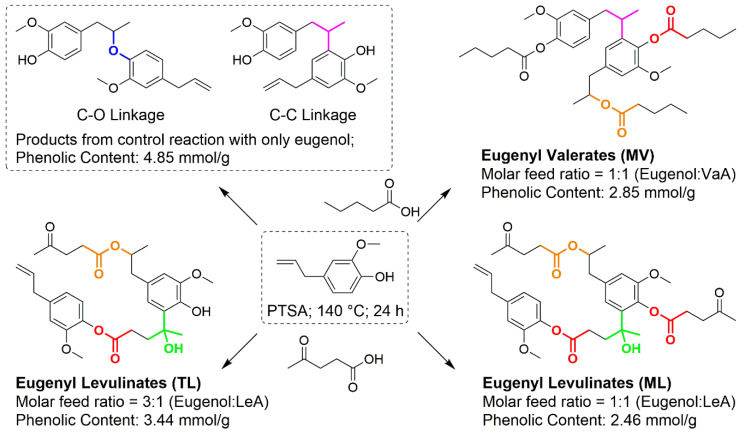
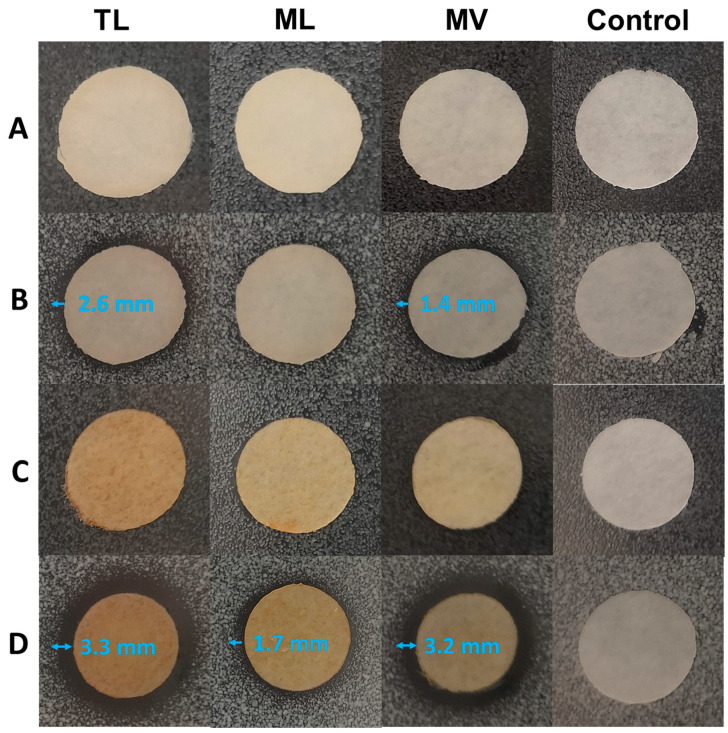
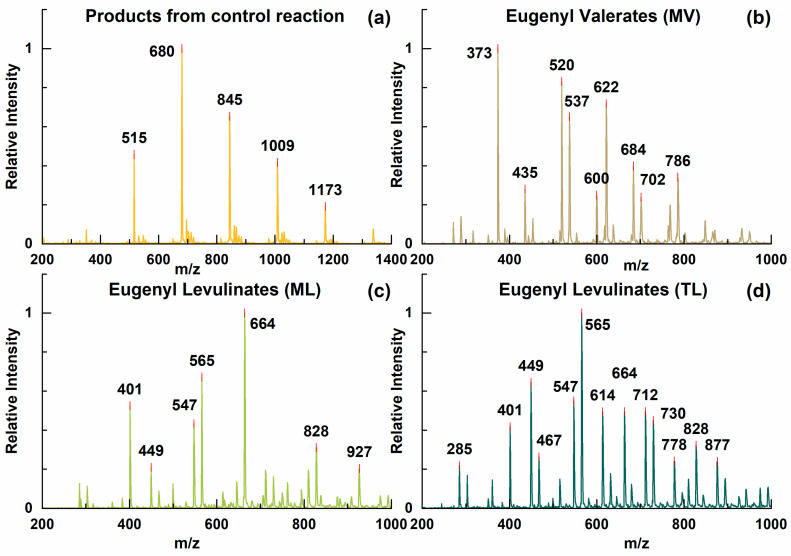
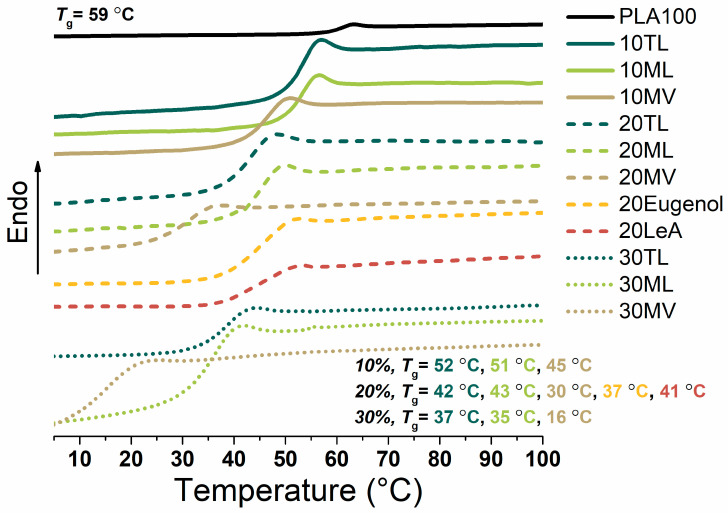
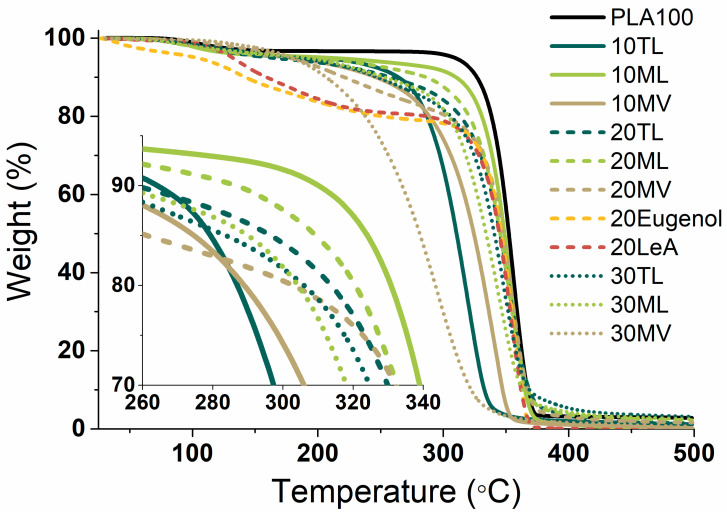
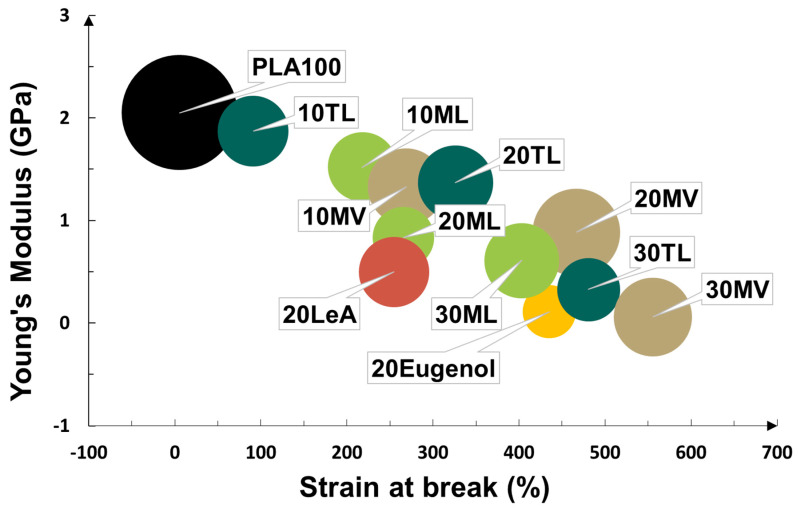
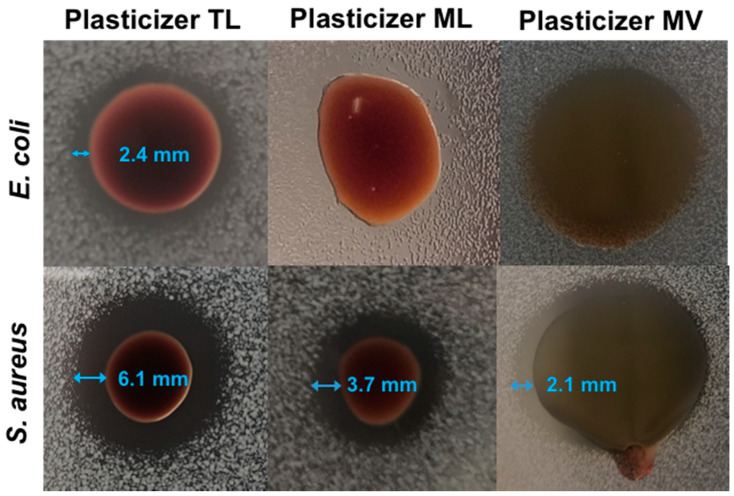
Dual-functioning additives with plasticizing and antibacterial functions were designed by exploiting the natural aromatic compound eugenol and green platform chemical levulinic acid or valeric acid that can be produced from biobased resources. One-pot synthesis methodology was utilized to create three ester-rich plasticizers. The plasticizers were thoroughly characterized by several nuclear magnetic resonance techniques (H NMR, C NMR, P NMR, HSQC, COSY, HMBC) and by electrospray ionization-mass spectrometry (ESI-MS) and their performances, as plasticizers for polylactide (PLA), were evaluated. The eugenyl valerate was equipped with a strong capability to depress the glass transition temperature () of PLA. Incorporating 30 wt% plasticizer led to a reduction of the by 43 °C. This was also reflected by a remarkable change in mechanical properties, illustrated by a strain at break of 560%, almost 110 times the strain for the breaking of neat PLA. The two eugenyl levulinates also led to PLA with significantly increased strain at breaking. The eugenyl levulinates portrayed higher thermal stabilities than eugenyl valerate, both neat and in PLA blends. The different concentrations of phenol, carboxyl and alcohol functional groups in the three plasticizers caused different bactericidal activities. The eugenyl levulinate with the highest phenol-, carboxyl- and alcohol group content significantly inhibited the growth of and , while the other two plasticizers could only inhibit the growth of . Thus, the utilization of eugenol as a building block in plasticizer design for PLA illustrated an interesting potential for production of additives with dual functions, being both plasticizers and antibacterial agents.
设计了具有增塑和抗菌功能的双功能添加剂,利用天然芳香化合物丁香酚和绿色平台化学品乙酰丙酸或戊酸,这些物质可以从生物基资源中生产。采用一锅合成方法合成了三种酯含量丰富的增塑剂。通过几种核磁共振技术(H NMR、C NMR、P NMR、HSQC、COSY、HMBC)和电喷雾电离质谱(ESI-MS)对增塑剂进行了彻底的表征,并评估了它们作为聚乳酸(PLA)增塑剂的性能。丁香酚戊酸酯具有很强的降低 PLA 玻璃化转变温度(Tg)的能力。加入 30wt%的增塑剂可使 Tg 降低 43°C。这也反映在机械性能的显著变化上,表现为断裂伸长率增加了 560%,几乎是纯 PLA 断裂伸长率的 110 倍。两种丁香酚乙酰丙酸酯也使 PLA 的断裂伸长率显著增加。与丁香酚戊酸酯相比,两种丁香酚乙酰丙酸酯的纯态和 PLA 共混物的热稳定性都更高。三种增塑剂中不同浓度的酚、羧基和醇官能团导致了不同的杀菌活性。三种增塑剂中酚、羧基和醇基含量最高的丁香酚乙酰丙酸酯显著抑制了 和 的生长,而其他两种增塑剂只能抑制 的生长。因此,将丁香酚用作 PLA 增塑剂设计中的构建块,展示了生产具有增塑和抗菌双重功能添加剂的有趣潜力。