University of Duisburg-Essen Faculty of Chemistry Universitätsstr. 7 45117 Essen Germany.
ChemistryOpen. 2020 Jun 4;9(6):667-682. doi: 10.1002/open.201900367. eCollection 2020 Jun.
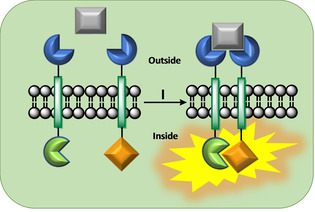
Communication between and inside cells as well as their response to external stimuli relies on elaborated systems of signal transduction. They all require a directional transmission across membranes, often realized by primary messenger docking onto external receptor units and subsequent internalization of the signal in form of a released second messenger. This in turn starts a cascade of events which ultimately control all functions of the living cell. Although signal transduction is a fundamental biological process realized by supramolecular recognition and multiplication events with small molecules, chemists have just begun to invent artificial models which allow to study the underlying rules, and one day perhaps to rescue damaged transduction systems in nature. This review summarizes the exciting pioneering efforts of chemists to create simple models for the basic principles of signal transduction across a membrane. It starts with first attempts to establish molecular recognition events on liposomes with embedded receptor amphiphiles and moves on to simple transmembrane signaling across lipid bilayers. More elaborated systems step by step incorporate more elements of cell signaling, such as primary and secondary messenger or a useful cellular response such as cargo release.
细胞之间和细胞内部的通讯以及它们对外界刺激的反应依赖于精细的信号转导系统。这些都需要跨膜的定向传输,通常通过主要信使与外部受体单元对接,并随后以释放的第二信使的形式内化信号来实现。这反过来又引发了一系列事件,最终控制着活细胞的所有功能。尽管信号转导是一种由超分子识别和小分子的增殖事件实现的基本生物学过程,但化学家才刚刚开始发明人工模型,这些模型可以研究潜在的规则,并有朝一日也许可以挽救自然界中受损的转导系统。这篇综述总结了化学家在创建简单模型以研究跨膜信号转导基本原理方面令人兴奋的开创性工作。它首先从在嵌入受体两亲体的脂质体上建立分子识别事件的最初尝试开始,然后进展到简单的跨膜脂质双层信号传递。更精细的系统逐步纳入更多的细胞信号元件,例如初级和次级信使或有用的细胞反应,如货物释放。