Department of Cell Toxicology, Helmholtz Centre for Environmental Research - UFZ, Leipzig, Germany.
Environmental Toxicology, Center for Applied Geoscience, Eberhard Karls University Tübingen, Tübingen, Germany.
Environ Health Perspect. 2020 Jul;128(7):77007. doi: 10.1289/EHP6664. Epub 2020 Jul 23.
High-throughput screening of chemicals with reporter gene assays in Tox21 has produced a large database on cytotoxicity and specific modes of action. However, the validity of some of the reported activities is questionable due to the "cytotoxicity burst," which refers to the supposition that many stress responses are activated in a nonspecific way at concentrations close to cell death.
We propose a pragmatic method to identify whether reporter gene activation is specific or cytotoxicity-triggered by comparing the measured effects with baseline toxicity.
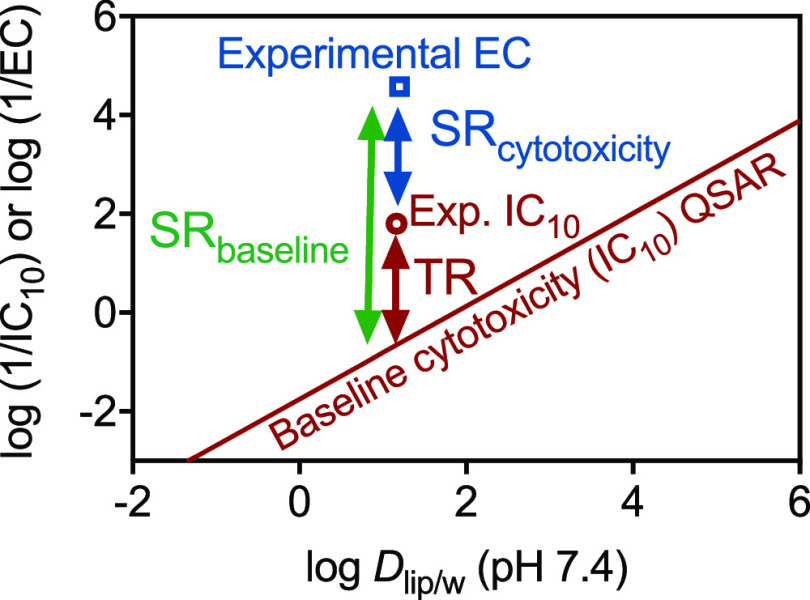
Baseline toxicity, also termed narcosis, is the minimal toxicity any chemical causes. Quantitative structure-activity relationships (QSARs) developed for baseline toxicity in mammalian reporter gene cell lines served as anchors to define the chemical-specific threshold for the cytotoxicity burst and to evaluate the degree of specificity of the reporter gene activation. Measured 10% effect concentrations were related to measured or QSAR-predicted 10% cytotoxicity concentrations yielding specificity ratios (SR). We applied this approach to our own experimental data and to chemicals that were tested in six of the high-throughput Tox21 reporter gene assays.
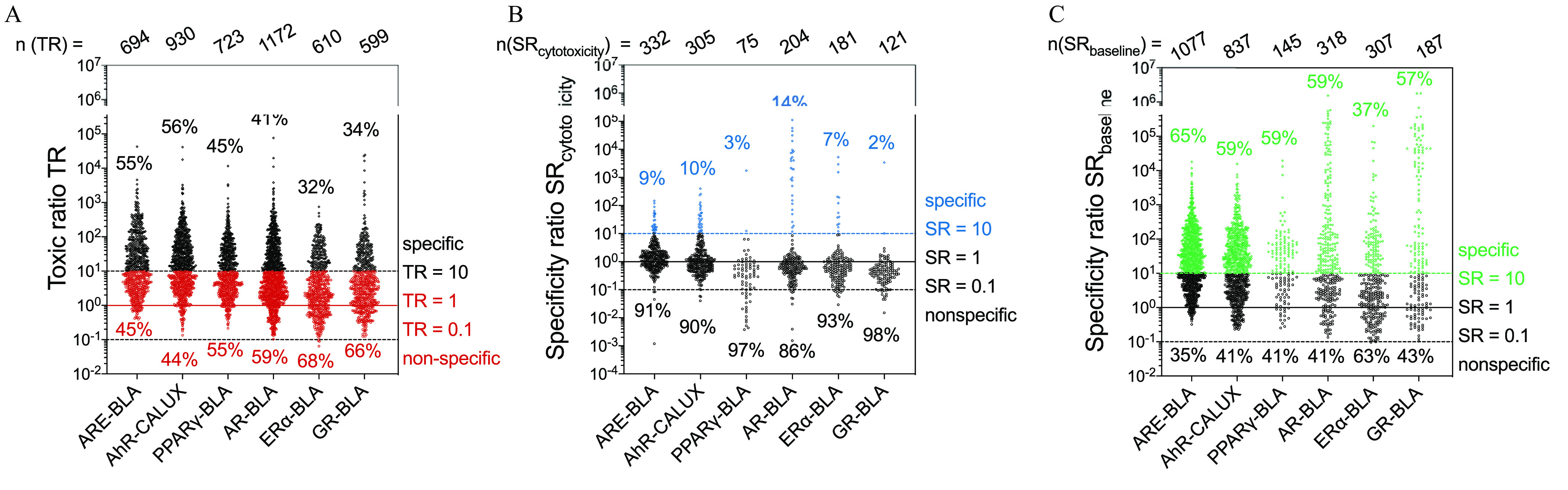
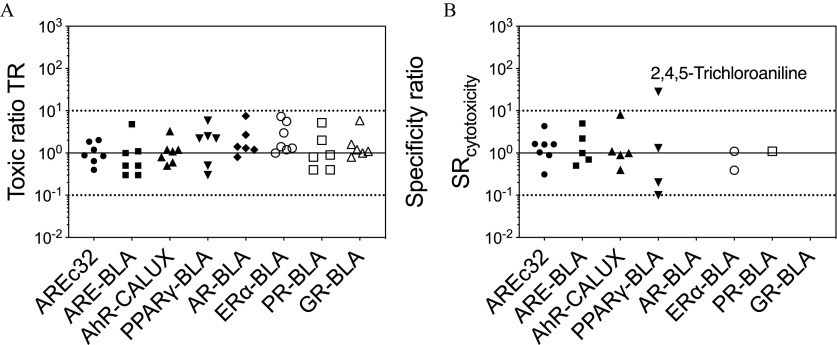
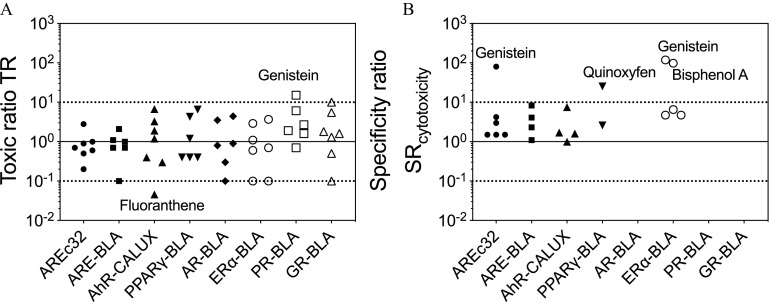
Confirmed baseline toxicants activated reporter gene activity around cytotoxic concentrations triggered by the cytotoxicity burst. In six Tox21 assays, 37%-87% of the active hits were presumably caused by the cytotoxicity burst () and only 2%-14% were specific with against experimental cytotoxicity but 75%-97% were specific against baseline toxicity. This difference was caused by a large fraction of chemicals showing excess cytotoxicity.
The specificity analysis for measured effects identified whether a cytotoxicity burst had likely occurred. The SR-analysis not only prevented false positives, but it may also serve as measure for relative effect potency and can be used for quantitative extrapolation and risk assessment of chemicals. https://doi.org/10.1289/EHP6664.
利用 Tox21 中的报告基因检测进行高通量筛选化学品,已经产生了大量关于细胞毒性和特定作用模式的数据库。然而,由于“细胞毒性爆发”,一些报告的活性的有效性值得怀疑,“细胞毒性爆发”是指在接近细胞死亡的浓度下,许多应激反应会以非特异性的方式被激活的假设。
我们提出了一种实用的方法,通过将测量的效应与基线毒性进行比较,来确定报告基因的激活是特异性的还是由细胞毒性触发的。
基线毒性,也称为麻醉,是任何化学物质引起的最小毒性。在哺乳动物报告基因细胞系中开发的用于基线毒性的定量构效关系(QSAR)作为锚点,用于定义细胞毒性爆发的化学特异性阈值,并评估报告基因激活的特异性程度。测量的 10%效应浓度与测量的或 QSAR 预测的 10%细胞毒性浓度相关,得出特异性比值(SR)。我们将这种方法应用于我们自己的实验数据和在六个高通量 Tox21 报告基因检测中测试的化学品。
确认的基线毒物在细胞毒性爆发引发的细胞毒性浓度周围激活了报告基因活性。在六个 Tox21 检测中,37%-87%的活性命中化合物可能是由细胞毒性爆发引起的,而只有 2%-14%是特异性的,与实验细胞毒性相比,但 75%-97%是特异性的与基线毒性相比。这种差异是由于大量的化学品显示出过度的细胞毒性。
对测量的效应进行特异性分析可以确定是否发生了细胞毒性爆发。SR 分析不仅可以防止假阳性,还可以作为相对效应强度的度量,并可用于化学品的定量外推和风险评估。https://doi.org/10.1289/EHP6664.