Department of Urology, Kaohsiung Chang Gung Memorial Hospital and Chang Gung University College of Medicine, Kaohsiung, Taiwan.
College of Medicine, Kaohsiung Medical University, Kaohsiung, Taiwan.
PLoS One. 2020 Jul 23;15(7):e0236026. doi: 10.1371/journal.pone.0236026. eCollection 2020.
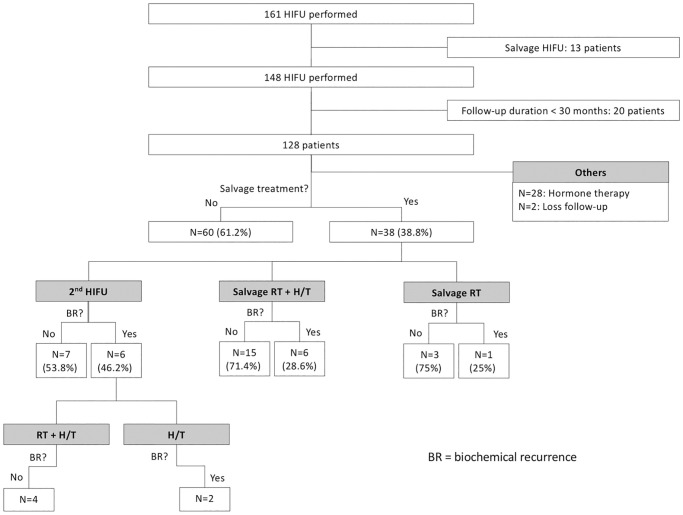
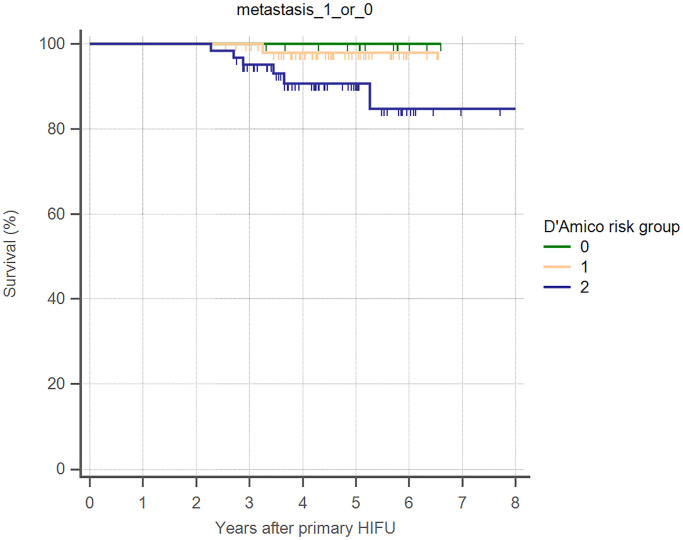
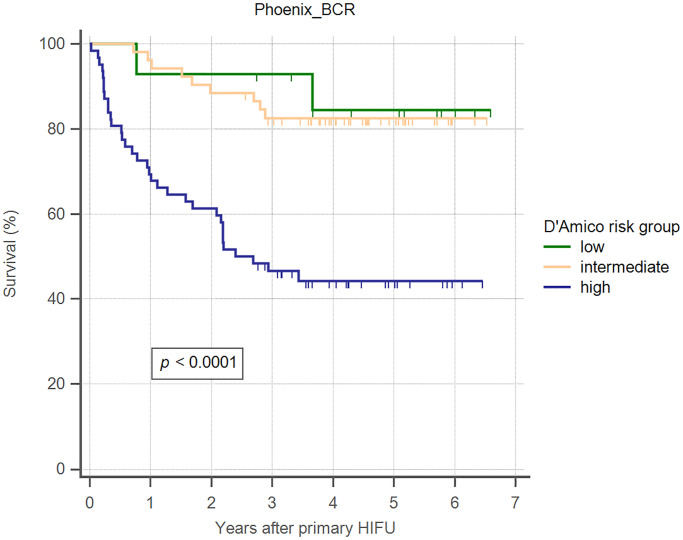
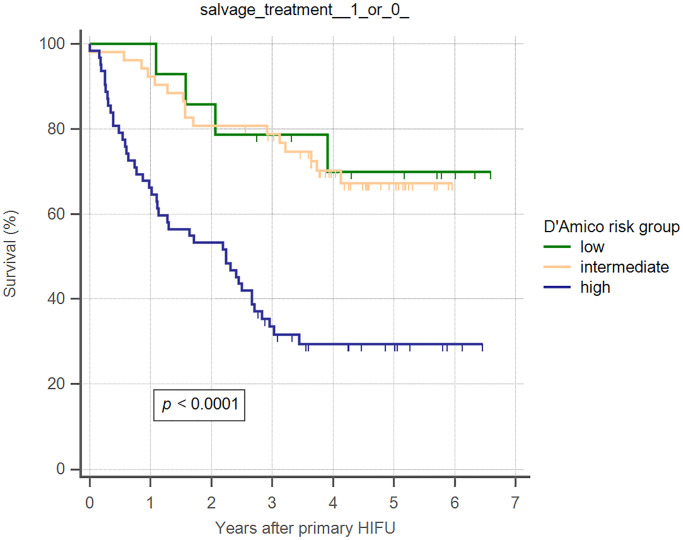
We report medium-term results in men receiving primary whole-gland HIFU (WG-HIFU) and following salvage treatment. One hundred and twenty-eight patients in a single hospital were enrolled. The enrolled patients were treated with WG-HIFU for primary localized prostate cancer. Salvage treatment include androgen deprivation therapy, secondary HIFU and salvage radiation therapy. Our primary outcomes were biochemical recurrence-free survival, salvage treatment-free survival, and metastasis-free survival. Secondary outcomes included urinary incontinence, de novo erectile dysfunction, acute epididymitis, bladder neck contracture, and urethral stricture. The 5-year biochemical recurrence-free survival rates were 85.7%, 82.7%, and 45.2% for D'Amico low-, intermediate-, and high-risk groups, respectively. Multivariate analysis revealed high risk group is the only predictor of significant shorter biochemical recurrence free survival, salvage treatment free survival, and metastasis free survival. Of 38 patients receiving salvage treatment after biochemical recurrence, 29 (76.3%) became free from biochemical recurrence. Rates of the adverse events of urinary incontinence, acute epididymitis, bladder neck contracture or urethral stricture, and de novo erectile dysfunction were 2.3%, 10.9%, 20.3%, 65.6%, respectively. In conclusion, WG-HIFU is an effective treatment option for localised prostate cancer, especially in D'Amico low- and intermediate-risk cases. The success rate of salvage treatment with radiation therapy and secondary HIFU for biochemical recurrence was acceptable. Fewer adverse events were caused by HIFU, especially incontinence and erectile dysfunction, than by radical prostatectomy and radiotherapy.
我们报告了接受原发性全腺体高强度聚焦超声(WG-HIFU)治疗并随后接受挽救性治疗的男性的中期结果。在一家医院共招募了 128 名患者。入组患者均因原发性局限性前列腺癌接受 WG-HIFU 治疗。挽救性治疗包括雄激素剥夺治疗、二次 HIFU 和挽救性放疗。我们的主要结局是生化无复发生存率、挽救性治疗无复发生存率和无转移生存率。次要结局包括尿失禁、新发勃起功能障碍、急性附睾炎、膀胱颈挛缩和尿道狭窄。D'Amico 低危、中危和高危组的 5 年生化无复发生存率分别为 85.7%、82.7%和 45.2%。多因素分析显示,高危组是生化无复发生存率、挽救性治疗无复发生存率和无转移生存率显著缩短的唯一预测因素。在 38 名生化复发后接受挽救性治疗的患者中,有 29 名(76.3%)患者生化复发得到缓解。尿失禁、急性附睾炎、膀胱颈挛缩或尿道狭窄和新发勃起功能障碍的不良事件发生率分别为 2.3%、10.9%、20.3%和 65.6%。总之,WG-HIFU 是局限性前列腺癌的有效治疗选择,尤其是在 D'Amico 低危和中危病例中。放疗和二次 HIFU 治疗生化复发的挽救性治疗成功率可接受。与根治性前列腺切除术和放疗相比,HIFU 引起的不良事件更少,尤其是尿失禁和勃起功能障碍。