Department of Medical Technology, Maesot General Hospital, Tak, Thailand.
Department of Family Medicine, Faculty of Medicine, Chiang Mai University, Chiang Mai, Thailand.
PLoS One. 2020 Jul 23;15(7):e0236496. doi: 10.1371/journal.pone.0236496. eCollection 2020.
To improve the quality of diagnosing pulmonary tuberculosis (TB), WHO recommends the use of rapid molecular testing as an alternative to conventional microscopic methods. Loop-mediated isothermal amplification assay (LAMP test) is a practical and cost-effective nucleic amplification technique. We evaluated the pragmatic accuracy of an in-house LAMP assay for the diagnosis of TB in a remote health care setting where an advanced rapid molecular test is not available.
A prospective diagnostic accuracy study was conducted. Patients with clinical symptoms suggestive of TB were consecutively enrolled from April to August 2016. Sputum samples were collected from each patient and were sent for microscopic examination (both acid-fast stain and fluorescence stain), in-house LAMP test, and TB culture.
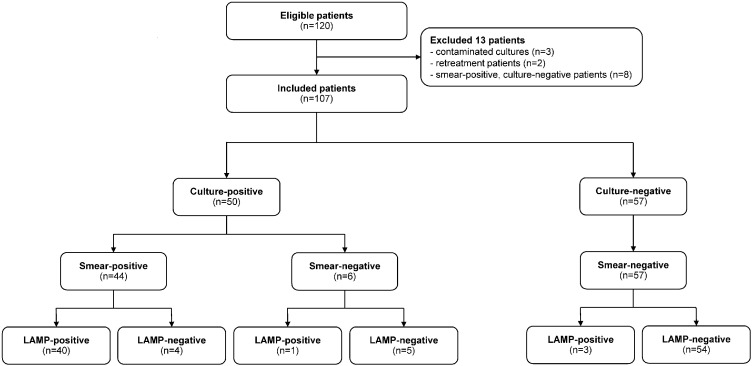
One hundred and seven patients with TB symptoms were used in the final analysis. This included 50 (46.7%) culture-positive TB patients and 57 (53.3%) culture-negative patients. The overall sensitivity of the in-house LAMP based on culture positivity was 88.8% (95/107) with a 95%CI of 81.2-94.1. The sensitivity was 90.9% (40/44) with a 95%CI of 78.3-97.5 for smear-positive, culture-positive patients, and was 16.7% (1/6) with a 95%CI of 0.4-64.1 for smear-negative, culture-positive patients. The overall sensitivity of the in-house LAMP test compared to smear microscopy methods were not significantly different (p = 0.375). The specificity of the in-house LAMP based on non-TB patients (smear-negative, culture-negative) was 94.7% (54/57) with a 95%CI of 85.4-98.9.
The diagnostic accuracy of the in-house LAMP test in a community hospital was comparable to other previous reports in terms of specificity. The sensitivity of the in-house assay could be improved with better sputum processing and DNA extraction method.
为了提高肺结核(TB)诊断的质量,世界卫生组织(WHO)建议使用快速分子检测作为传统显微镜方法的替代方法。环介导等温扩增检测(LAMP 检测)是一种实用且具有成本效益的核酸扩增技术。我们评估了在无法获得先进的快速分子检测的偏远医疗环境中,内部 LAMP 检测对 TB 诊断的实用准确性。
进行了前瞻性诊断准确性研究。从 2016 年 4 月至 8 月,连续招募有 TB 症状的患者。从每位患者采集痰液样本,并进行显微镜检查(包括抗酸染色和荧光染色)、内部 LAMP 检测和 TB 培养。
最终分析包括 107 例有 TB 症状的患者。这包括 50 例(46.7%)培养阳性的 TB 患者和 57 例(53.3%)培养阴性的患者。基于培养阳性的内部 LAMP 的总体敏感性为 88.8%(95/107),95%置信区间为 81.2-94.1。在涂阳、培养阳性的患者中,内部 LAMP 的敏感性为 90.9%(40/44),95%置信区间为 78.3-97.5;在涂阴、培养阳性的患者中,敏感性为 16.7%(1/6),95%置信区间为 0.4-64.1。内部 LAMP 试验与涂片显微镜方法的总体敏感性无显著差异(p=0.375)。基于非 TB 患者(涂阴、培养阴性)的内部 LAMP 的特异性为 94.7%(54/57),95%置信区间为 85.4-98.9。
在社区医院中,内部 LAMP 检测的诊断准确性在特异性方面与其他先前的报告相当。通过改进痰液处理和 DNA 提取方法,内部检测的敏感性可以提高。