Morgen Tobias O, Baur Maximilian, Göttker-Schnetmann Inigo, Mecking Stefan
Chair of Chemical Materials Science, Department of Chemistry, University of Konstanz, 78457, Konstanz, Germany.
Nat Commun. 2020 Jul 23;11(1):3693. doi: 10.1038/s41467-020-17542-5.
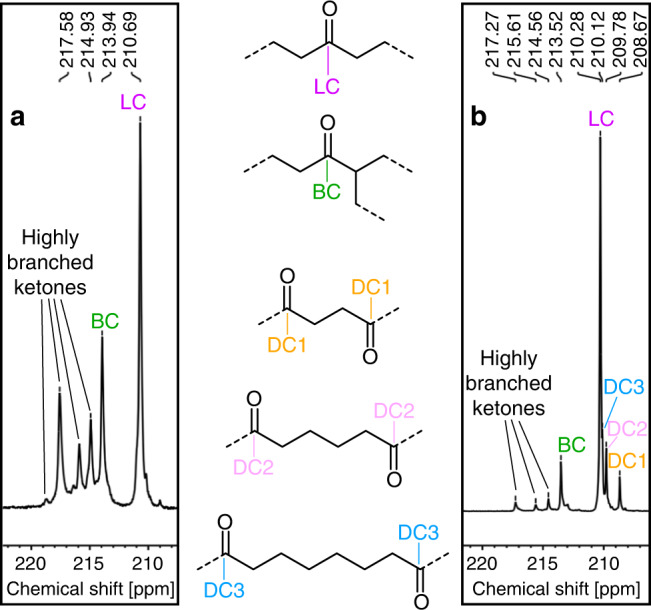
Small amounts of in-chain keto groups render polyethylene (PE) photodegradable, a desirable feature in view of environmental plastics pollution. Free-radical copolymerization of CO and ethylene is challenging due to the formation of stable acyl radicals which hinders further chain growth. Here, we report that copolymerization to polyethylenes with desirable low ketone content is enabled in dimethyl carbonate organic solvent or under aqueous conditions at comparatively moderate pressures <350 atm that compare favorable to typical ethylene polymerization at 2000 atm. Hereby, thermoplastic processable materials can be obtained as demonstrated by injection molding and tensile testing. Colloidally stable dipersions from aqueous polymerizations form continuous thin films upon drying at ambient conditions. Extensive spectroscopic investigation including C labeling provides an understanding of the branching microstructures associated with keto groups. Exposure of injection molded materials or thin films to simulated sunlight under sea-like conditions results in photodegradation.
少量链内酮基可使聚乙烯(PE)具有光降解性,鉴于环境塑料污染问题,这是一个理想的特性。由于稳定的酰基自由基的形成会阻碍链的进一步增长,因此一氧化碳与乙烯的自由基共聚具有挑战性。在此,我们报告,在碳酸二甲酯有机溶剂中或在相对中等压力(<350 atm)的水性条件下,能够实现与具有所需低酮含量的聚乙烯的共聚,与典型的2000 atm乙烯聚合相比,该压力条件较为有利。由此,可以获得可热塑性加工的材料,如注塑成型和拉伸测试所示。水性聚合得到的胶体稳定分散体在环境条件下干燥后形成连续薄膜。包括碳标记在内的广泛光谱研究有助于理解与酮基相关的支化微观结构。将注塑成型材料或薄膜在类似海洋的条件下暴露于模拟阳光下会导致光降解。