Lockard Cathy L, Richards Chris J, Lockard Caleb G, Youngers Maggie, Woolsoncroft Mariah A, Husz Taylor C, Wilson Blake K, Goad Carla L, Jackson Todd A, Step Douglas L, Bernhard Bryan C, Corbin Marilyn J, Krehbiel Clint R
Department of Animal and Food Science, Oklahoma State University, Stillwater, OK.
Department of Statistics, Oklahoma State University, Stillwater, OK.
Transl Anim Sci. 2019 Oct 4;4(1):102-117. doi: 10.1093/tas/txz157. eCollection 2020 Jan.
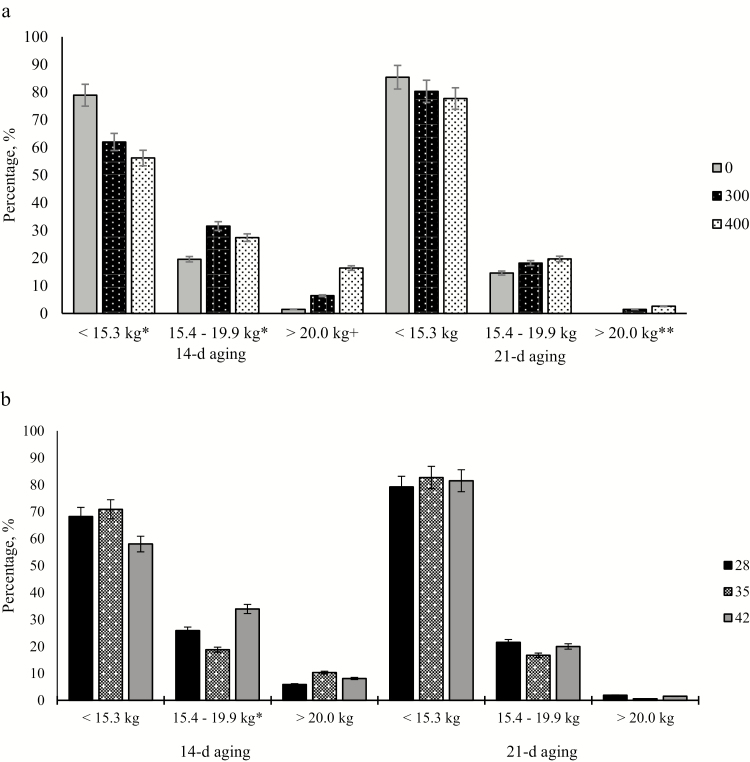
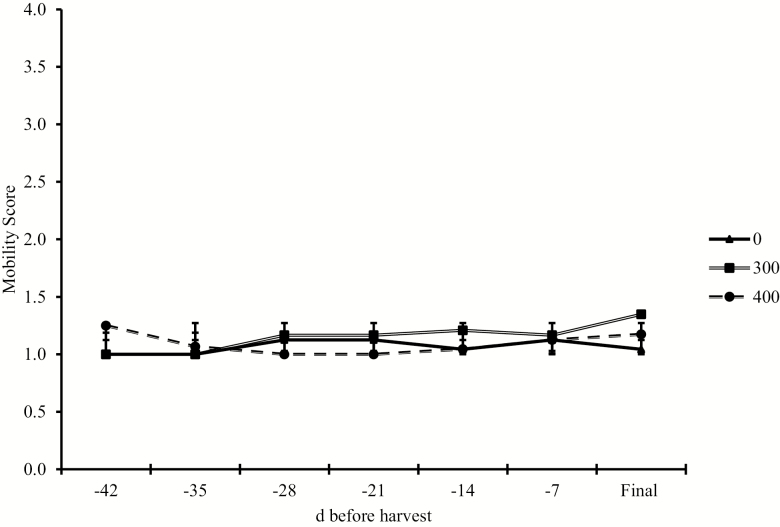
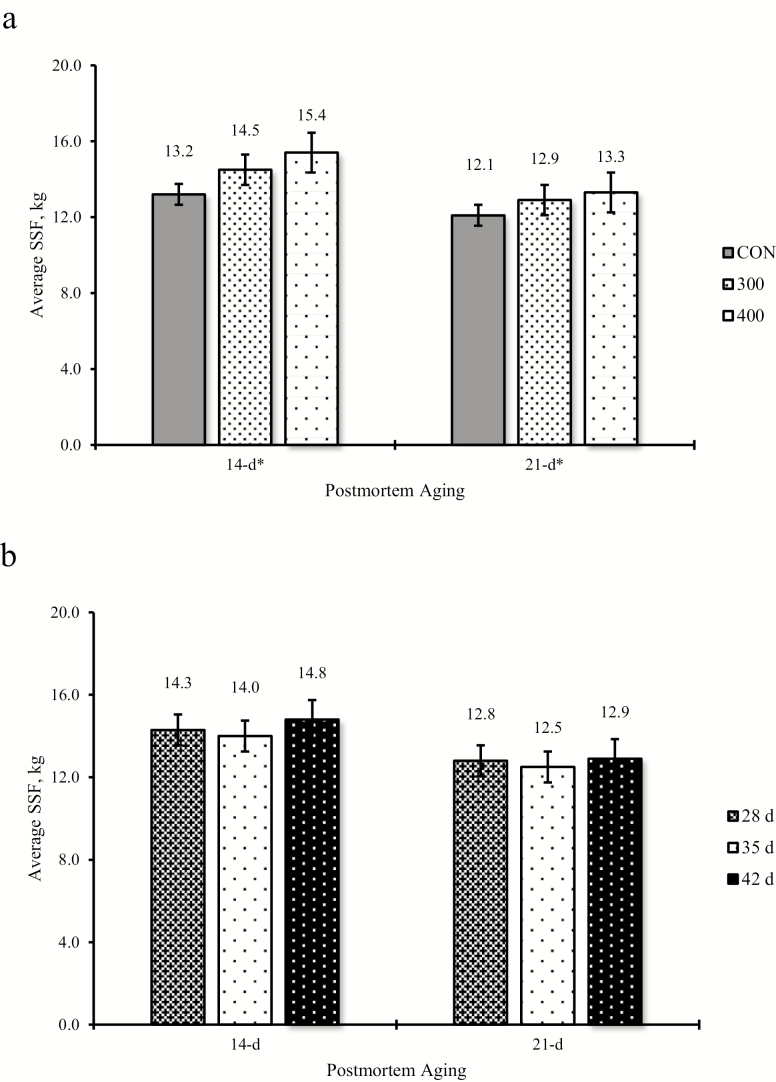
Growth-promoting technologies such as implants, ionophores, and β-agonists improve feedlot performance, efficiency, and carcass characteristics of cattle. The objective of this experiment was to determine the effects of dose and duration of ractopamine hydrochloride (RH) on feedlot performance and carcass characteristics when fed to Holstein steers. A randomized complete block design was used with a 3 × 3 factorial arrangement of treatments with 3 RH doses (0, 300, or 400 mg∙steer∙d) fed for 3 durations (28, 35, or 42 d). Holstein steers ( = 855; initial body weight [BW] = 448 ± 37 kg) were blocked by BW and randomly allocated to 1 of 9 pens (15 blocks; 9 dose × duration treatment combinations) approximately 72 d before harvest. Weekly pen weights, chute temperament scores, and animal mobility were determined during the RH feeding period. At harvest, carcass data were collected on all steers, and tenderness was measured on steaks from 3 or 4 randomly selected steers from each pen and slice shear force (SSF) was determined on one steak selected from each side of the carcass after aging for 14 or 21 d. For feedlot performance, carcass characteristics, and SSF, no dose × duration interactions were observed ( ≥ 0.11). With increasing RH dose, average daily gain (ADG) and gain-to-feed ratio (G:F) increased linearly ( ≤ 0.01), whereas BW gain increased linearly with RH dose and duration ( ≤ 0.01). Hot carcass weight ( = 0.02) and longissimus muscle (LM) area ( ≤ 0.01) increased linearly with increasing RH dose. The percentage of carcasses in the USDA Yield Grade 2 category increased linearly ( ≤ 0.01) and percentage of carcasses in the USDA Yield Grade 4 category tended ( = 0.08) to decrease linearly as RH dose increased. In the 14-d aged steaks, the percentage of steaks with SSF ≤ 15.3 kg decreased linearly ( ≤ 0.01), whereas the percentage of steaks with ≥20.0 kg SSF increased linearly ( ≤ 0.01) with increasing RH dose. After 21-d aging, there was a tendency ( = 0.06) for a greater percentage of steaks from steers fed RH to have SSF ≥ 20.0 kg (2% of total steaks), but no difference ( ≥ 0.12) in the percentage of steaks with SSF ≤ 19.9 kg. Final chute temperament ( ≥ 0.45) and animal mobility ( ≥ 0.67) scores were not affected by feeding RH. Increasing the dose of RH (300 or 400 mg∙steer∙d) fed for 28 to 42 d before harvest increased ADG, G:F, hot carcass weight, and LM area when fed to Holstein steers with no negative effects on behavior or mobility. The percentage of steaks classified as not tender improved when steaks were aged for 21 d from steers treated with RH.
诸如植入物、离子载体和β-激动剂等促生长技术可改善肉牛的饲养场性能、效率和胴体特性。本实验的目的是确定盐酸莱克多巴胺(RH)的剂量和持续时间对荷斯坦阉牛育肥性能和胴体特性的影响。采用随机完全区组设计,以3×3析因排列进行处理,设置3种RH剂量(0、300或400mg∙头∙天),饲喂3种持续时间(28、35或42天)。荷斯坦阉牛(n = 855;初始体重[BW]=448±37kg)按体重进行分块,并在屠宰前约72天随机分配到9个栏舍中的1个(15个区组;9种剂量×持续时间处理组合)。在RH饲喂期内,每周测定栏舍体重、 chute气质评分和动物活动能力。屠宰时,收集所有阉牛的胴体数据,并对每个栏舍中随机选取的3或4头阉牛的牛排进行嫩度测量,在胴体陈化14或21天后,从胴体两侧各选取一块牛排测定切片剪切力(SSF)。对于育肥性能、胴体特性和SSF,未观察到剂量×持续时间的交互作用(P≥0.11)。随着RH剂量增加,平均日增重(ADG)和增重与饲料比(G:F)呈线性增加(P≤0.01),而体重增加随RH剂量和持续时间呈线性增加(P≤0.01)。热胴体重(P = 0.02)和背最长肌(LM)面积(P≤0.01)随RH剂量增加呈线性增加。随着RH剂量增加,美国农业部2级产肉率等级胴体的百分比呈线性增加(P≤0.01),而美国农业部4级产肉率等级胴体的百分比呈线性下降趋势(P = 0.08)。在陈化14天的牛排中,SSF≤15.3kg的牛排百分比随RH剂量增加呈线性下降(P≤0.01),而SSF≥20.0kg的牛排百分比随RH剂量增加呈线性增加(P≤0.01)。陈化21天后,饲喂RH的阉牛的牛排中SSF≥20.0kg的百分比有增加趋势(P = 0.06)(占牛排总数的2%),但SSF≤19.9kg的牛排百分比无差异(P≥0.12)。最终的 chute气质评分(P≥0.45)和动物活动能力评分(P≥0.67)不受饲喂RH的影响。在屠宰前28至42天增加RH的剂量(300或400mg∙头∙天)饲喂荷斯坦阉牛,可提高ADG、G:F、热胴体重和LM面积,且对行为或活动能力无负面影响。从用RH处理的阉牛获取的牛排陈化21天后,分类为不嫩的牛排百分比有所提高。