Department of Gastroenterology, Xin Hua Hospital Affiliated to Shanghai Jiao Tong University School of Medicine, Shanghai 200092, P.R. China.
Department of Endocrinology, Xin Hua Hospital Affiliated to Shanghai Jiao Tong University School of Medicine, Shanghai 200092, P.R. China.
Mol Med Rep. 2020 Sep;22(3):1702-1708. doi: 10.3892/mmr.2020.11249. Epub 2020 Jun 17.
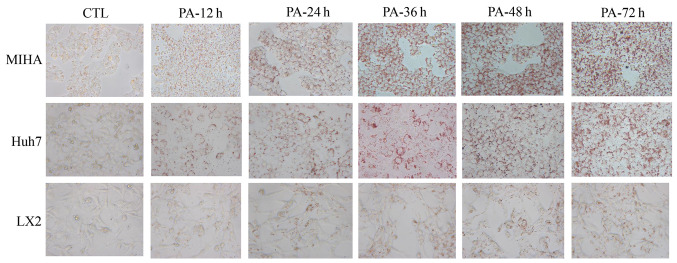
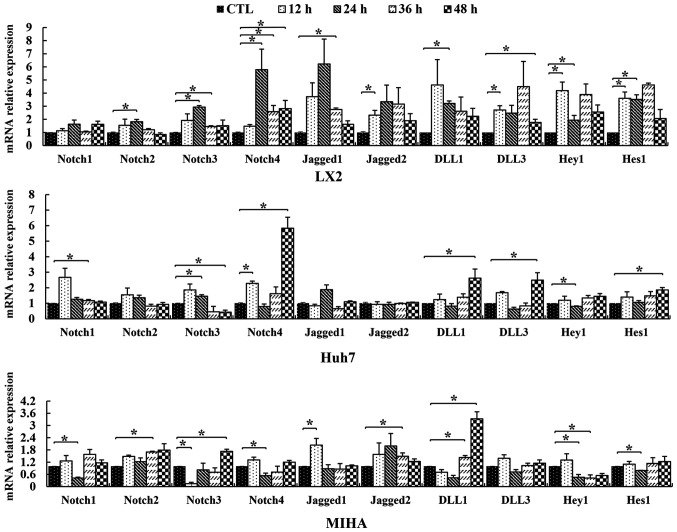
The aim of the present study was to explore the dynamic relationship between Notch and non‑alcoholic fatty liver disease (NAFLD), both in vitro and in vivo. The LX2, Huh7 and MIHA hepatic cell lines were used to establish a cell steatosis model induced by palmitic acid (PA) at different concentrations (0.1, 0.25 and 0.5 mM). Cell proliferation and migration were assessed using a 5‑bromo‑2'‑deoxyuridine kit and a wound healing assay. The dosage of 0.25 mM PA for 36‑48 h treatment was chosen for subsequent experiments. Steatotic cells were identified by Oil Red O staining. Feeding mice a methionine‑choline‑deficient (MCD) diet is known induce a model of NAFLD, compared with a methionine‑choline‑sufficient (MCS) diet. Therefore, Notch family mRNA expression was evaluated in the liver of MCD‑fed mice at varying time points (days 5, 10, 21 and 70) using reverse transcription‑quantitative PCR. Notch expression levels were also assessed in cell lines at 12, 24, 36 and 48 h after PA treatment. Notch signaling molecules changed in the PA or MCD model over time. In vitro, the mRNA levels of Notch1, ‑2 and ‑4 increased in all cell lines after 12‑h PA treatment. At 24 h, these genes were upregulated only in LX2 cells, while showing a 'down‑up' pattern in MIHA cells (i.e. these genes were downregulated at 24 h but upregulated at 36 h). However, expression of Notch1, ‑2, ‑3 and ‑4 mRNA rose significantly in the early stage (day 10) of NAFLD. At week 3, the levels of Notch1 and ‑2 were higher in the MCD group than in the MCS group, while the reverse was observed for Notch3 and ‑4. Expression of these four genes increased again in the late stage (day 70) of NAFLD. Therefore, these results indicated that Notch family members Notch1‑4 were involved in the development of NAFLD and played an important role in steatosis in this model.
本研究旨在从体内和体外两个方面探讨 Notch 与非酒精性脂肪性肝病(NAFLD)之间的动态关系。使用 LX2、Huh7 和 MIHA 肝细胞系,建立不同浓度(0.1、0.25 和 0.5 mM)软脂酸(PA)诱导的细胞脂肪变性模型。采用 5-溴-2'-脱氧尿苷试剂盒和划痕愈合试验评估细胞增殖和迁移。选择 0.25 mM PA 处理 36-48 h 用于后续实验。油红 O 染色鉴定脂肪变性细胞。用蛋氨酸-胆碱缺乏(MCD)饮食喂养小鼠可诱导 NAFLD 模型,而用蛋氨酸-胆碱充足(MCS)饮食喂养则不会。因此,采用逆转录定量 PCR 法检测 MCD 喂养小鼠肝组织中 Notch 家族 mRNA 表达在不同时间点(第 5、10、21 和 70 天)的变化。还在 PA 处理后 12、24、36 和 48 h 评估细胞系中 Notch 表达水平。随着时间的推移,PA 或 MCD 模型中 Notch 信号分子发生变化。在体外,PA 处理 12 h 后,所有细胞系中 Notch1、-2 和 -4 的 mRNA 水平均升高。在 24 h 时,这些基因仅在 LX2 细胞中上调,而在 MIHA 细胞中呈“下调-上调”模式(即这些基因在 24 h 时下调,但在 36 h 时上调)。然而,在 NAFLD 的早期(第 10 天),Notch1、-2、-3 和 -4 mRNA 的表达明显升高。在第 3 周,MCD 组 Notch1 和 Notch2 的水平高于 MCS 组,而 Notch3 和 Notch4 的水平则相反。在 NAFLD 的晚期(第 70 天),这四个基因的表达再次增加。因此,这些结果表明 Notch 家族成员 Notch1-4 参与了 NAFLD 的发生发展,在该模型的脂肪变性中发挥了重要作用。