Lee Sangrae, Nam Ki-Ho, Seo Kwangwon, Kim Gunhwi, Han Haksoo
Department of Chemical and Biomolecular Engineering, Yonsei University, 50 Yonsei-ro, Seodaemun-gu, Seoul 120-749, Korea.
Polymers (Basel). 2020 Jul 19;12(7):1604. doi: 10.3390/polym12071604.
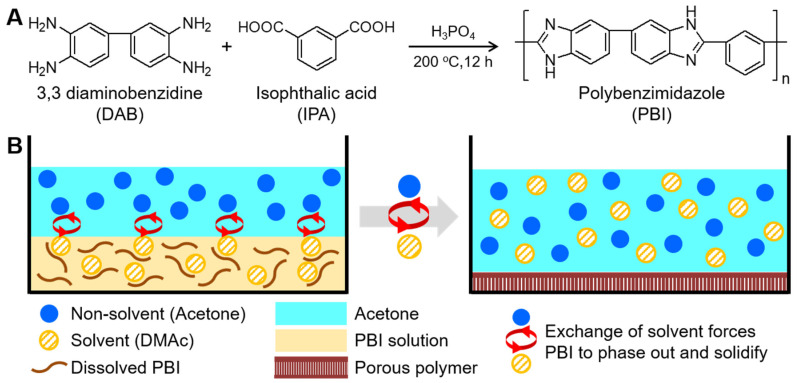
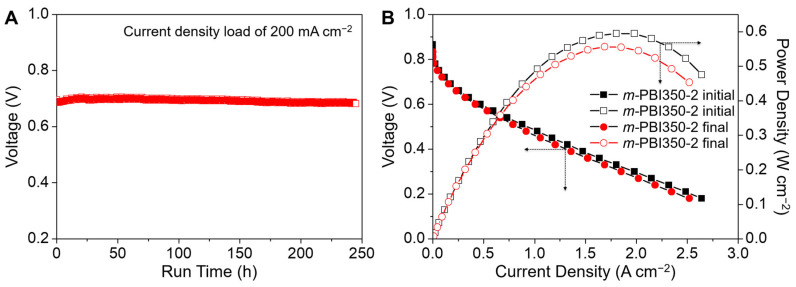
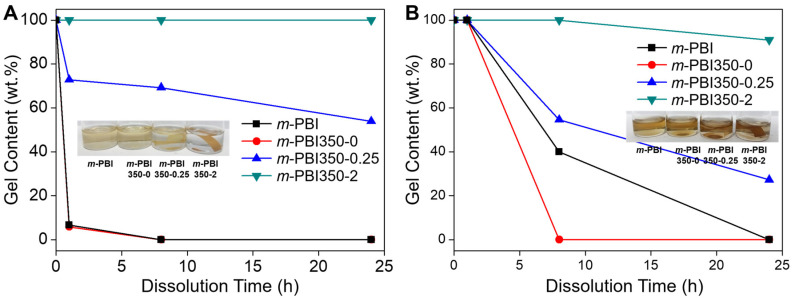
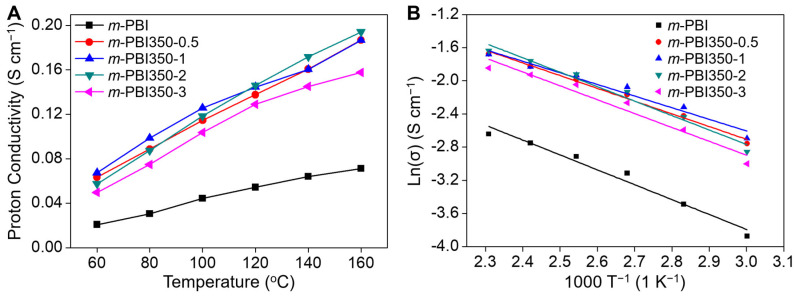
To cope with the demand for cleaner alternative energy, polymer electrolyte membrane fuel cells (PEMFCs) have received significant research attention owing to their high-power density, high fuel efficiency, and low polluting by-product. However, the water requirement of these cells has necessitated research on systems that do not require water and/or use other mediums with higher boiling points. In this work, a highly porous -polybenzimidazole (-PBI) membrane was fabricated through the non-solvent induced phase inversion technique and thermal cross-linking for high-temperature PEMFC (HT-PEMFC) applications. Standard non-thermally treated porous membranes are susceptible to phosphoric acid (PA) even at low concentrations and are unsuitable as polymer electrolyte membranes (PEMs). With the porous structure of -PBI membranes, higher PA uptake and minimal swelling, which is controlled via cross-linking, was achieved. In addition, the membranes exhibited partial asymmetrical morphology and are directly applicable to fuel cell systems without any further modifications. Membranes with insufficient cross-linking resulted in an unstable performance in HT-PEMFC environments. By optimizing thermal treatment, a high-performance membrane with limited swelling and improved proton conductivity was achieved. Finally, the -PBI membrane exhibited enhanced acid retention, proton conductivity, and fuel cell performance.
为了满足对更清洁替代能源的需求,聚合物电解质膜燃料电池(PEMFC)因其高功率密度、高燃料效率和低污染副产物而受到了大量的研究关注。然而,这些电池对水的需求使得有必要研究不需要水和/或使用其他沸点更高介质的系统。在这项工作中,通过非溶剂诱导相转化技术和热交联制备了一种高度多孔的聚苯并咪唑(-PBI)膜,用于高温PEMFC(HT-PEMFC)应用。标准的未经热处理的多孔膜即使在低浓度下也容易受到磷酸(PA)的影响,不适合作为聚合物电解质膜(PEM)。凭借-PBI膜的多孔结构,实现了更高的PA吸收量和通过交联控制的最小溶胀。此外,这些膜呈现出部分不对称形态,无需任何进一步改性即可直接应用于燃料电池系统。交联不足的膜在HT-PEMFC环境中表现出不稳定的性能。通过优化热处理,获得了具有有限溶胀和改善质子传导率的高性能膜。最后,-PBI膜表现出增强的酸保留率、质子传导率和燃料电池性能。