Felten Sandra, Klein-Richers Ute, Hofmann-Lehmann Regina, Bergmann Michèle, Unterer Stefan, Leutenegger Christian M, Hartmann Katrin
Clinic of Small Animal Medicine, Centre for Clinical Veterinary Medicine, LMU Munich, Veterinaerstrasse 13, 80539 Munich, Germany.
Clinical Laboratory, Vetsuisse Faculty, Department of Clinical Diagnostics and Services, and Center for Clinical Studies, University of Zurich, Winterthurerstrasse 260, 8057 Zurich, Switzerland.
Pathogens. 2020 Jul 22;9(8):598. doi: 10.3390/pathogens9080598.
Feline coronavirus (FCoV) infection is ubiquitous in multi-cat households. Responsible for the continuous presence are cats that are chronically shedding a high load of FCoV. The aim of the study was to determine a possible correlation between FCoV antibody titer and frequency and load of fecal FCoV shedding in cats from catteries.
Four fecal samples from each of 82 cats originating from 19 German catteries were examined for FCoV viral loads by quantitative reverse transcriptase polymerase chain reaction (RT-qPCR). Additionally, antibody titers were determined by an immunofluorescence assay.
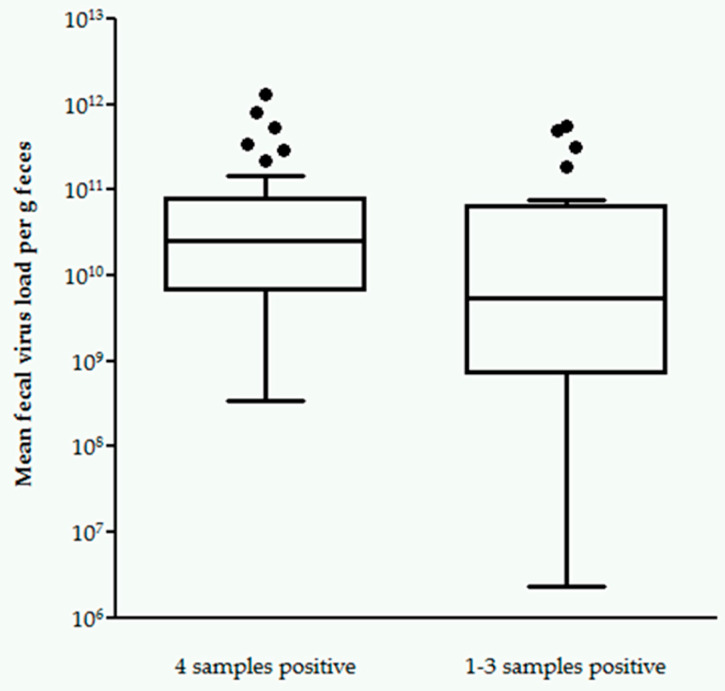
Cats with antibodies were more likely to be FCoV shedders than non-shedders, and there was a weak positive correlation between antibody titer and mean fecal virus load (Spearman = 0.2984; = 0.0072). Antibody titers were significantly higher if cats shed FCoV more frequently throughout the study period ( = 0.0063). When analyzing only FCoV shedders, cats that were RT-qPCR-positive in all four samples had significantly higher antibody titers ( = 0.0014) and significantly higher mean fecal virus loads ( = 0.0475) than cats that were RT-qPCR-positive in only one, two, or three samples.
The cats' antibody titers correlate with the likelihood and frequency of FCoV shedding and fecal virus load. Chronic shedders have higher antibody titers and shed more virus. This knowledge is important for the management of FCoV infections in multi-cat environments, but the results indicate that antibody measurement cannot replace fecal RT-qPCR.
猫冠状病毒(FCoV)感染在多猫家庭中普遍存在。长期高负荷 shedding FCoV 的猫是导致其持续存在的原因。本研究的目的是确定猫舍中猫的 FCoV 抗体滴度与粪便 FCoV shedding 的频率和负荷之间的可能相关性。
对来自 19 个德国猫舍的 82 只猫中的每只猫的 4 份粪便样本进行定量逆转录聚合酶链反应(RT-qPCR)检测 FCoV 病毒载量。此外,通过免疫荧光测定法确定抗体滴度。
有抗体的猫比不 shedding 的猫更有可能是 FCoV shedder,并且抗体滴度与平均粪便病毒负荷之间存在弱正相关(Spearman = 0.2984; = 0.0072)。如果猫在整个研究期间更频繁地 shedding FCoV,则抗体滴度显著更高( = 0.0063)。仅分析 FCoV shedder 时,在所有 4 个样本中 RT-qPCR 呈阳性的猫比仅在 1 个、2 个或 3 个样本中 RT-qPCR 呈阳性的猫具有显著更高的抗体滴度( = 0.0014)和显著更高的平均粪便病毒负荷( = 0.0475)。
猫的抗体滴度与 FCoV shedding 的可能性和频率以及粪便病毒负荷相关。慢性 shedder 具有更高的抗体滴度且 shedding 更多病毒。这一知识对于多猫环境中 FCoV 感染的管理很重要,但结果表明抗体测量不能替代粪便 RT-qPCR。