Department of Biochemistry and Molecular Biology, University of Miami Miller School of Medicine, Miami, FL 33136, USA.
The Dr. John T. McDonald Foundation Bionanotechnology Institute of University of Miami, Miami, FL 33136, USA.
Int J Mol Sci. 2020 Jul 16;21(14):5015. doi: 10.3390/ijms21145015.
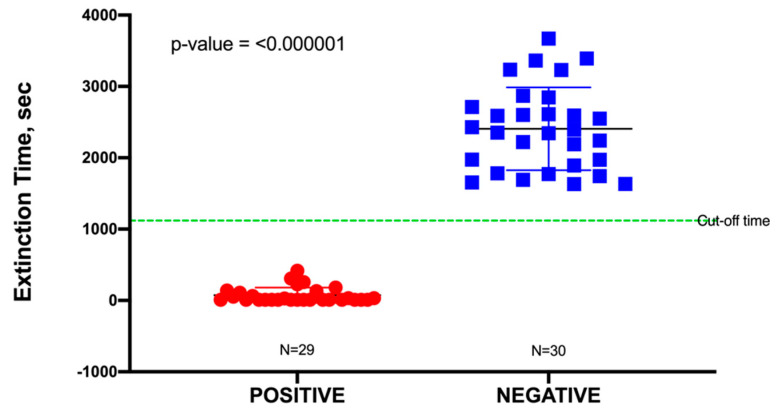
Urinary tract infection (UTI) is one of the most common infections, accounting for a substantial portion of outpatient hospital and clinic visits. Standard diagnosis of UTI by culture and sensitivity can take at least 48 h, and improper diagnosis can lead to an increase in antibiotic resistance following therapy. To address these shortcomings, rapid bioluminescence assays were developed and evaluated for the detection of UTI using intact, viable cells of USTCMS 1132 or previously lyophilized cells of ATCC 33981™. Two platform technologies-tube bioluminescence extinction technology urine (TuBETUr) and cellphone-based UTI bioluminescence extinction technology (CUBET)-were developed and standardized using artificial urine to detect four commonly isolated UTI pathogens-namely, , , , and . Besides detection, these assays could also provide information regarding pathogen concentration/level, helping guide treatment decisions. These technologies were able to detect microbes associated with UTI at less than 10 CFU/mL, which is usually the lower cut-off limit for a positive UTI diagnosis. Among the 29 positive UTI samples yielding 10-10 CFU/mL pathogen concentrations, a total of 29 urine specimens were correctly detected by TuBETUr as UTI-positive based on an 1119 s detection window. Similarly, the rapid CUBET method was able to discriminate UTIs from normal samples with high confidence ( ≤ 0.0001), using single-pot conditions and cell phone-based monitoring. These technologies could potentially address the need for point-of-care UTI detection while reducing the possibility of antibiotic resistance associated with misdiagnosed cases of urinary tract infections, especially in low-resource environments.
尿路感染 (UTI) 是最常见的感染之一,占大量门诊医院和诊所就诊的很大一部分。通过培养和药敏标准诊断 UTI 至少需要 48 小时,而不当的诊断可能会导致治疗后抗生素耐药性增加。为了解决这些缺点,开发了快速生物发光测定法,并使用 USTCMS 1132 的完整、存活细胞或先前冻干的 ATCC 33981™细胞评估其对 UTI 的检测。两种平台技术——管内生物发光消光技术尿液 (TuBETUr) 和基于手机的 UTI 生物发光消光技术 (CUBET)——使用人工尿液进行了开发和标准化,以检测四种常见的尿路感染病原体——即 、 、 和 。除了检测之外,这些测定法还可以提供有关病原体浓度/水平的信息,有助于指导治疗决策。这些技术能够检测到低于 10 CFU/mL 的与 UTI 相关的微生物,这通常是阳性 UTI 诊断的下限。在 29 份阳性 UTI 样本中,有 29 份样本的病原体浓度为 10-10 CFU/mL,TuBETUr 在 1119 s 的检测窗口内正确检测到 29 份 UTI 阳性样本。同样,快速 CUBET 方法也能够使用单池条件和基于手机的监测,以高置信度(≤0.0001)区分 UTI 与正常样本。这些技术有可能解决即时护理 UTI 检测的需求,同时减少与误诊尿路感染相关的抗生素耐药性的可能性,特别是在资源匮乏的环境中。