Thoracic Oncology Service, Division of Solid Tumor Oncology, Department of Medicine, Memorial Sloan Kettering Cancer Center, Weill Cornell Medical College, New York, New York.
Center for Molecular Oncology, Memorial Sloan Kettering Cancer Center, New York, New York.
Clin Cancer Res. 2020 Nov 1;26(21):5701-5708. doi: 10.1158/1078-0432.CCR-20-1825. Epub 2020 Jul 24.
mutations are among the most common recurrent alterations in non-small cell lung cancer (NSCLC), but the relationship to other genomic abnormalities and clinical impact has not been established.
To characterize alterations in NSCLC, we analyzed the genomic, protein expression, and clinical outcome data of patients with alterations treated at Memorial Sloan Kettering.
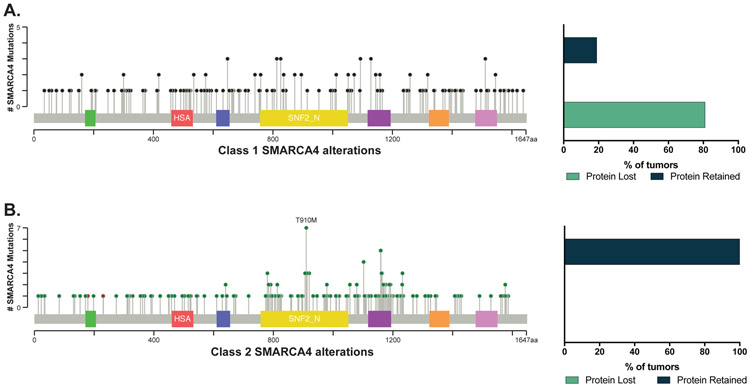
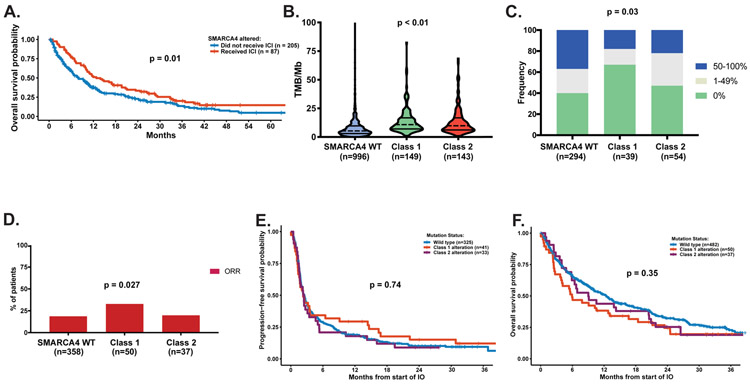
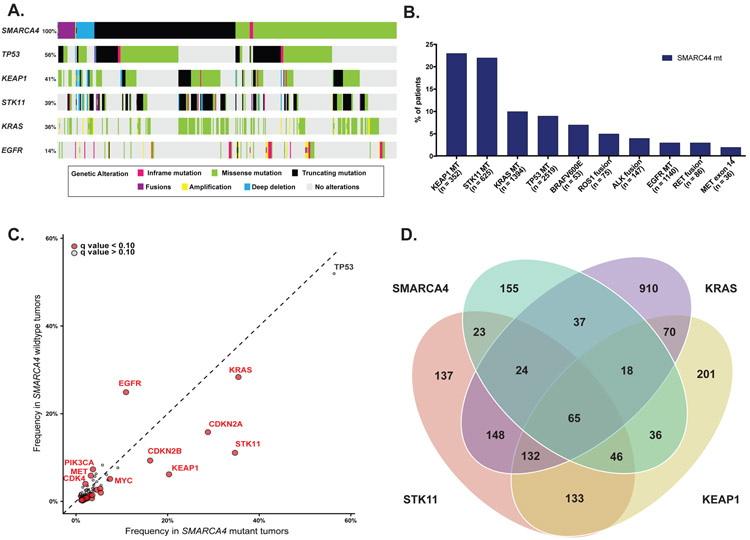
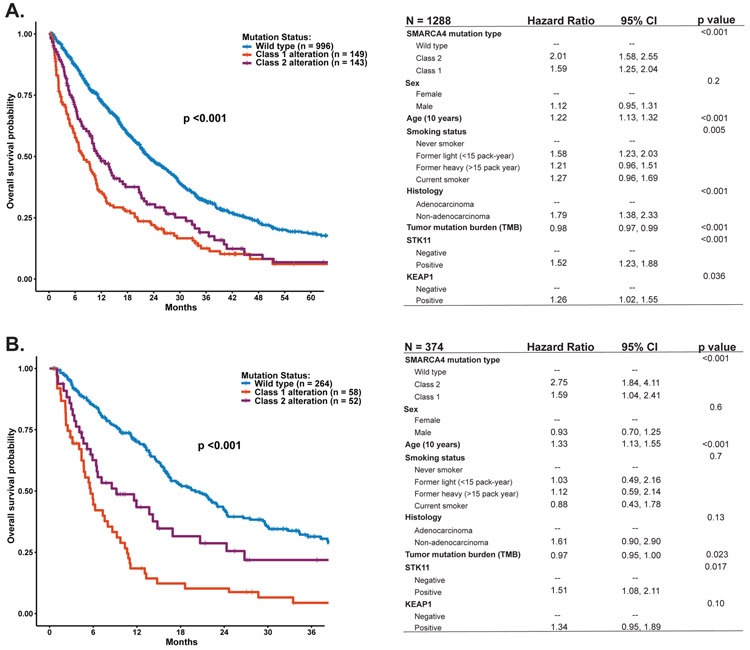
In 4,813 tumors from patients with NSCLC, we identified 8% ( = 407) of patients with -mutant lung cancer. We describe two categories of mutations: class 1 mutations (truncating mutations, fusions, and homozygous deletion) and class 2 mutations (missense mutations). Protein expression loss was associated with class 1 mutation (81% vs. 0%, < 0.001). Both classes of mutation co-occurred more frequently with , and mutations compared with wild-type tumors ( < 0.001). In patients with metastatic NSCLC, alterations were associated with shorter overall survival, with class 1 alterations associated with shortest survival times ( < 0.001). Conversely, we found that treatment with immune checkpoint inhibitors (ICI) was associated with improved outcomes in patients with -mutant tumors ( = 0.01), with class 1 mutations having the best response to ICIs ( = 0.027).
alterations can be divided into two clinically relevant genomic classes associated with differential protein expression as well as distinct prognostic and treatment implications. Both classes co-occur with , and mutations, but individually represent independent predictors of poor prognosis. Despite association with poor outcomes, -mutant lung cancers may be more sensitive to immunotherapy.
突变是非小细胞肺癌(NSCLC)中最常见的反复出现的改变之一,但与其他基因组异常的关系及其临床影响尚未确定。
为了阐明 NSCLC 中的改变,我们分析了在 Memorial Sloan Kettering 治疗的具有改变的患者的基因组、蛋白表达和临床结局数据。
在 4813 例 NSCLC 患者的肿瘤中,我们确定了 8%(=407)的患者患有突变型肺癌。我们描述了两类突变:第 1 类突变(截断突变、融合和纯合缺失)和第 2 类突变(错义突变)。蛋白表达缺失与第 1 类突变相关(81%比 0%,<0.001)。与野生型肿瘤相比,两类突变都更常与、和突变共发生(<0.001)。在转移性 NSCLC 患者中,改变与总生存期较短相关,第 1 类改变与最短的生存时间相关(<0.001)。相反,我们发现免疫检查点抑制剂(ICI)治疗与突变型肿瘤患者的结局改善相关(=0.01),第 1 类突变对 ICI 的反应最佳(=0.027)。
改变可分为两类具有临床相关性的基因组类别,与不同的蛋白表达以及不同的预后和治疗意义相关。两类都与和突变共发生,但各自代表预后不良的独立预测因素。尽管与不良结局相关,但突变型肺癌可能对免疫治疗更敏感。