School of Water Sciences, Cranfield University, Cranfield, Bedfordshire, MK43 0AL, UK.
BYK Additives Ltd, Moorfield Road, Widnes, Cheshire, WA8 3AA, UK.
Sci Rep. 2020 Jul 24;10(1):12426. doi: 10.1038/s41598-020-69348-6.
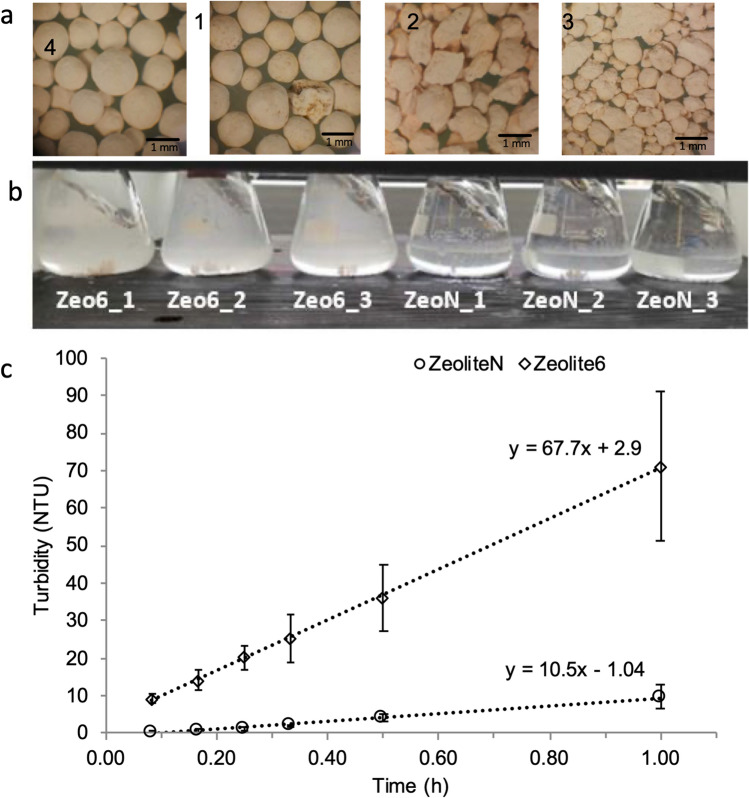
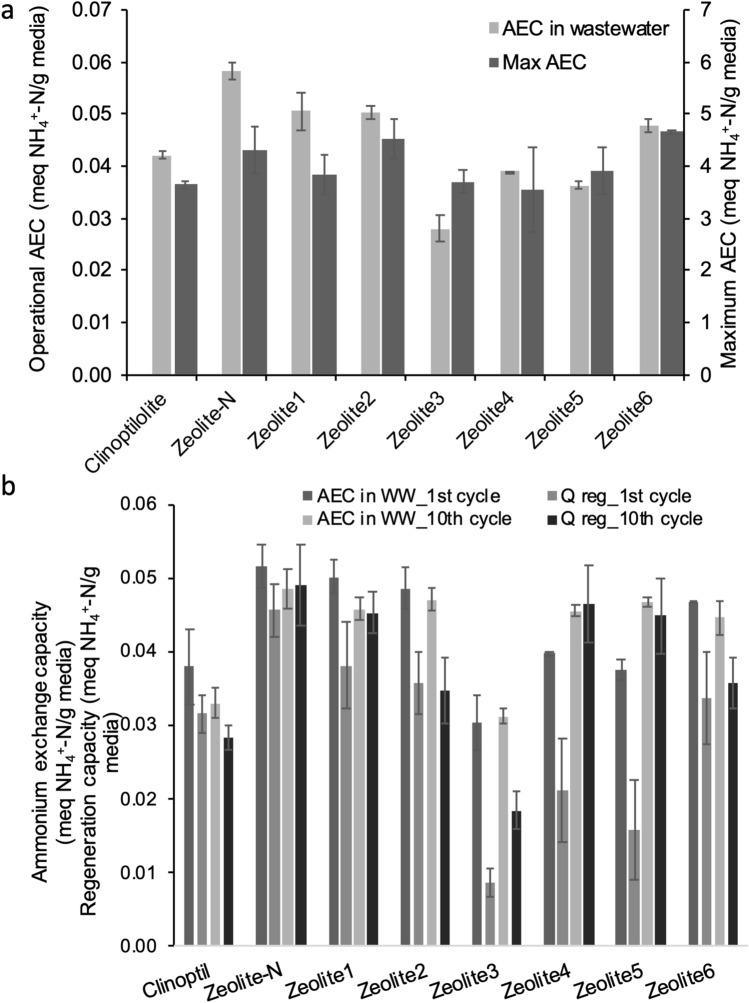
The application of ion exchange process for ammonium (NH-N) removal from wastewater is limited due to the lack of suppliers of engineered zeolites which present high ammonium exchange capacity (AEC) and mechanical strength. This study focuses on the preparation and evaluation of synthetic zeolites (Zeolite1-6) by measuring AEC and resistance to attrition and compression, against natural (clinoptilolite) and engineered zeolite (reference, Zeolite-N). At high NH-N concentrations, Zeolite6 and Zeolite2 showed capacities of 4.7 and 4.5 meq NH-N/g media, respectively. In secondary effluent wastewater (initial NH-N of 0.7 meq NH-N/L), Zeolite1, 2 and 6 showed an AEC of 0.05 meq NH-N/g media, similar to Zeolite-N (0.06 meq NH-N /g media). Among the synthetic zeolites, Zeolite3 and 6 showed higher resistance to attrition (disintegration rate = 2.7, 4.1 NTU/h, respectively) when compared with Zeolite-N (disintegration rate = 13.2 NTU/h). Zeolite4 and 6 showed higher resistance to compression (11 N and 6 N, respectively). Due its properties, Zeolite6 was further tested in an ion exchange demonstration scale plant treating secondary effluent from a municipal wastewater treatment plant. However, Zeolite6 disintegrated after 2 months of operation, whilst Zeolite-N remained stable for 1.5 year. This highlighted the importance of the zeolite's mechanical strength for successful application. In particular, future work should focus on the optimization of the zeolite production process (temperature, time and dimension of the kiln during calcination) to obtain an engineered zeolite with a spherical shape thus reducing eventual sharp edges which can affect mechanical strength.
离子交换法在废水除氨(NH-N)中的应用受到限制,原因是缺乏具有高铵交换容量(AEC)和机械强度的工程沸石供应商。本研究通过测量 AEC 和抗磨损与抗压能力,重点研究了合成沸石(沸石 1-6)的制备和评价,与天然沸石(斜发沸石)和工程沸石(参比沸石,沸石-N)进行了对比。在高 NH-N 浓度下,沸石 6 和沸石 2 的容量分别为 4.7 和 4.5 meq NH-N/g 介质。在二级出水(初始 NH-N 为 0.7 meq NH-N/L)中,沸石 1、2 和 6 的 AEC 为 0.05 meq NH-N/g 介质,与沸石-N(0.06 meq NH-N /g 介质)相似。在合成沸石中,沸石 3 和 6 的抗磨损能力(分解率分别为 2.7 和 4.1 NTU/h)高于沸石-N(分解率为 13.2 NTU/h)。沸石 4 和 6 的抗压能力较高(分别为 11 N 和 6 N)。由于其特性,沸石 6 进一步在处理城市污水处理厂二级出水的离子交换示范规模工厂中进行了测试。然而,沸石 6 在运行 2 个月后就解体了,而沸石-N 则稳定运行了 1.5 年。这突出了沸石机械强度对于成功应用的重要性。特别是,未来的工作应侧重于优化沸石生产工艺(煅烧过程中的温度、时间和窑尺寸),以获得具有球形的工程沸石,从而减少可能影响机械强度的尖锐边缘。