
Cellgevity®补充剂对选定大鼠肝脏细胞色素P450酶活性及卡马西平药代动力学参数的影响。
Effect of Cellgevity® Supplement on Selected Rat Liver Cytochrome P450 Enzyme Activity and Pharmacokinetic Parameters of Carbamazepine.
作者信息
Amponsah Seth Kwabena, N'guessan Benoit Banga, Akandawen Martin, Aning Abigail, Agboli Sedem Yawa, Danso Eunice Ampem, Opuni Kwabena Frimpong-Manso, Asiedu-Gyekye Isaac Julius, Appiah-Opong Regina
机构信息
Department of Pharmacology and Toxicology, School of Pharmacy, College of Health Sciences, University of Ghana, Accra, Ghana.
Department of Clinical Pathology, Noguchi Memorial Institute for Medical Research, College of Health Sciences, University of Ghana, Accra, Ghana.
出版信息
Evid Based Complement Alternat Med. 2020 Jul 3;2020:7956493. doi: 10.1155/2020/7956493. eCollection 2020.
BACKGROUND
There is considerable evidence that many patients concurrently administer dietary supplements with conventional drugs, creating a risk for potential drug-supplement interaction. The aim of this study was to determine the effect of Cellgevity® supplement on selected rat liver cytochrome P450 (CYP) enzymes. Also, based on our previous finding, we sought to determine the effect of Cellgevity® on the pharmacokinetics of carbamazepine, a CYP3A4 substrate.
METHODS
Male Sprague-Dawley (SD) rats were randomly put into 5 groups and administered either distilled water (negative control), Cellgevity® (3 separate doses), or phenobarbital (positive control), . Modulation of liver CYP enzyme activity was evaluated after 30 days of treatment, using probe substrates, spectroscopic, and high-performance liquid chromatographic methods. In the pharmacokinetic study, 12 SD rats were put into 2 groups and administered carbamazepine plus normal saline (group 1) or carbamazepine plus Cellgevity® (group 2), , both over a period of 14 days. Blood samples from rats in the same group were collected after treatment. Serum samples were prepared and pooled together at each specific sampling time point. Levels of carbamazepine were determined using a fluorescence polarization immunoassay.
RESULTS
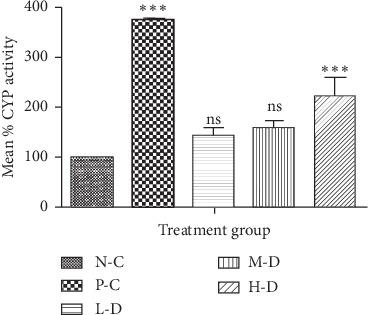
Activities of rat liver CYP1A1/2, CYP2C9, and CYP2D6 were significantly increased by Cellgevity® after 30-day treatment. Pharmacokinetic parameters for rats administered carbamazepine with Cellgevity® vis-a-vis carbamazepine with normal saline were as follows: ; 20 mol/L vs 11 mol/L, AUC; 347 mol h/L vs 170 mol h/L, ; 0.28 h vs 0.41 h, and ; 2.3 h vs 1.7 h, respectively.
CONCLUSIONS
Cellgevity® increased the activity of rat CYP1A1/2, CYP2C9, and CYP2D6 enzymes and was found to alter the pharmacokinetics of carbamazepine in rats.
背景
有大量证据表明,许多患者同时服用膳食补充剂和传统药物,这增加了药物与补充剂之间潜在相互作用的风险。本研究的目的是确定Cellgevity®补充剂对选定的大鼠肝脏细胞色素P450(CYP)酶的影响。此外,基于我们之前的发现,我们试图确定Cellgevity®对CYP3A4底物卡马西平药代动力学的影响。
方法
将雄性Sprague-Dawley(SD)大鼠随机分为5组,分别给予蒸馏水(阴性对照)、Cellgevity®(3个不同剂量)或苯巴比妥(阳性对照)。治疗30天后,使用探针底物、光谱法和高效液相色谱法评估肝脏CYP酶活性的调节情况。在药代动力学研究中,将12只SD大鼠分为2组,分别给予卡马西平加生理盐水(第1组)或卡马西平加Cellgevity®(第2组),为期14天。治疗后采集同一组大鼠的血样。制备血清样本并在每个特定采样时间点合并。使用荧光偏振免疫测定法测定卡马西平的水平。
结果
治疗30天后,Cellgevity®显著提高了大鼠肝脏CYP1A1/2、CYP2C9和CYP2D6的活性。与给予卡马西平加生理盐水的大鼠相比,给予卡马西平加Cellgevity®的大鼠的药代动力学参数如下: ;20μmol/L对11μmol/L,AUC;347μmol·h/L对170μmol·h/L, ;0.28小时对0.41小时,以及 ;2.3小时对1.7小时。
结论
Cellgevity®增加了大鼠CYP1A1/2、CYP2C9和CYP2D6酶的活性,并发现其改变了大鼠体内卡马西平的药代动力学。




 Zotero 插件