Ferris Jennifer, Espona-Fiedler Margarita, Hamilton Claudia, Holohan Caitriona, Crawford Nyree, McIntyre Alex J, Roberts Jamie Z, Wappett Mark, McDade Simon S, Longley Daniel B, Coyle Victoria
Centre for Cancer Research and Cell Biology, Queen's University Belfast, Belfast, Northern Ireland BT9 7BL UK.
Cell Death Discov. 2020 Jul 21;6:61. doi: 10.1038/s41420-020-00296-w. eCollection 2020.
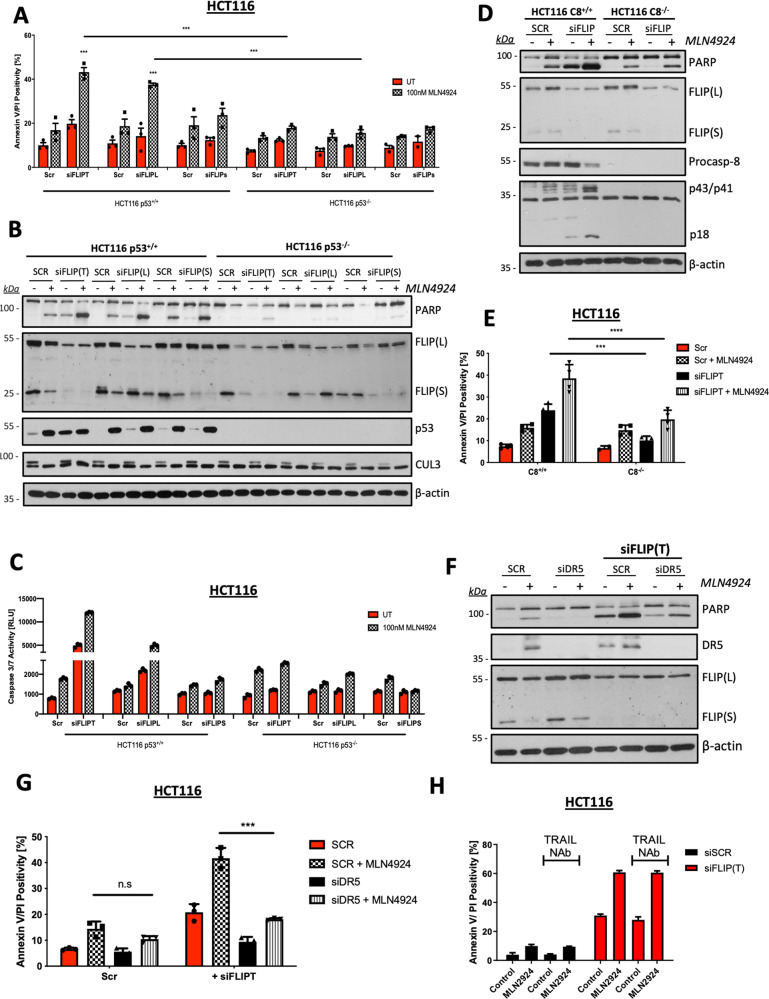
Pevonedistat (MLN4924), a selective inhibitor of the NEDD8-activating enzyme E1 regulatory subunit (NAE1), has demonstrated significant therapeutic potential in several malignancies. Although multiple mechanisms-of-action have been identified, how MLN4924 induces cell death and its potential as a combinatorial agent with standard-of-care (SoC) chemotherapy in colorectal cancer (CRC) remains largely undefined. In an effort to understand MLN4924-induced cell death in CRC, we identified p53 as an important mediator of the apoptotic response to MLN4924. We also identified roles for the extrinsic (TRAIL-R2/caspase-8) and intrinsic (BAX/BAK) apoptotic pathways in mediating the apoptotic effects of MLN4924 in CRC cells, as well as a role for BID, which modulates a cross-talk between these pathways. Depletion of the anti-apoptotic protein FLIP, which we identify as a novel mediator of resistance to MLN4924, enhanced apoptosis in a p53-, TRAIL-R2/DR5-, and caspase-8-dependent manner. Notably, TRAIL-R2 was involved in potentiating the apoptotic response to MLN4924 in the absence of FLIP, in a ligand-independent manner. Moreoever, when paired with SoC chemotherapies, MLN4924 demonstrated synergy with the irinotecan metabolite SN38. The cell death induced by MLN4924/SN38 combination was dependent on activation of mitochondria through BAX/BAK, but in a p53-independent manner, an important observation given the high frequency of mutation(s) in advanced CRC. These results uncover mechanisms of cell death induced by MLN4924 and suggest that this second-generation proteostasis-disrupting agent may have its most widespread activity in CRC, in combination with irinotecan-containing treatment regimens.
pevonedistat(MLN4924)是一种NEDD8激活酶E1调节亚基(NAE1)的选择性抑制剂,已在多种恶性肿瘤中显示出显著的治疗潜力。尽管已确定了多种作用机制,但MLN4924如何诱导细胞死亡及其作为结直肠癌(CRC)标准护理(SoC)化疗联合用药的潜力仍 largely 未明确。为了了解MLN4924在CRC中诱导的细胞死亡,我们确定p53是对MLN4924凋亡反应的重要介质。我们还确定了外在(TRAIL-R2/半胱天冬酶-8)和内在(BAX/BAK)凋亡途径在介导MLN4924对CRC细胞的凋亡作用中的作用,以及BID的作用,它调节这些途径之间的相互作用。抗凋亡蛋白FLIP的缺失,我们将其确定为对MLN4924耐药的新介质,以p53、TRAIL-R2/DR5和半胱天冬酶-8依赖的方式增强凋亡。值得注意的是,TRAIL-R2以非配体依赖的方式参与在没有FLIP的情况下增强对MLN4924的凋亡反应。此外,当与SoC化疗联合使用时,MLN4924与伊立替康代谢物SN38显示出协同作用。MLN4924/SN38组合诱导的细胞死亡依赖于通过BAX/BAK激活线粒体,但以p53非依赖的方式,鉴于晚期CRC中高频率的突变,这是一个重要的观察结果。这些结果揭示了MLN4924诱导细胞死亡的机制,并表明这种第二代蛋白稳态破坏剂与含伊立替康的治疗方案联合使用时,可能在CRC中具有最广泛的活性。