Department of Biology and Biochemistry and Department of Mathematical Sciences, University of Bath, Claverton Down, Bath, United Kingdom.
Elife. 2020 Jul 27;9:e52998. doi: 10.7554/eLife.52998.
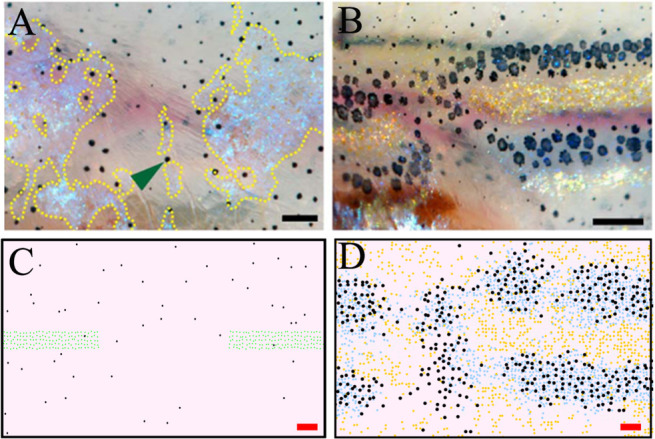
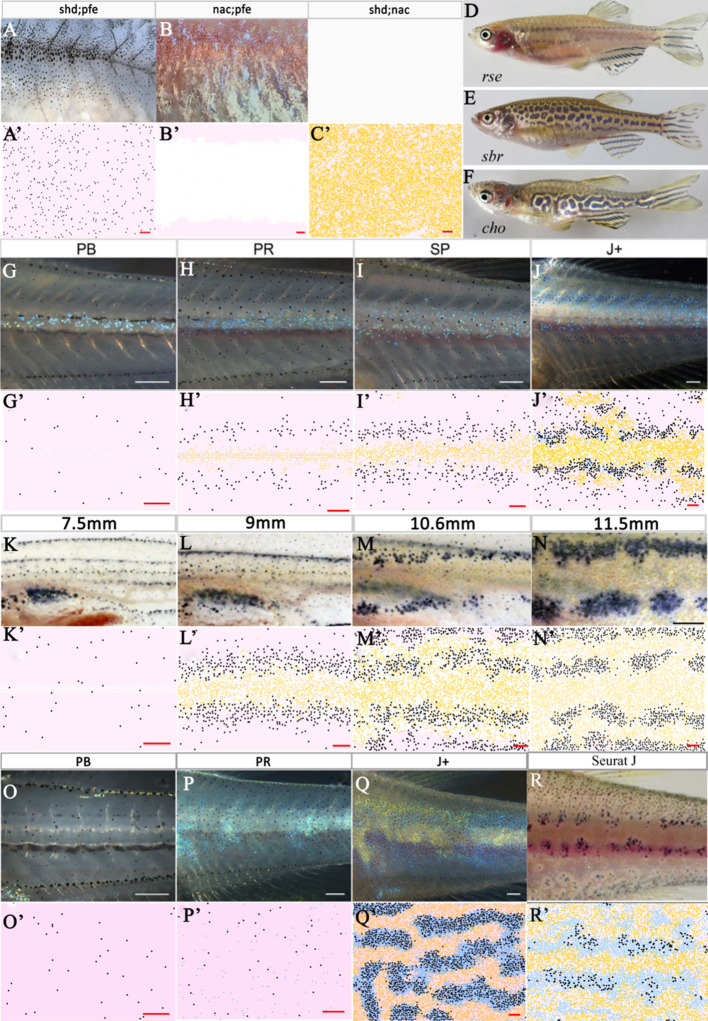
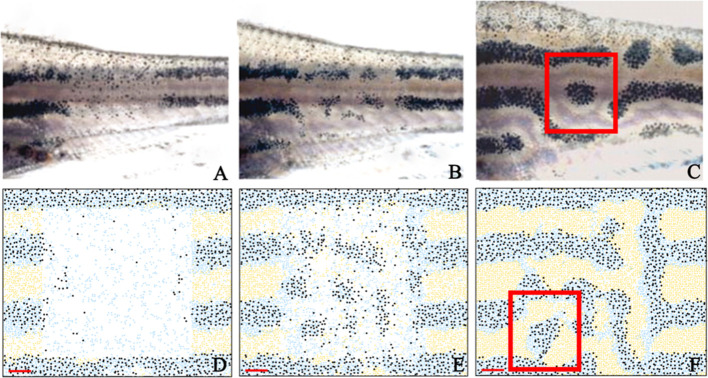
Pattern formation is a key aspect of development. Adult zebrafish exhibit a striking striped pattern generated through the self-organisation of three different chromatophores. Numerous investigations have revealed a multitude of individual cell-cell interactions important for this self-organisation, but it has remained unclear whether these known biological rules were sufficient to explain pattern formation. To test this, we present an individual-based mathematical model incorporating all the important cell-types and known interactions. The model qualitatively and quantitatively reproduces wild type and mutant pigment pattern development. We use it to resolve a number of outstanding biological uncertainties, including the roles of domain growth and the initial iridophore stripe, and to generate hypotheses about the functions of . We conclude that our rule-set is sufficient to recapitulate wild-type and mutant patterns. Our work now leads the way for further in silico exploration of the developmental and evolutionary implications of this pigment patterning system.
模式形成是发育的一个关键方面。成年斑马鱼表现出一种显著的条纹图案,通过三种不同色素细胞的自我组织产生。大量的研究揭示了许多对这种自我组织很重要的单个细胞-细胞相互作用,但尚不清楚这些已知的生物学规则是否足以解释图案形成。为了检验这一点,我们提出了一个基于个体的数学模型,其中包含了所有重要的细胞类型和已知的相互作用。该模型定性和定量地再现了野生型和突变体色素图案的发育。我们利用它来解决一些悬而未决的生物学问题,包括域生长和初始虹彩细胞条纹的作用,并对 的功能提出假设。我们得出结论,我们的规则集足以再现野生型和突变型模式。我们的工作为进一步在计算机上探索这种色素图案形成系统的发育和进化意义奠定了基础。