UCSF Department of Medicine, San Francisco, United States.
Howard Hughes Medical Institute, Chevy Chase, United States.
Elife. 2020 Jul 28;9:e55909. doi: 10.7554/eLife.55909.
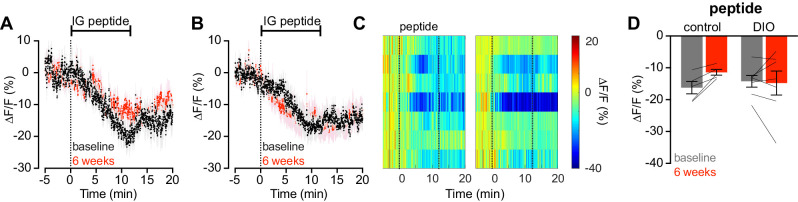
Body weight is regulated by interoceptive neural circuits that track energy need, but how the activity of these circuits is altered in obesity remains poorly understood. Here we describe the in vivo dynamics of hunger-promoting AgRP neurons during the development of diet-induced obesity in mice. We show that high-fat diet attenuates the response of AgRP neurons to an array of nutritionally-relevant stimuli including food cues, intragastric nutrients, cholecystokinin and ghrelin. These alterations are specific to dietary fat but not carbohydrate or protein. Subsequent weight loss restores the responsiveness of AgRP neurons to exterosensory cues but fails to rescue their sensitivity to gastrointestinal hormones or nutrients. These findings reveal that obesity triggers broad dysregulation of hypothalamic hunger neurons that is incompletely reversed by weight loss and may contribute to the difficulty of maintaining a reduced weight.
体重由感知内部状态的神经网络调控,这些网络追踪能量需求,但肥胖相关的这些神经网络的活动如何改变仍不清楚。本研究描述了在高脂饮食诱导的肥胖发展过程中,AgRP 神经元的体内活动变化。我们发现高脂饮食减弱了 AgRP 神经元对一系列营养相关刺激的反应,包括食物线索、胃内营养素、胆囊收缩素和 ghrelin。这些改变是膳食脂肪特异性的,与碳水化合物或蛋白质无关。随后的体重减轻恢复了 AgRP 神经元对外感官线索的反应,但未能恢复其对胃肠激素或营养素的敏感性。这些发现揭示了肥胖会引发广泛的下丘脑饥饿神经元失调,而体重减轻并不能完全逆转这种失调,这可能是维持减轻体重困难的原因之一。