Zhang Boxian, Chen Chunhuan, He Jianchao, Hou Jinbao, Chai Lu, Lv Yanlong
School of Materials Science and Engineering, Dalian Jiaotong University, Dalian 116028, China.
Institute of Special Environments Physical Sciences, Harbin Institute of Technology, Shenzhen 518055, China.
Materials (Basel). 2020 Jul 24;13(15):3300. doi: 10.3390/ma13153300.
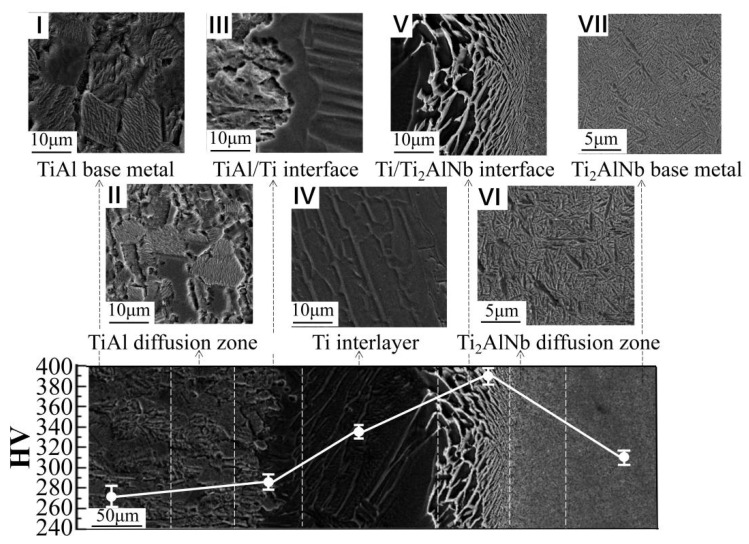
To solve the problem of poor weldability between TiAl-based and TiAlNb-based alloys, spark plasma diffusion bonding was employed to join a TiAl alloy and a TiAlNb alloy with a pure Ti foil as interlayer at 950 °C/10 KN/60 min. After welding, slow cooling was carried out at a rate of 5 °C/min, followed by homogenization at 800 °C for 24 h. The microstructural evolution and elemental migration of the joint were analyzed via a scanning electron microscope equipped with an energy dispersive spectrometer, while the mechanical properties of the joint were assessed via microhardness and tensile tests. The results show that the spark plasma diffusion bonding formed a joint of TiAl/Ti/TiAlNb without microcracks or microvoids, while also effectively protecting the base metal. Before heat treatment, the maximum hardness value (401 HV) appeared at the TiAlNb/Ti interface, while the minimum hardness value (281 HV) occurred in the TiAl base metal. The tensile strength of the heat-treated joint at room temperature was measured to be up to 454 MPa, with a brittle fracture occurring in the interlayer. The tensile strength of the joint at 650 °C was measured to be up to 538 MPa, with intergranular cracks occurring in the TiAl base metal.
为解决TiAl基合金与TiAlNb基合金之间焊接性差的问题,采用放电等离子体扩散连接工艺,以纯Ti箔为中间层,在950℃、10KN、60min条件下连接TiAl合金和TiAlNb合金。焊接后,以5℃/min的速率进行缓冷,然后在800℃下进行24h的均匀化处理。通过配备能谱仪的扫描电子显微镜分析接头的微观组织演变和元素迁移,同时通过显微硬度和拉伸试验评估接头的力学性能。结果表明,放电等离子体扩散连接形成了TiAl/Ti/TiAlNb接头,无微观裂纹或微孔,同时有效地保护了母材。热处理前,TiAlNb/Ti界面处硬度最大值(401HV)出现,而TiAl母材中硬度最小值(281HV)出现。热处理后接头室温拉伸强度高达454MPa,在中间层发生脆性断裂。接头在650℃时的拉伸强度高达538MPa,在TiAl母材中出现沿晶裂纹。