Wilmink Gerald, Dupey Katherine, Alkire Schon, Grote Jeffrey, Zobel Gregory, Fillit Howard M, Movva Satish
CarePredict, Plantation, FL, United States.
Lifewell Senior Living Corporation, Houston, TX, United States.
JMIR Aging. 2020 Sep 10;3(2):e19554. doi: 10.2196/19554.
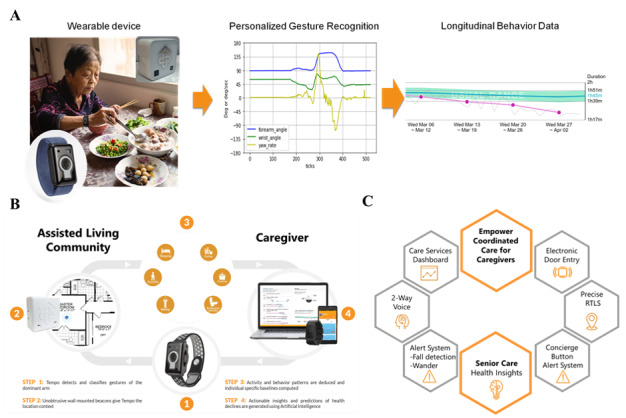
Wearables and artificial intelligence (AI)-powered digital health platforms that utilize machine learning algorithms can autonomously measure a senior's change in activity and behavior and may be useful tools for proactive interventions that target modifiable risk factors.
The goal of this study was to analyze how a wearable device and AI-powered digital health platform could provide improved health outcomes for older adults in assisted living communities.
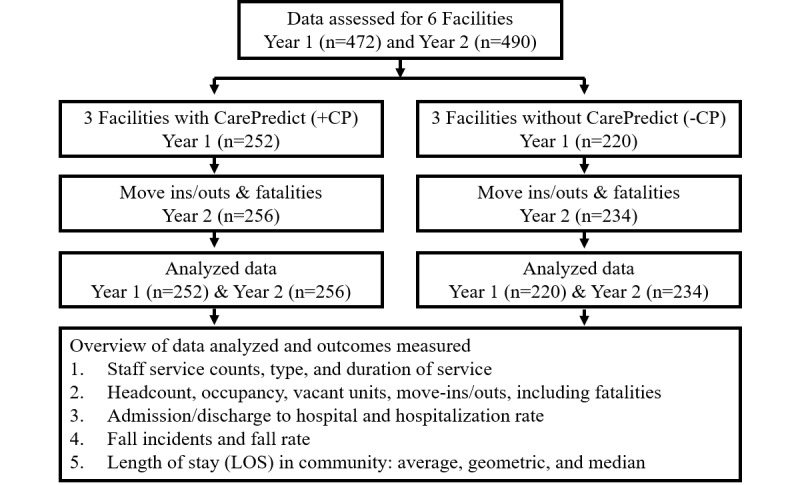
Data from 490 residents from six assisted living communities were analyzed retrospectively over 24 months. The intervention group (+CP) consisted of 3 communities that utilized CarePredict (n=256), and the control group (-CP) consisted of 3 communities (n=234) that did not utilize CarePredict. The following outcomes were measured and compared to baseline: hospitalization rate, fall rate, length of stay (LOS), and staff response time.
The residents of the +CP and -CP communities exhibit no statistical difference in age (P=.64), sex (P=.63), and staff service hours per resident (P=.94). The data show that the +CP communities exhibited a 39% lower hospitalization rate (P=.02), a 69% lower fall rate (P=.01), and a 67% greater length of stay (P=.03) than the -CP communities. The staff alert acknowledgment and reach resident times also improved in the +CP communities by 37% (P=.02) and 40% (P=.02), respectively.
The AI-powered digital health platform provides the community staff with actionable information regarding each resident's activities and behavior, which can be used to identify older adults that are at an increased risk for a health decline. Staff can use this data to intervene much earlier, protecting seniors from conditions that left untreated could result in hospitalization. In summary, the use of wearables and AI-powered digital health platform can contribute to improved health outcomes for seniors in assisted living communities. The accuracy of the system will be further validated in a larger trial.
可穿戴设备以及利用机器学习算法的人工智能(AI)驱动的数字健康平台能够自主测量老年人的活动和行为变化,可能是针对可改变风险因素进行主动干预的有用工具。
本研究的目的是分析可穿戴设备和AI驱动的数字健康平台如何为辅助生活社区中的老年人提供更好的健康结果。
对来自六个辅助生活社区的490名居民在24个月内的数据进行回顾性分析。干预组(+CP)由3个使用CarePredict的社区组成(n = 256),对照组(-CP)由3个未使用CarePredict的社区组成(n = 234)。测量以下结果并与基线进行比较:住院率、跌倒率、住院时间(LOS)和工作人员响应时间。
+CP社区和-CP社区的居民在年龄(P = 0.64)、性别(P = 0.63)和每位居民的工作人员服务小时数(P = 0.94)方面无统计学差异。数据显示,与-CP社区相比,+CP社区的住院率降低了39%(P = 0.02),跌倒率降低了69%(P = 0.01),住院时间延长了67%(P = 0.03)。+CP社区的工作人员警报确认和到达居民的时间也分别提高了37%(P = 0.02)和40%(P = 0.02)。
AI驱动的数字健康平台为社区工作人员提供了有关每位居民活动和行为的可操作信息,可用于识别健康状况下降风险增加的老年人。工作人员可以利用这些数据更早地进行干预,保护老年人免受未经治疗可能导致住院的疾病的影响。总之,使用可穿戴设备和AI驱动的数字健康平台有助于改善辅助生活社区中老年人的健康结果。该系统的准确性将在更大规模的试验中进一步验证。